TikTok vs Meta Ads for DTC Brands: What to Prioritize in 2026
Meta Ads
September 21, 2026

Table Of Contents
TikTok CPMs run 30–40% lower than Meta's on average. That sounds like a clear winner—until you realize cheaper impressions don't guarantee cheaper customers.
The real question isn't which platform costs less per thousand eyeballs. It's which platform delivers profitable customer acquisition for your specific product, price point, and audience. This guide breaks down the benchmarks, creative requirements, and budget allocation frameworks that actually matter for DTC brands deciding where to put their ad spend in 2026.
Key takeaways for TikTok vs Meta ad spend decisions
For most DTC brands, Meta remains the default paid social channel. The platform has more mature targeting, stronger purchase-intent signals, and more predictable CAC (Customer Acquisition Cost—your total ad spend divided by the number of customers acquired). TikTok often delivers lower CPMs (Cost Per Mille, meaning cost per 1,000 impressions), but lower CPMs do not automatically mean lower CAC.
Here's what actually matters when deciding where to put your budget:
Meta wins for higher-AOV products and audiences 30+. Purchase intent is stronger, and the algorithm has more conversion data to work with.
TikTok wins for impulse-price products under $50 and audiences under 30. Discovery-mode users convert faster on low-friction offers.
Creative determines platform success more than media buying. The same ad rarely works on both platforms without significant adaptation.
In-platform ROAS is unreliable on both. Validate allocation decisions with MER (Marketing Efficiency Ratio = total revenue ÷ total ad spend) or holdout tests.
Brands spending under $25K/month typically benefit from consolidating on one platform—usually Meta—before testing TikTok.
How TikTok and Meta ad spend compare for DTC brands
Meta is the foundation for most DTC paid social programs. The platform's targeting maturity, pixel data depth, and purchase-intent audience make it the safer bet when you want predictable, scalable customer acquisition.
TikTok offers reach at a lower cost per impression, but the audience behaves differently. Users are in discovery mode—scrolling for entertainment, not shopping. That means TikTok can work well for impulse-friendly products, though it often underperforms for considered purchases or higher price points.
The real question isn't which platform is "better." It's which platform fits your product, price point, and creative capacity right now.
TikTok vs Meta benchmarks for CPM, CPC, CPA, and ROAS
Benchmarks give you a starting point, not a guarantee. Actual performance varies by vertical, AOV (Average Order Value), and creative quality. The ranges below reflect what we've seen across accounts, though your results will depend on your specific situation.
Metric | TikTok (Typical Range) | Meta (Typical Range) |
|---|---|---|
CPM | $4–$10 | $8–$18 |
CPC (Cost Per Click) | $0.30–$1.00 | $0.50–$2.00 |
CTR (Click-Through Rate) | 1.0%–2.5% | 0.8%–1.5% |
CPA (Cost Per Acquisition) | Varies by vertical | Varies by vertical |
ROAS (Return on Ad Spend) | Often inflated | Often inflated |
CPM benchmarks on TikTok vs Meta
TikTok CPMs tend to run lower than Meta's—sometimes significantly so. However, CPM is an input metric, not an outcome metric. Cheaper impressions mean nothing if those impressions don't convert. You're paying for eyeballs, not customers.
CPC and CTR benchmarks
TikTok often shows higher CTR because native-feeling content blends into the feed. Users tap through more readily. But clicks do not equal conversions, and Meta's clicks tend to be more qualified because users are closer to purchase intent when they engage. — TikTok's conversion rate fell 6.2% year-over-year even as CTR rose — and Meta's clicks tend to be more qualified because users are closer to purchase intent when they engage.
CPA and CAC benchmarks by DTC vertical
CPA varies significantly by category. Here's what we typically see:
Beauty and skincare: TikTok often delivers lower CPA for impulse buys under $40
Apparel: Mixed results depending on price point and existing brand awareness
Health and wellness: Meta typically outperforms for subscription products
Home goods: Meta tends to convert better for higher-AOV items above $100
ROAS benchmarks and the MER reality check
Both platforms over-report conversions due to view-through attribution and iOS signal loss. In-platform ROAS is directionally useful but not trustworthy for allocation decisions.
MER works better as your source of truth. Track total revenue divided by total ad spend weekly, then watch how MER moves when you shift budget between platforms. If MER drops when you increase TikTok spend, that tells you something.
Audience and purchase intent on TikTok vs Meta
The core difference comes down to intent. Meta users are further along in the buying journey. TikTok users are browsing for entertainment.
Meta audience: Skews older (25–55), more purchase-ready, responds to direct-response offers with clear CTAs
TikTok audience: Skews younger (18–34), responds to entertainment-first content, impulse-driven
TikTok's audience is expanding in age, but purchase behavior still differs. On TikTok, you're interrupting entertainment. On Meta, you're often capturing existing demand.
Creative requirements that drive performance on each platform
Creative is the largest lever for performance on both platforms. Targeting and bidding matter, but they can't save weak creative. This is why Flighted treats creative strategy as central to paid media—not a separate workstream.
Meta creative formats and testing volume
What works on Meta:
UGC-style video: Authentic, testimonial-driven, feels like a real person talking
Direct-response statics: Clear offer, strong hook, benefit-focused
Carousels: Product education, multiple angles, comparison content
AI voiceover VSLs: Scalable storytelling for brands without creator relationships
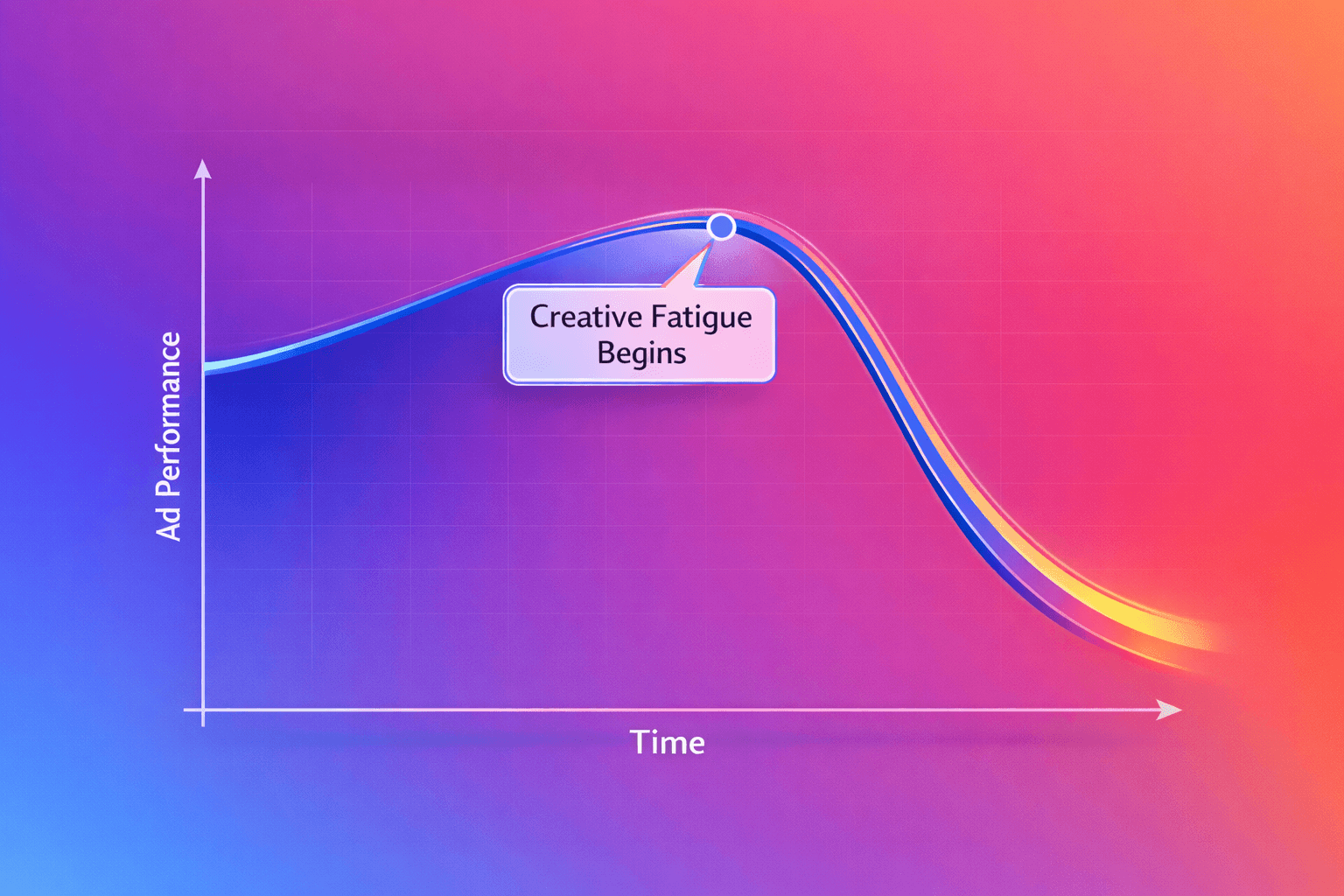
Meta requires high-frequency creative testing. At scale, plan to introduce several new concepts per week to combat creative fatigue.
TikTok creative formats and testing volume
What works on TikTok:
Native, lo-fi video: If it looks like an ad, it fails
Creator/influencer content: Outperforms polished brand content consistently
Trend-jacking: Requires fast turnaround and cultural awareness
TikTok creative burns faster than Meta. Refresh cycles often run twice as frequent.
When the same creative works on both platforms
Repurposing rarely works without adaptation. UGC can sometimes cross over, but aspect ratio, pacing, and hook structure differ between platforms. Test before assuming portability—what stops the scroll on TikTok may feel out of place on Instagram.
Attribution and tracking differences between TikTok and Meta
Both platforms over-report conversions. This isn't a secret—it's a structural reality of platform ROAS inflation, view-through attribution, and iOS privacy changes.
Meta Ads Manager: Tends to over-credit, especially on view-through conversions
TikTok Ads Manager: Newer pixel, often less accurate for post-click tracking
Practical approach: Use MER or a third-party attribution tool as your source of truth
Incrementality testing—running holdout groups to measure true lift—is the gold standard for validating platform performance. Without it, you're making allocation decisions based on inflated numbers.
How to split budget between TikTok and Meta by AOV and spend tier
Budget allocation depends on AOV, monthly spend, and creative capacity. There's no universal formula, but there are useful starting points.
1. Set a baseline split by AOV band
AOV under $50: Consider testing TikTok earlier since impulse purchases can convert
AOV $50–$150: Meta is typically the safer default, with TikTok as a test channel
AOV above $150: Meta almost always outperforms, and TikTok works better for brand awareness only
2. Adjust by monthly spend tier
Under $25K/month: Consolidate on one platform (usually Meta) to generate enough learning
$25K–$100K/month: Test TikTok with 10–20% of budget after Meta is profitable
Above $100K/month: Run both with distinct creative and separate measurement
3. Rebalance using MER and incrementality testing
Allocation decisions work best when based on blended MER movement, not in-platform ROAS. If MER drops when you increase TikTok spend, that's your signal to pull back.
When to prioritize Meta ads over TikTok ads for DTC
Meta is the right primary channel when:
Your product is higher-AOV and requires a considered purchase
Your audience skews 30+
You have a proven creative library and want scale, not discovery
You're running subscription or replenishment models
You want predictable, stable CAC
When to prioritize TikTok ads over Meta ads for DTC
TikTok may outperform when:
Your product is under $50 and impulse-friendly
Your brand has strong creator or influencer relationships
You can produce native, trend-driven content quickly
Your target audience is under 30
You're launching a new product and want awareness at low CPM
How to run TikTok and Meta together without cannibalization
Running both platforms requires distinct creative, distinct audiences, and unified measurement. Without separation, you risk paying twice to reach the same people.
Creative separation: Do not run identical ads—adapt to each platform's native format
Audience separation: Use audience exclusions or let algorithms find non-overlapping users
Unified measurement: Track blended MER weekly and avoid optimizing each platform in isolation
TikTok CPMs run 30–40% lower than Meta's on average. That sounds like a clear winner—until you realize cheaper impressions don't guarantee cheaper customers.
The real question isn't which platform costs less per thousand eyeballs. It's which platform delivers profitable customer acquisition for your specific product, price point, and audience. This guide breaks down the benchmarks, creative requirements, and budget allocation frameworks that actually matter for DTC brands deciding where to put their ad spend in 2026.
Key takeaways for TikTok vs Meta ad spend decisions
For most DTC brands, Meta remains the default paid social channel. The platform has more mature targeting, stronger purchase-intent signals, and more predictable CAC (Customer Acquisition Cost—your total ad spend divided by the number of customers acquired). TikTok often delivers lower CPMs (Cost Per Mille, meaning cost per 1,000 impressions), but lower CPMs do not automatically mean lower CAC.
Here's what actually matters when deciding where to put your budget:
Meta wins for higher-AOV products and audiences 30+. Purchase intent is stronger, and the algorithm has more conversion data to work with.
TikTok wins for impulse-price products under $50 and audiences under 30. Discovery-mode users convert faster on low-friction offers.
Creative determines platform success more than media buying. The same ad rarely works on both platforms without significant adaptation.
In-platform ROAS is unreliable on both. Validate allocation decisions with MER (Marketing Efficiency Ratio = total revenue ÷ total ad spend) or holdout tests.
Brands spending under $25K/month typically benefit from consolidating on one platform—usually Meta—before testing TikTok.
How TikTok and Meta ad spend compare for DTC brands
Meta is the foundation for most DTC paid social programs. The platform's targeting maturity, pixel data depth, and purchase-intent audience make it the safer bet when you want predictable, scalable customer acquisition.
TikTok offers reach at a lower cost per impression, but the audience behaves differently. Users are in discovery mode—scrolling for entertainment, not shopping. That means TikTok can work well for impulse-friendly products, though it often underperforms for considered purchases or higher price points.
The real question isn't which platform is "better." It's which platform fits your product, price point, and creative capacity right now.
TikTok vs Meta benchmarks for CPM, CPC, CPA, and ROAS
Benchmarks give you a starting point, not a guarantee. Actual performance varies by vertical, AOV (Average Order Value), and creative quality. The ranges below reflect what we've seen across accounts, though your results will depend on your specific situation.
Metric | TikTok (Typical Range) | Meta (Typical Range) |
|---|---|---|
CPM | $4–$10 | $8–$18 |
CPC (Cost Per Click) | $0.30–$1.00 | $0.50–$2.00 |
CTR (Click-Through Rate) | 1.0%–2.5% | 0.8%–1.5% |
CPA (Cost Per Acquisition) | Varies by vertical | Varies by vertical |
ROAS (Return on Ad Spend) | Often inflated | Often inflated |
CPM benchmarks on TikTok vs Meta
TikTok CPMs tend to run lower than Meta's—sometimes significantly so. However, CPM is an input metric, not an outcome metric. Cheaper impressions mean nothing if those impressions don't convert. You're paying for eyeballs, not customers.
CPC and CTR benchmarks
TikTok often shows higher CTR because native-feeling content blends into the feed. Users tap through more readily. But clicks do not equal conversions, and Meta's clicks tend to be more qualified because users are closer to purchase intent when they engage. — TikTok's conversion rate fell 6.2% year-over-year even as CTR rose — and Meta's clicks tend to be more qualified because users are closer to purchase intent when they engage.
CPA and CAC benchmarks by DTC vertical
CPA varies significantly by category. Here's what we typically see:
Beauty and skincare: TikTok often delivers lower CPA for impulse buys under $40
Apparel: Mixed results depending on price point and existing brand awareness
Health and wellness: Meta typically outperforms for subscription products
Home goods: Meta tends to convert better for higher-AOV items above $100
ROAS benchmarks and the MER reality check
Both platforms over-report conversions due to view-through attribution and iOS signal loss. In-platform ROAS is directionally useful but not trustworthy for allocation decisions.
MER works better as your source of truth. Track total revenue divided by total ad spend weekly, then watch how MER moves when you shift budget between platforms. If MER drops when you increase TikTok spend, that tells you something.
Audience and purchase intent on TikTok vs Meta
The core difference comes down to intent. Meta users are further along in the buying journey. TikTok users are browsing for entertainment.
Meta audience: Skews older (25–55), more purchase-ready, responds to direct-response offers with clear CTAs
TikTok audience: Skews younger (18–34), responds to entertainment-first content, impulse-driven
TikTok's audience is expanding in age, but purchase behavior still differs. On TikTok, you're interrupting entertainment. On Meta, you're often capturing existing demand.
Creative requirements that drive performance on each platform
Creative is the largest lever for performance on both platforms. Targeting and bidding matter, but they can't save weak creative. This is why Flighted treats creative strategy as central to paid media—not a separate workstream.
Meta creative formats and testing volume
What works on Meta:
UGC-style video: Authentic, testimonial-driven, feels like a real person talking
Direct-response statics: Clear offer, strong hook, benefit-focused
Carousels: Product education, multiple angles, comparison content
AI voiceover VSLs: Scalable storytelling for brands without creator relationships
Meta requires high-frequency creative testing. At scale, plan to introduce several new concepts per week to combat creative fatigue.
TikTok creative formats and testing volume
What works on TikTok:
Native, lo-fi video: If it looks like an ad, it fails
Creator/influencer content: Outperforms polished brand content consistently
Trend-jacking: Requires fast turnaround and cultural awareness
TikTok creative burns faster than Meta. Refresh cycles often run twice as frequent.
When the same creative works on both platforms
Repurposing rarely works without adaptation. UGC can sometimes cross over, but aspect ratio, pacing, and hook structure differ between platforms. Test before assuming portability—what stops the scroll on TikTok may feel out of place on Instagram.
Attribution and tracking differences between TikTok and Meta
Both platforms over-report conversions. This isn't a secret—it's a structural reality of platform ROAS inflation, view-through attribution, and iOS privacy changes.
Meta Ads Manager: Tends to over-credit, especially on view-through conversions
TikTok Ads Manager: Newer pixel, often less accurate for post-click tracking
Practical approach: Use MER or a third-party attribution tool as your source of truth
Incrementality testing—running holdout groups to measure true lift—is the gold standard for validating platform performance. Without it, you're making allocation decisions based on inflated numbers.
How to split budget between TikTok and Meta by AOV and spend tier
Budget allocation depends on AOV, monthly spend, and creative capacity. There's no universal formula, but there are useful starting points.
1. Set a baseline split by AOV band
AOV under $50: Consider testing TikTok earlier since impulse purchases can convert
AOV $50–$150: Meta is typically the safer default, with TikTok as a test channel
AOV above $150: Meta almost always outperforms, and TikTok works better for brand awareness only
2. Adjust by monthly spend tier
Under $25K/month: Consolidate on one platform (usually Meta) to generate enough learning
$25K–$100K/month: Test TikTok with 10–20% of budget after Meta is profitable
Above $100K/month: Run both with distinct creative and separate measurement
3. Rebalance using MER and incrementality testing
Allocation decisions work best when based on blended MER movement, not in-platform ROAS. If MER drops when you increase TikTok spend, that's your signal to pull back.
When to prioritize Meta ads over TikTok ads for DTC
Meta is the right primary channel when:
Your product is higher-AOV and requires a considered purchase
Your audience skews 30+
You have a proven creative library and want scale, not discovery
You're running subscription or replenishment models
You want predictable, stable CAC
When to prioritize TikTok ads over Meta ads for DTC
TikTok may outperform when:
Your product is under $50 and impulse-friendly
Your brand has strong creator or influencer relationships
You can produce native, trend-driven content quickly
Your target audience is under 30
You're launching a new product and want awareness at low CPM
How to run TikTok and Meta together without cannibalization
Running both platforms requires distinct creative, distinct audiences, and unified measurement. Without separation, you risk paying twice to reach the same people.
Creative separation: Do not run identical ads—adapt to each platform's native format
Audience separation: Use audience exclusions or let algorithms find non-overlapping users
Unified measurement: Track blended MER weekly and avoid optimizing each platform in isolation
Landing page requirements for TikTok and Meta traffic
Traffic source affects landing page performance. TikTok traffic is colder and typically requires more education. Meta traffic often converts on shorter, more direct pages.
For TikTok traffic: Mobile-first, video-forward, longer page with social proof
For Meta traffic: Direct-response, clear CTA, faster path to purchase
At Flighted, landing pages are a core performance lever alongside paid media and creative—not an afterthought. Ongoing A/B testing is required to understand what works for each traffic source.
What to prioritize in your DTC paid social mix going forward
Most DTC brands benefit from treating Meta as the foundation and TikTok as a test channel until they have creative capacity and MER validation to scale both.
Platform selection matters less than the system behind it. Paid media expertise, creative strategy, and landing page optimization work together—not as separate workstreams. When all three are aligned, you can scale profitably on either platform.
Book a call with Flighted if you want help building a cross-platform paid social system that scales profitably.
Frequently asked questions about TikTok vs Meta ad spend for DTC brands
What is the minimum monthly budget to test TikTok ads against Meta for a DTC brand?
Most brands benefit from at least $5K–$10K/month on TikTok to exit the learning phase and gather meaningful data. Testing TikTok works best after Meta is already profitable.
How long should a TikTok ads test run before deciding to scale or cut it?
Running tests for at least 2–3 weeks with a minimum of 30–50 conversions provides enough data for allocation decisions. Fewer conversions means insufficient signal.
Does TikTok Shop change how DTC brands allocate spend between TikTok and Meta?
TikTok Shop reduces friction for in-app purchases and can improve CAC for certain categories. It does not replace the value of a standalone site or Meta as a primary channel., with eMarketer projecting $23.41 billion in US sales in 2026. It does not replace the value of a standalone site or Meta as a primary channel.
How often do DTC brands refresh ad creative on TikTok compared to Meta?
TikTok creative fatigues faster due to the platform's content velocity. Planning for twice as many refreshes on TikTok compared to Meta is a reasonable starting point.
Is Advantage+ or GMV Max better for scaling DTC ad spend on Meta and TikTok?
Advantage+ (Meta) and GMV Max (TikTok) are both algorithm-driven campaign types designed for scale. Testing each against manual campaigns and evaluating using MER helps determine which delivers incremental results for your brand.
Related Posts
Related Posts
Related Posts
Related Posts























































Ready to talk?
Book A Call
New York, NY 11217
hello@flighted.co
© Flighted, 2026
Ready to talk?
Book A Call
New York, NY 11217
hello@flighted.co
© Flighted, 2026