How Many Ads Should You Put in A Meta Ad Set? The Definitive 2026 Guide
Meta Ads
July 2, 2026

Table Of Contents
"How many ads per ad set?" is one of the most common Meta Ads questions, and the most common answer — "it depends" — is useless without a framework.
The real answer is not a single number. It is a function of your ad set budget, your testing goals, and how Meta's delivery algorithm distributes spend across creatives. Get it wrong in either direction and you waste money. Too few ads and you under-use your budget's delivery potential. Too many and Meta's algorithm concentrates spend on one or two early winners, starving the rest before you can learn anything.
This post gives you a practical range, the budget math behind it, and the structural rules that keep your creative tests readable. If you are still building out your Meta ads account structure guide, start there first — then come back here to dial in your ad set composition.
Key Takeaways
Start with 3–6 ads per ad set for most testing ad sets. Budget is the deciding factor, not a fixed rule.
Never drop below 3 ads — Meta needs multiple creatives to sequence impressions across your audience.
Watch the ad-to-budget ratio. Loading 15 ads into an ad set that can only fund 5 destroys your test signal.
Segment ad sets by concept so you can read performance at the concept level, not just the ad level.
Scale the ad count up (to 10–15 per ad set) only when your daily budget can generate enough impressions to give each ad a fair shot.
1. Why the Number of Ads Per Ad Set Actually Matters
Meta's delivery system does not split budget evenly across every ad in an ad set. It runs a real-time auction and concentrates spend on whichever ads show early promise.
That concentration is fine when you have a few strong creatives competing. It becomes a problem when you overload an ad set with too many ads. The algorithm picks two or three winners fast, and the remaining ads get almost no spend. You cannot tell whether those starved ads were genuinely weak or simply lost to the in-ad-set winners.
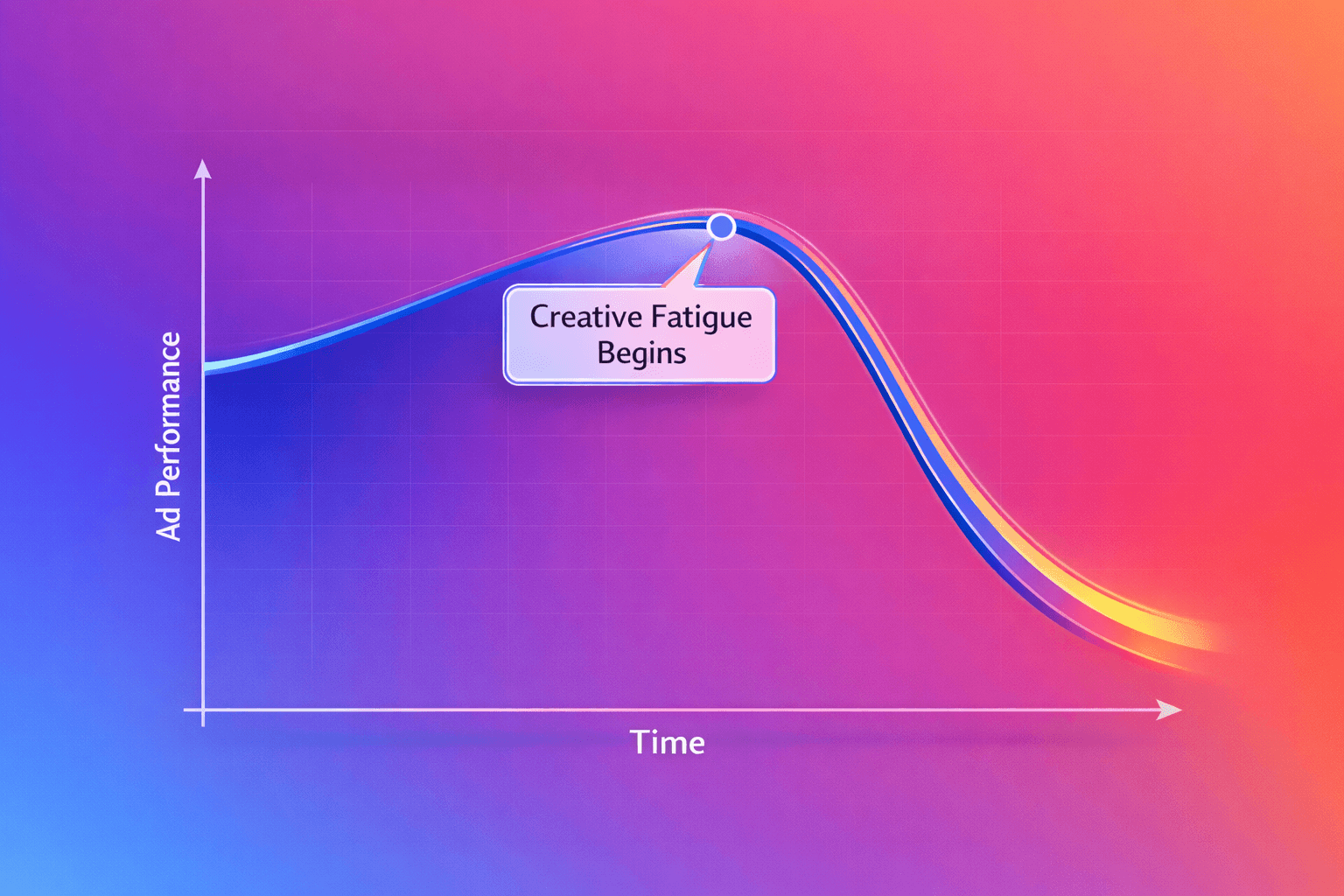
The flip side is just as bad. Run a single ad in an ad set and you lose the ability to sequence creatives. People typically need to see an ad 2–6 times before buying. One ad cannot sequence — your audience sees the same static or video repeatedly, fatigue sets in, and your cost per acquisition (CPA) climbs.
Your ad count is not a style choice. It directly controls whether your testing data is useful or noise.
2. The Starting Range: 3–6 Ads Per Ad Set
For most testing ad sets, 3–6 ads is the right starting point. Here is why:
3 ads is the minimum. Below this, your ad set cannot sequence across creatives, and you have no competitive signal to identify winners.
6 ads is the upper bound for smaller budgets. If your daily ad set budget is $50–$150, six ads is likely the most Meta can meaningfully distribute spend across.
The practical rule of thumb is 3–15 ads per ad set, depending on budget and volume. Some accounts with large budgets run up to 200 ads in a single ad set. That is the exception, not the rule.
Do not memorize a number. Memorize the principle: every ad in the ad set needs enough budget to exit the learning phase and generate a readable signal.
Meta officially allows up to 50 ads per ad set (Meta Business Help Center). The platform limit is not your performance limit. Just because you can load 50 ads does not mean you should.
3. Let Your Budget Decide the Ad Count
The right number of ads per ad set is a budget question, not a best-practice question. Here is the math.
Use this formula to calculate your daily test budget:
Daily test budget = target conversions x expected CPA / test duration in days
Example: You want 20 conversions to validate a concept. Your expected CPA is $100. You plan a 14-day test window.
20 x $100 / 14 = ~$143/day
Now divide that daily budget by the number of ads. At $143/day with 6 ads, each ad gets roughly $24/day in potential spend. That may be enough for a low-CPA product. For a $100 CPA product, it is not — you would need weeks to accumulate enough data per ad.
The rule: if dividing your daily ad set budget by the number of ads gives each ad less than one expected conversion per day, you have too many ads for that budget.
For a deeper breakdown of how to calculate your testing budget, read how to calculate your testing budget.
A note on Meta's learning phase: Meta's recommendation of "50 conversions every 7 days to exit learning" is misleading for most advertisers. That threshold applies to ad set-level delivery optimization, not to individual ad validation. Do not use it as your baseline for how many ads to run.
4. Segment Ad Sets by Concept, Not by Individual Ad
This is where most operators get the structure wrong. They dump every new creative into one big testing ad set and let Meta sort it out.
Instead, segment your ad sets by concept. A concept is a distinct angle, hook, or messaging approach — not a format variation.
Concepts compete at the ad set level. You compare ad set performance to see which concept resonates.
Ads within a concept compete at the ad level. You compare individual ads to see which execution of the concept works best.
This split restores a readable signal. When all your ads are in one ad set, you cannot tell whether a winning ad won because of its concept or because of its thumbnail, hook, or format. Splitting by concept lets you isolate variables.
For a full walkthrough of how to set up concept-level segmentation, read how to structure creative tests by concept.
Naming matters. Name each ad set with the persona, angle, offer, content type, and launch date. Example: DTC-Founders_SocialProof_FreeShip_UGC_2026-07. This naming convention lets you filter, compare, and report on concepts without digging through the Ads Manager UI.
5. How Ad Count Scales With Monthly Spend
The right ad count shifts as your budget grows. Here is a rough scaling framework:
$10K–$50K/month spend: 3–5 ads per ad set across 5–10 active testing ad sets. You are running 15–50 new ads per month.
$50K–$250K/month spend: 5–15 ads per ad set across ~20 active testing ad sets. This supports 100–300 new ads per month.
$250K+/month spend: 10–15+ ads per ad set, with dedicated ad sets for different concept clusters and audience segments.
The pattern: as your budget increases, you can support more ads per ad set because each ad gets enough spend to generate signal. You also need more total ads to avoid creative fatigue across a larger audience.
"How many ads per ad set?" is one of the most common Meta Ads questions, and the most common answer — "it depends" — is useless without a framework.
The real answer is not a single number. It is a function of your ad set budget, your testing goals, and how Meta's delivery algorithm distributes spend across creatives. Get it wrong in either direction and you waste money. Too few ads and you under-use your budget's delivery potential. Too many and Meta's algorithm concentrates spend on one or two early winners, starving the rest before you can learn anything.
This post gives you a practical range, the budget math behind it, and the structural rules that keep your creative tests readable. If you are still building out your Meta ads account structure guide, start there first — then come back here to dial in your ad set composition.
Key Takeaways
Start with 3–6 ads per ad set for most testing ad sets. Budget is the deciding factor, not a fixed rule.
Never drop below 3 ads — Meta needs multiple creatives to sequence impressions across your audience.
Watch the ad-to-budget ratio. Loading 15 ads into an ad set that can only fund 5 destroys your test signal.
Segment ad sets by concept so you can read performance at the concept level, not just the ad level.
Scale the ad count up (to 10–15 per ad set) only when your daily budget can generate enough impressions to give each ad a fair shot.
1. Why the Number of Ads Per Ad Set Actually Matters
Meta's delivery system does not split budget evenly across every ad in an ad set. It runs a real-time auction and concentrates spend on whichever ads show early promise.
That concentration is fine when you have a few strong creatives competing. It becomes a problem when you overload an ad set with too many ads. The algorithm picks two or three winners fast, and the remaining ads get almost no spend. You cannot tell whether those starved ads were genuinely weak or simply lost to the in-ad-set winners.
The flip side is just as bad. Run a single ad in an ad set and you lose the ability to sequence creatives. People typically need to see an ad 2–6 times before buying. One ad cannot sequence — your audience sees the same static or video repeatedly, fatigue sets in, and your cost per acquisition (CPA) climbs.
Your ad count is not a style choice. It directly controls whether your testing data is useful or noise.
2. The Starting Range: 3–6 Ads Per Ad Set
For most testing ad sets, 3–6 ads is the right starting point. Here is why:
3 ads is the minimum. Below this, your ad set cannot sequence across creatives, and you have no competitive signal to identify winners.
6 ads is the upper bound for smaller budgets. If your daily ad set budget is $50–$150, six ads is likely the most Meta can meaningfully distribute spend across.
The practical rule of thumb is 3–15 ads per ad set, depending on budget and volume. Some accounts with large budgets run up to 200 ads in a single ad set. That is the exception, not the rule.
Do not memorize a number. Memorize the principle: every ad in the ad set needs enough budget to exit the learning phase and generate a readable signal.
Meta officially allows up to 50 ads per ad set (Meta Business Help Center). The platform limit is not your performance limit. Just because you can load 50 ads does not mean you should.
3. Let Your Budget Decide the Ad Count
The right number of ads per ad set is a budget question, not a best-practice question. Here is the math.
Use this formula to calculate your daily test budget:
Daily test budget = target conversions x expected CPA / test duration in days
Example: You want 20 conversions to validate a concept. Your expected CPA is $100. You plan a 14-day test window.
20 x $100 / 14 = ~$143/day
Now divide that daily budget by the number of ads. At $143/day with 6 ads, each ad gets roughly $24/day in potential spend. That may be enough for a low-CPA product. For a $100 CPA product, it is not — you would need weeks to accumulate enough data per ad.
The rule: if dividing your daily ad set budget by the number of ads gives each ad less than one expected conversion per day, you have too many ads for that budget.
For a deeper breakdown of how to calculate your testing budget, read how to calculate your testing budget.
A note on Meta's learning phase: Meta's recommendation of "50 conversions every 7 days to exit learning" is misleading for most advertisers. That threshold applies to ad set-level delivery optimization, not to individual ad validation. Do not use it as your baseline for how many ads to run.
4. Segment Ad Sets by Concept, Not by Individual Ad
This is where most operators get the structure wrong. They dump every new creative into one big testing ad set and let Meta sort it out.
Instead, segment your ad sets by concept. A concept is a distinct angle, hook, or messaging approach — not a format variation.
Concepts compete at the ad set level. You compare ad set performance to see which concept resonates.
Ads within a concept compete at the ad level. You compare individual ads to see which execution of the concept works best.
This split restores a readable signal. When all your ads are in one ad set, you cannot tell whether a winning ad won because of its concept or because of its thumbnail, hook, or format. Splitting by concept lets you isolate variables.
For a full walkthrough of how to set up concept-level segmentation, read how to structure creative tests by concept.
Naming matters. Name each ad set with the persona, angle, offer, content type, and launch date. Example: DTC-Founders_SocialProof_FreeShip_UGC_2026-07. This naming convention lets you filter, compare, and report on concepts without digging through the Ads Manager UI.
5. How Ad Count Scales With Monthly Spend
The right ad count shifts as your budget grows. Here is a rough scaling framework:
$10K–$50K/month spend: 3–5 ads per ad set across 5–10 active testing ad sets. You are running 15–50 new ads per month.
$50K–$250K/month spend: 5–15 ads per ad set across ~20 active testing ad sets. This supports 100–300 new ads per month.
$250K+/month spend: 10–15+ ads per ad set, with dedicated ad sets for different concept clusters and audience segments.
The pattern: as your budget increases, you can support more ads per ad set because each ad gets enough spend to generate signal. You also need more total ads to avoid creative fatigue across a larger audience.
Looking for Meta ads support?
We're a small, hardworking, US-based team. Book a call and get a free audit today.
6. Common Mistakes That Waste Your Ad Set Budget
Avoid these patterns. Each one corrupts your testing data or burns budget without learning:
Loading 15+ ads into a $50/day ad set. Meta will concentrate spend on 2–3 ads immediately. The other 12 get almost no impressions. You learn nothing about them.
Running a single ad per ad set. No sequencing, no competitive signal, and faster creative fatigue.
Mixing unrelated concepts in one ad set. A UGC testimonial and a product demo are not the same concept. Putting them in the same ad set makes it impossible to read concept-level performance.
Ignoring the ad-to-budget ratio after launch. Check 48–72 hours after launch. If more than half your ads have less than 5% of the ad set's total spend, you have too many ads for that budget.
Treating Meta's 50-ad limit as a target. The platform limit is a ceiling. Your performance limit is your budget divided by meaningful spend per ad.
7. Mix Awareness Stages, Not Audiences
One structural question that comes up alongside ad count: should you split ad sets by funnel stage?
No. All ads in an ad set should resonate with the same audience. But you should mix awareness stages within that ad set — awareness-level hooks alongside conversion-level offers.
This gives Meta's delivery system more options for sequencing. A prospect might see a problem-aware ad first, then a product-specific ad on the second impression, then a social-proof ad on the third. That sequencing only works if the ad set contains creative across awareness stages.
What you should not do is split top-of-funnel and bottom-of-funnel into separate ad sets targeting the same audience. That fragments your data and forces Meta to compete against itself in the auction.
Conclusion
The answer to "how many ads per ad set on Meta" is not a fixed number. It is a budget-driven decision.
Start with 3–6 ads per ad set for testing. Let your daily budget and expected CPA determine the upper limit. Segment ad sets by concept so you can read the data. Scale the ad count only when your budget can support each ad getting enough spend to generate a meaningful signal.
Do not chase Meta's 50-ad platform limit. Do not run a single ad and expect it to carry an ad set. The goal is enough ads to sequence and compete, but not so many that Meta starves most of them before you learn anything.
Build the structure right, and every dollar of ad spend teaches you something.
Related Posts
Related Posts
Related Posts
Related Posts





















































Ready to talk?
New York, NY 11217
hello@flighted.co
© Flighted, 2026
Ready to talk?
New York, NY 11217
hello@flighted.co
© Flighted, 2026