B2B SaaS Meta Ads: Agency vs In-House in 2026
Meta Ads
May 10, 2026
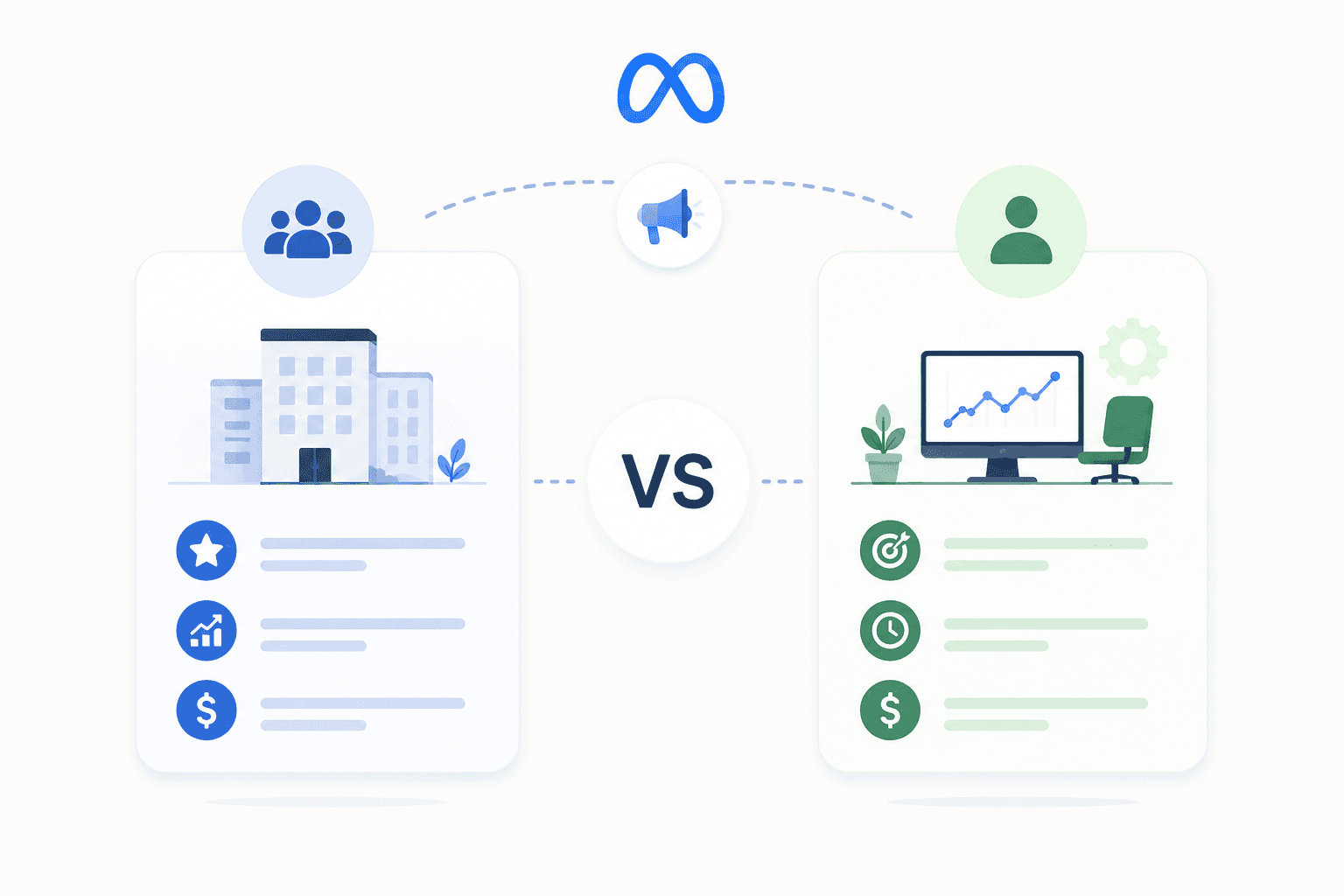
Table Of Contents
The decision between hiring an agency or building in-house for B2B SaaS Meta Ads comes down to stage and spend. Agencies deliver faster time-to-performance and lower upfront costs for companies scaling without internal expertise, while in-house teams make sense once you're spending six figures monthly and want full ownership of the channel.
This guide breaks down the real trade-offs—cost, speed, creative output, and scalability—so you can make the right call for where your company is today.
Key Takeaways
Agencies work well for earlier-stage B2B SaaS companies: If you're scaling spend but don't have internal Meta expertise, an agency delivers faster time-to-performance and lower upfront costs than hiring a full-time operator.
In-house makes sense at scale: Companies with consistent monthly spend in the six figures often benefit from dedicated headcount with deep product knowledge.
The hybrid model is underrated: Many growth-stage companies use an agency for execution and creative production while keeping strategy and reporting internal.
Creative determines performance: On Meta, B2B SaaS results depend on creative testing velocity. Whichever model you choose, creative production can't be a bottleneck.
Cost comparisons mislead without context: Fully-loaded in-house costs—salary, tools, management overhead—often exceed agency retainers, especially before you hit scale.
Why Meta Ads Still Work for B2B SaaS
There's a common assumption that Meta is only for DTC brands selling impulse purchases. That's not accurate. Meta is projected to generate $243 billion in ad revenue in 2026, and B2B SaaS buyers are still consumers. They scroll Instagram and Facebook outside of work hours, and Meta's targeting capabilities allow you to reach them by job title, industry, and professional behavior.
The difference comes down to creative. B2B SaaS ads on Meta require messaging that earns attention in a feed designed for entertainment. Generic product screenshots don't perform. What does work: direct-response creative tied to specific pain points, short-form video that hooks viewers in under two seconds, and landing pages built for conversion.
Targeting still works: Meta's Advantage+ and custom audience tools let you reach professional audiences with precision.
CPLs can compete with LinkedIn: B2B SaaS companies running Meta well often see cost-per-lead figures that rival LinkedIn at a fraction of the CPM.
Creative is the variable: The brands winning on Meta treat creative as a performance lever, not a brand exercise.
Core Differences Between In-House and Agency Meta Ads Teams
The fundamental trade-off is access versus ownership. An in-house team gives you full control and deep product context. An agency gives you immediate access to specialized expertise and cross-account pattern recognition from managing spend across many brands.
In-House | Agency |
|---|---|
Ownership of strategy and execution | Access to specialized expertise |
Deep product and customer context | Cross-account pattern recognition |
Fixed headcount costs | Variable costs tied to scope |
Neither model is universally better. The right choice depends on your stage, spend level, and internal capacity.
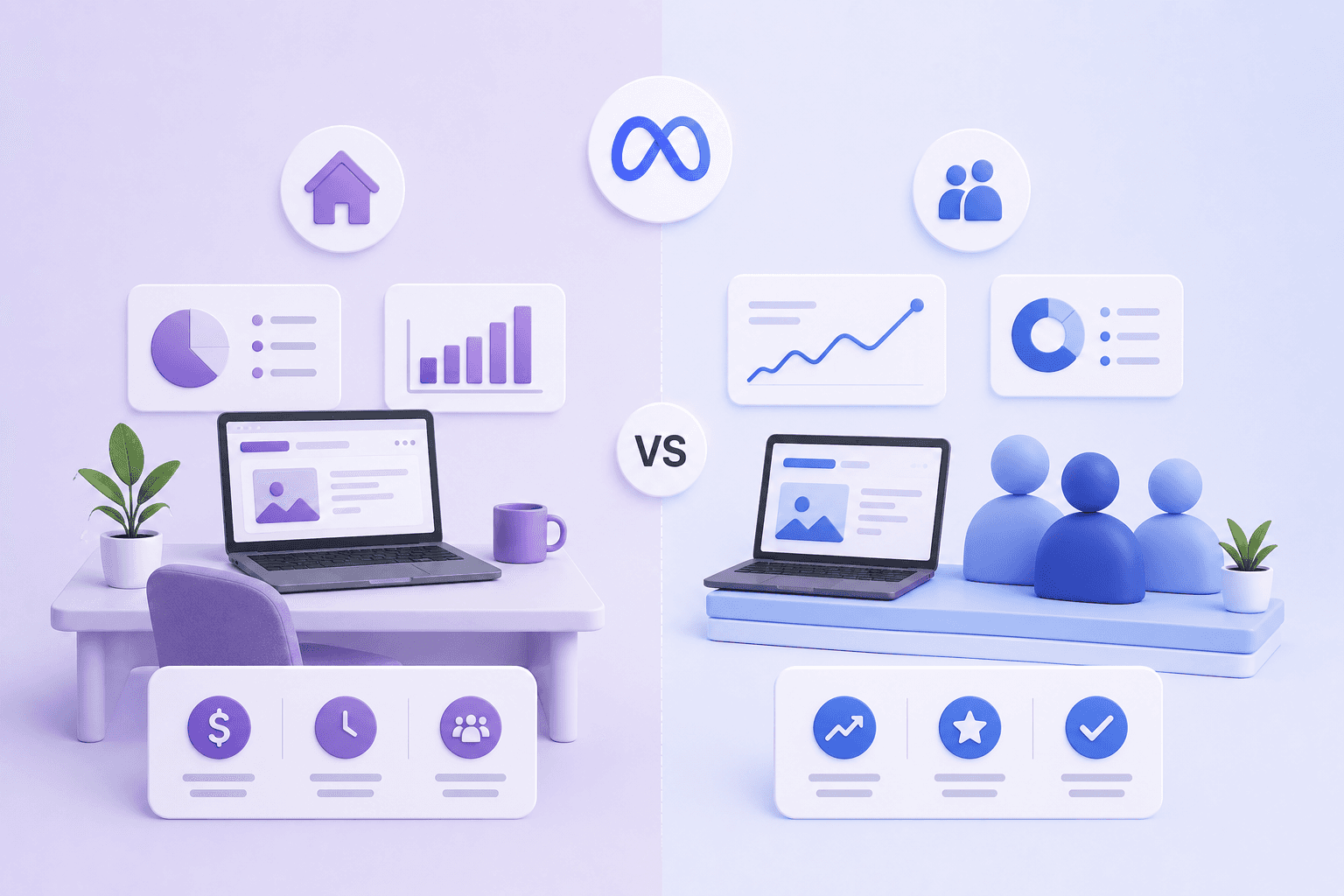
In-House vs Agency Side by Side for B2B SaaS Meta Ads
Here's how the two models compare across five dimensions that matter most for B2B SaaS.
Meta Expertise
In-house requires you to hire and retain a platform specialist who manages Meta daily — a platform that saw over 250 updates in 2025 alone. That's a competitive hire, and good operators are expensive. Agencies bring immediate access to people who already manage meaningful spend across multiple accounts. They've seen what works and what doesn't across different verticals and price points.
Creative Output
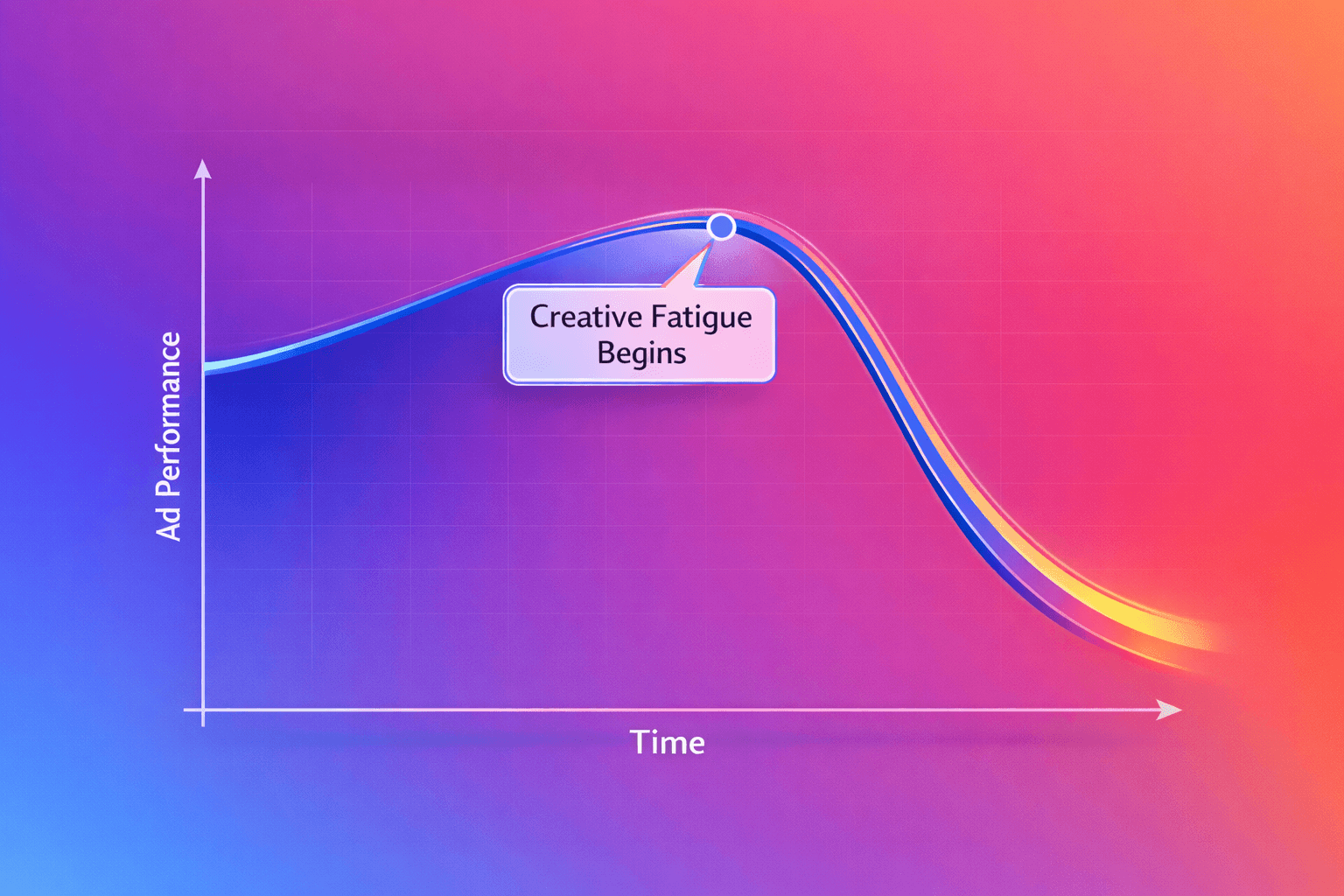
Creative fatigue is the silent killer of Meta performance. In-house teams often bottleneck on creative production because the paid media operator isn't also a video editor or designer. Agencies with integrated creative teams can ship more volume and run structured testing without waiting on external freelancers or internal design queues.
Cost
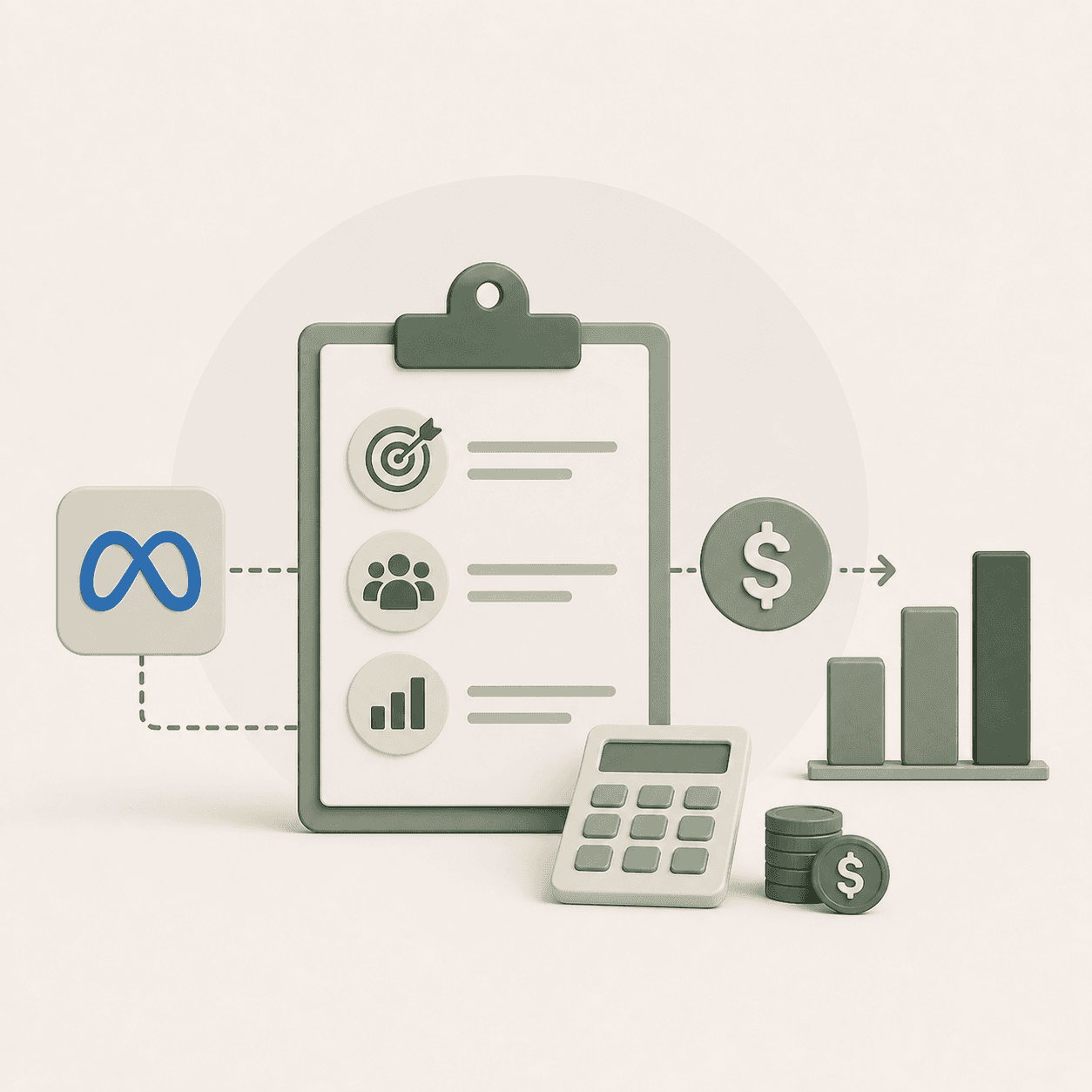
Fully-loaded in-house costs include salary, benefits, tools, and management overhead. For a senior paid media hire, the total cost often exceeds what you'd pay an agency—especially before you hit scale. Agencies offer variable costs tied to scope, which tends to be more efficient at lower spend levels.
Speed
Agencies deploy faster. They have existing SOPs, creative templates, and onboarding processes already in place. In-house teams ramp slower, though they eventually develop tighter feedback loops with product and sales once they're up to speed.
Scalability
Agencies scale with your spend without additional hiring. If you want to double your Meta budget next quarter, an agency can absorb that increase. In-house requires headcount growth to scale, which takes time and adds fixed costs.
When Building an In-House B2B SaaS Meta Ads Team Makes Sense
In-house fits companies where Meta is a primary acquisition channel and you want full ownership of the function long-term.
High ARR and spend threshold: You have the budget to hire, train, and retain a senior paid media operator, and you're spending enough monthly to justify that fixed cost.
Meta is a core channel: Paid social is central to your acquisition strategy, not experimental. You're committed to the channel for the foreseeable future.
Deep product context required: Complex products with long sales cycles benefit from in-house operators who understand the ICP and can collaborate directly with sales.
If you're below those thresholds, in-house often means overpaying for capacity you don't fully use.
When a B2B SaaS Meta Ads Agency Makes Sense
Agencies work well when you want specialized Meta knowledge and creative testing infrastructure you don't have internally.
You're scaling spend but lack expertise: An agency brings immediate access to operators who have managed meaningful spend and know how to avoid common mistakes.
Creative fatigue is killing performance: Agencies with integrated creative production can ship more variants and run structured testing without bottlenecking on your internal team.
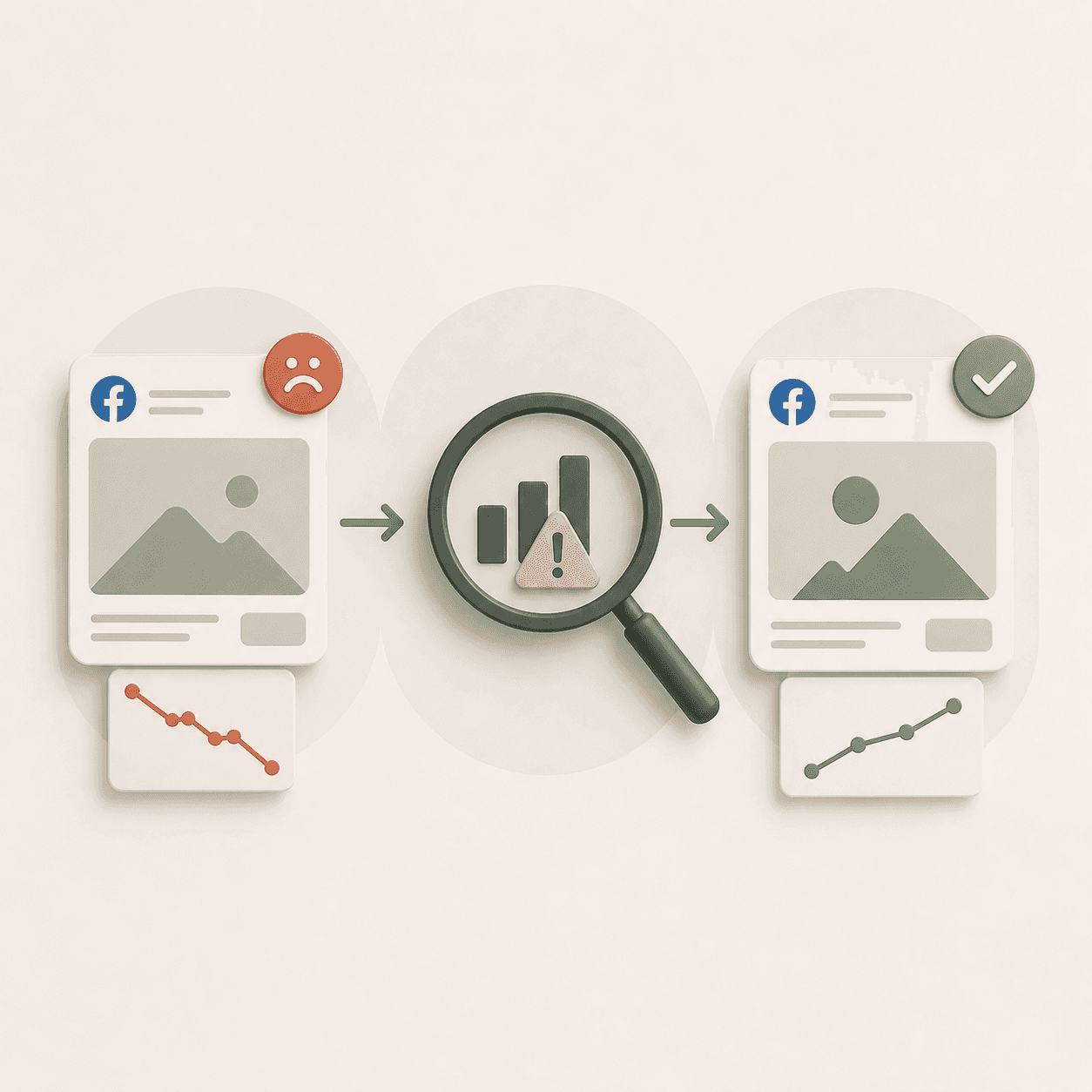
You hit a plateau and want a fresh perspective: Cross-account pattern recognition helps agencies diagnose issues faster than someone who's only ever seen your account.
The best agency relationships feel like an extension of your team rather than a vendor you manage at arm's length.
Why B2B SaaS Teams Hire a Meta Ads Agency
Most SaaS marketing teams can launch a Meta campaign. Consistent, profitable growth from Meta is a different problem entirely. Here's why B2B SaaS companies bring in a specialized Meta ads agency rather than trying to solve it internally.
Internal Teams Optimize for the Wrong Metrics
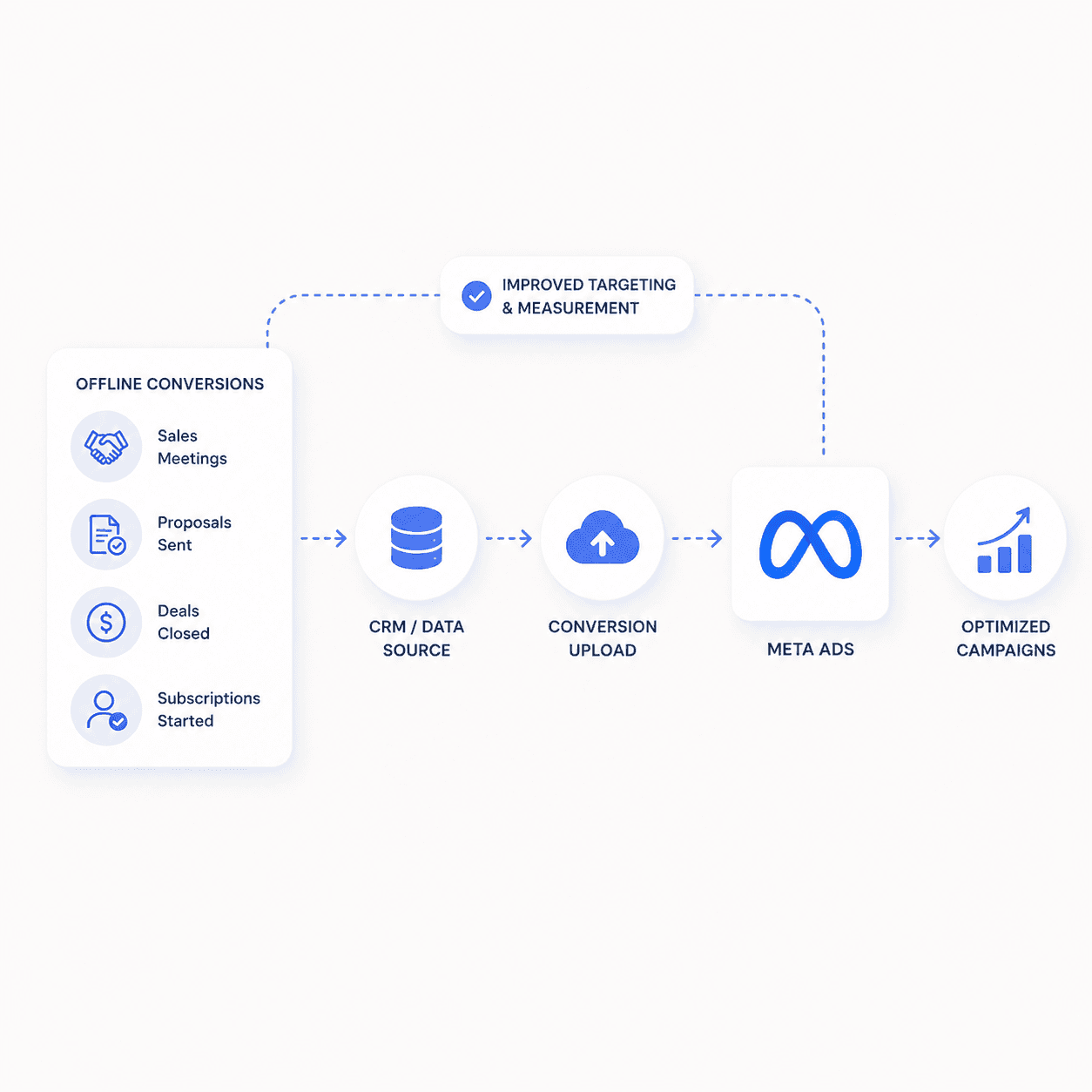
The most common mistake SaaS teams make on Meta is optimizing for lead volume instead of lead quality. Running campaigns toward top-of-funnel form fills generates activity, not pipeline. A B2B SaaS Meta ads agency structures campaigns around downstream conversion events — qualified demos, MQLs, SQLs — and uses CRM integrations with platforms like HubSpot or Salesforce to fire offline conversions selectively. The algorithm learns what a high-value lead looks like. Spend concentrates on accounts that convert, not just click.
SaaS Creative Requires a Different Approach
Generic product UI screenshots and on-brand static ads don't perform on Meta. B2B buyers don't purchase platforms, they buy solutions to specific problems. Agencies that specialize in B2B SaaS Meta ads build creative around pain-point hooks, demo-style explainers, customer testimonials, and objection-handling copy. They test creative angles systematically until they find what drives the best CAC, rather than running one or two assets and hoping for results.
Landing Pages Determine Whether Ad Spend Converts
Strong ads sent to the wrong destination waste budget. SaaS teams frequently push Meta traffic to homepages or pricing pages: pages built for warmer audiences, not cold social traffic. An effective B2B SaaS growth agency builds and tests dedicated landing pages for each campaign: listicle-style pages with social proof, objection-handling sections that mirror sales conversations, CTAs matched to the ad hook, and mobile-first design. The landing page is part of the campaign, not an afterthought.
Agencies Plug In Faster Than a New Hire
Recruiting a senior paid social operator takes 2-4 months. Onboarding takes longer. Meanwhile, performance drifts and budget burns. A specialized Meta ads agency has existing SOPs, creative templates, and account structures ready to deploy. For B2B SaaS companies scaling spend without deep internal Meta expertise, the time-to-performance advantage alone often justifies the engagement.
CAC Tracking Requires Infrastructure Most Teams Don't Have
Profitable Meta ads for SaaS depend on knowing your true cost per acquisition — not just cost per lead. That means tracking which creative drives signups, which campaigns contribute to pipeline, and how spend maps to closed revenue. Agencies that specialize in B2B SaaS Meta ads build this measurement infrastructure from day one: CPA optimization, pipeline contribution reporting, and CAC vs. LTV analysis. Without it, you're scaling blind.
Signs It's Time to Bring in a Meta Ads Agency
If any of these are true, the internal model isn't working:
CAC is rising but signups aren't keeping pace
You're running fewer than three active creative variants
Attribution is unclear and true CAC is unknown
Landing page conversion rates are flat
The internal team is stretched across too many channels to give Meta real attention
You've hit a performance plateau and don't know why
A B2B SaaS Meta ads agency doesn't just run campaigns. It builds the system — creative, targeting, landing pages, measurement — that turns paid social into a predictable acquisition channel.
Hidden Costs of Running Meta Ads In-House
The "cost" of in-house is not just salary. B2B SaaS companies often underestimate several line items that add up quickly.
Recruiting and hiring time alone can take 2-4 months for a senior hire. Then there's the onboarding and ramp-up period before that person is fully productive. Software and tooling costs—analytics platforms, creative production tools, attribution software—add another layer. Management and oversight bandwidth from your leadership team is real time that has a cost. And creative production capacity constraints slow testing velocity, which directly impacts performance.
Add all of that up, and the fully-loaded cost of in-house often exceeds what you'd pay an agency, especially in the first year.
How the Hybrid Meta Ads Model Works for B2B SaaS
The hybrid model splits responsibilities. Your in-house team owns strategy and reporting, while an agency handles execution, creative production, and testing.
This approach works well for growth-stage companies scaling spend. You keep strategic control and internal context while offloading the execution work that requires specialized expertise and high creative volume.
In-house owns: Strategy, budget allocation, reporting to leadership, CRM integration
Agency owns: Campaign execution, creative production, audience testing, platform optimization
Flighted operates this way with many B2B SaaS clients, functioning as an extension of the internal team rather than a separate vendor.
How to Choose a B2B SaaS Meta Ads Agency You Can Trust
If you decide an agency is the right path, here's how to vet your options.
1. Review their case studies and spend managed
Look for case studies with B2B SaaS clients specifically. Confirm cumulative spend managed is meaningful for your scale. An agency that's only managed five-figure monthly budgets may not be ready for six figures.
2. Talk to current and past B2B SaaS clients
Ask about responsiveness, creative output, and whether the agency hit CAC (Customer Acquisition Cost) and ROAS (Return on Ad Spend) targets. CAC is the total cost to acquire a customer. ROAS is the revenue generated per dollar of ad spend. References matter more than pitch decks.
3. Vet the account team you will actually work with
Ask who will manage your account day-to-day. Avoid agencies that kick work to junior associates after the sale closes.
4. Pressure test the proposal against your CAC and ROAS targets
Make sure the agency understands your unit economics and can tie their strategy to your targets. If they can't speak to your numbers, they're not ready.
The decision between hiring an agency or building in-house for B2B SaaS Meta Ads comes down to stage and spend. Agencies deliver faster time-to-performance and lower upfront costs for companies scaling without internal expertise, while in-house teams make sense once you're spending six figures monthly and want full ownership of the channel.
This guide breaks down the real trade-offs—cost, speed, creative output, and scalability—so you can make the right call for where your company is today.
Key Takeaways
Agencies work well for earlier-stage B2B SaaS companies: If you're scaling spend but don't have internal Meta expertise, an agency delivers faster time-to-performance and lower upfront costs than hiring a full-time operator.
In-house makes sense at scale: Companies with consistent monthly spend in the six figures often benefit from dedicated headcount with deep product knowledge.
The hybrid model is underrated: Many growth-stage companies use an agency for execution and creative production while keeping strategy and reporting internal.
Creative determines performance: On Meta, B2B SaaS results depend on creative testing velocity. Whichever model you choose, creative production can't be a bottleneck.
Cost comparisons mislead without context: Fully-loaded in-house costs—salary, tools, management overhead—often exceed agency retainers, especially before you hit scale.
Why Meta Ads Still Work for B2B SaaS
There's a common assumption that Meta is only for DTC brands selling impulse purchases. That's not accurate. Meta is projected to generate $243 billion in ad revenue in 2026, and B2B SaaS buyers are still consumers. They scroll Instagram and Facebook outside of work hours, and Meta's targeting capabilities allow you to reach them by job title, industry, and professional behavior.
The difference comes down to creative. B2B SaaS ads on Meta require messaging that earns attention in a feed designed for entertainment. Generic product screenshots don't perform. What does work: direct-response creative tied to specific pain points, short-form video that hooks viewers in under two seconds, and landing pages built for conversion.
Targeting still works: Meta's Advantage+ and custom audience tools let you reach professional audiences with precision.
CPLs can compete with LinkedIn: B2B SaaS companies running Meta well often see cost-per-lead figures that rival LinkedIn at a fraction of the CPM.
Creative is the variable: The brands winning on Meta treat creative as a performance lever, not a brand exercise.
Core Differences Between In-House and Agency Meta Ads Teams
The fundamental trade-off is access versus ownership. An in-house team gives you full control and deep product context. An agency gives you immediate access to specialized expertise and cross-account pattern recognition from managing spend across many brands.
In-House | Agency |
|---|---|
Ownership of strategy and execution | Access to specialized expertise |
Deep product and customer context | Cross-account pattern recognition |
Fixed headcount costs | Variable costs tied to scope |
Neither model is universally better. The right choice depends on your stage, spend level, and internal capacity.
In-House vs Agency Side by Side for B2B SaaS Meta Ads
Here's how the two models compare across five dimensions that matter most for B2B SaaS.
Meta Expertise
In-house requires you to hire and retain a platform specialist who manages Meta daily — a platform that saw over 250 updates in 2025 alone. That's a competitive hire, and good operators are expensive. Agencies bring immediate access to people who already manage meaningful spend across multiple accounts. They've seen what works and what doesn't across different verticals and price points.
Creative Output
Creative fatigue is the silent killer of Meta performance. In-house teams often bottleneck on creative production because the paid media operator isn't also a video editor or designer. Agencies with integrated creative teams can ship more volume and run structured testing without waiting on external freelancers or internal design queues.
Cost
Fully-loaded in-house costs include salary, benefits, tools, and management overhead. For a senior paid media hire, the total cost often exceeds what you'd pay an agency—especially before you hit scale. Agencies offer variable costs tied to scope, which tends to be more efficient at lower spend levels.
Speed
Agencies deploy faster. They have existing SOPs, creative templates, and onboarding processes already in place. In-house teams ramp slower, though they eventually develop tighter feedback loops with product and sales once they're up to speed.
Scalability
Agencies scale with your spend without additional hiring. If you want to double your Meta budget next quarter, an agency can absorb that increase. In-house requires headcount growth to scale, which takes time and adds fixed costs.
When Building an In-House B2B SaaS Meta Ads Team Makes Sense
In-house fits companies where Meta is a primary acquisition channel and you want full ownership of the function long-term.
High ARR and spend threshold: You have the budget to hire, train, and retain a senior paid media operator, and you're spending enough monthly to justify that fixed cost.
Meta is a core channel: Paid social is central to your acquisition strategy, not experimental. You're committed to the channel for the foreseeable future.
Deep product context required: Complex products with long sales cycles benefit from in-house operators who understand the ICP and can collaborate directly with sales.
If you're below those thresholds, in-house often means overpaying for capacity you don't fully use.
When a B2B SaaS Meta Ads Agency Makes Sense
Agencies work well when you want specialized Meta knowledge and creative testing infrastructure you don't have internally.
You're scaling spend but lack expertise: An agency brings immediate access to operators who have managed meaningful spend and know how to avoid common mistakes.
Creative fatigue is killing performance: Agencies with integrated creative production can ship more variants and run structured testing without bottlenecking on your internal team.
You hit a plateau and want a fresh perspective: Cross-account pattern recognition helps agencies diagnose issues faster than someone who's only ever seen your account.
The best agency relationships feel like an extension of your team rather than a vendor you manage at arm's length.
Why B2B SaaS Teams Hire a Meta Ads Agency
Most SaaS marketing teams can launch a Meta campaign. Consistent, profitable growth from Meta is a different problem entirely. Here's why B2B SaaS companies bring in a specialized Meta ads agency rather than trying to solve it internally.
Internal Teams Optimize for the Wrong Metrics
The most common mistake SaaS teams make on Meta is optimizing for lead volume instead of lead quality. Running campaigns toward top-of-funnel form fills generates activity, not pipeline. A B2B SaaS Meta ads agency structures campaigns around downstream conversion events — qualified demos, MQLs, SQLs — and uses CRM integrations with platforms like HubSpot or Salesforce to fire offline conversions selectively. The algorithm learns what a high-value lead looks like. Spend concentrates on accounts that convert, not just click.
SaaS Creative Requires a Different Approach
Generic product UI screenshots and on-brand static ads don't perform on Meta. B2B buyers don't purchase platforms, they buy solutions to specific problems. Agencies that specialize in B2B SaaS Meta ads build creative around pain-point hooks, demo-style explainers, customer testimonials, and objection-handling copy. They test creative angles systematically until they find what drives the best CAC, rather than running one or two assets and hoping for results.
Landing Pages Determine Whether Ad Spend Converts
Strong ads sent to the wrong destination waste budget. SaaS teams frequently push Meta traffic to homepages or pricing pages: pages built for warmer audiences, not cold social traffic. An effective B2B SaaS growth agency builds and tests dedicated landing pages for each campaign: listicle-style pages with social proof, objection-handling sections that mirror sales conversations, CTAs matched to the ad hook, and mobile-first design. The landing page is part of the campaign, not an afterthought.
Agencies Plug In Faster Than a New Hire
Recruiting a senior paid social operator takes 2-4 months. Onboarding takes longer. Meanwhile, performance drifts and budget burns. A specialized Meta ads agency has existing SOPs, creative templates, and account structures ready to deploy. For B2B SaaS companies scaling spend without deep internal Meta expertise, the time-to-performance advantage alone often justifies the engagement.
CAC Tracking Requires Infrastructure Most Teams Don't Have
Profitable Meta ads for SaaS depend on knowing your true cost per acquisition — not just cost per lead. That means tracking which creative drives signups, which campaigns contribute to pipeline, and how spend maps to closed revenue. Agencies that specialize in B2B SaaS Meta ads build this measurement infrastructure from day one: CPA optimization, pipeline contribution reporting, and CAC vs. LTV analysis. Without it, you're scaling blind.
Signs It's Time to Bring in a Meta Ads Agency
If any of these are true, the internal model isn't working:
CAC is rising but signups aren't keeping pace
You're running fewer than three active creative variants
Attribution is unclear and true CAC is unknown
Landing page conversion rates are flat
The internal team is stretched across too many channels to give Meta real attention
You've hit a performance plateau and don't know why
A B2B SaaS Meta ads agency doesn't just run campaigns. It builds the system — creative, targeting, landing pages, measurement — that turns paid social into a predictable acquisition channel.
Hidden Costs of Running Meta Ads In-House
The "cost" of in-house is not just salary. B2B SaaS companies often underestimate several line items that add up quickly.
Recruiting and hiring time alone can take 2-4 months for a senior hire. Then there's the onboarding and ramp-up period before that person is fully productive. Software and tooling costs—analytics platforms, creative production tools, attribution software—add another layer. Management and oversight bandwidth from your leadership team is real time that has a cost. And creative production capacity constraints slow testing velocity, which directly impacts performance.
Add all of that up, and the fully-loaded cost of in-house often exceeds what you'd pay an agency, especially in the first year.
How the Hybrid Meta Ads Model Works for B2B SaaS
The hybrid model splits responsibilities. Your in-house team owns strategy and reporting, while an agency handles execution, creative production, and testing.
This approach works well for growth-stage companies scaling spend. You keep strategic control and internal context while offloading the execution work that requires specialized expertise and high creative volume.
In-house owns: Strategy, budget allocation, reporting to leadership, CRM integration
Agency owns: Campaign execution, creative production, audience testing, platform optimization
Flighted operates this way with many B2B SaaS clients, functioning as an extension of the internal team rather than a separate vendor.
How to Choose a B2B SaaS Meta Ads Agency You Can Trust
If you decide an agency is the right path, here's how to vet your options.
1. Review their case studies and spend managed
Look for case studies with B2B SaaS clients specifically. Confirm cumulative spend managed is meaningful for your scale. An agency that's only managed five-figure monthly budgets may not be ready for six figures.
2. Talk to current and past B2B SaaS clients
Ask about responsiveness, creative output, and whether the agency hit CAC (Customer Acquisition Cost) and ROAS (Return on Ad Spend) targets. CAC is the total cost to acquire a customer. ROAS is the revenue generated per dollar of ad spend. References matter more than pitch decks.
3. Vet the account team you will actually work with
Ask who will manage your account day-to-day. Avoid agencies that kick work to junior associates after the sale closes.
4. Pressure test the proposal against your CAC and ROAS targets
Make sure the agency understands your unit economics and can tie their strategy to your targets. If they can't speak to your numbers, they're not ready.
Looking for Meta ads support?
We're a small, hardworking US-based team. Book a call and get a free audit today.
How to Decide Between In-House and Agency by Stage and Spend
Here's a simple framework based on company stage and monthly Meta spend:
Stage | Monthly Spend | Recommendation |
|---|---|---|
Early-stage / Seed | Low | Agency or freelancer |
Series A/B | Mid | Agency or hybrid |
Growth / Scale | High | In-house or hybrid |
The hybrid model often makes sense longer than companies expect. Even at scale, many teams keep an agency involved for creative production and testing while handling strategy internally.
How to Get the Most Out of a Meta Ads Agency Engagement
Once you've hired an agency, treat them like an extension of your team rather than a vendor you check in with monthly.
Set clear CAC and ROAS targets upfront: Align on what success looks like before launch.
Provide fast creative feedback: Slow feedback loops kill testing velocity. Aim for 24-48 hour turnaround on creative reviews.
Share first-party data and CRM access: Agencies perform better with full visibility into your funnel.
Establish a weekly reporting cadence: Don't let performance drift without regular check-ins.
The agencies that deliver the best results are the ones with full context on your business, not the ones kept at arm's length.
Scaling B2B SaaS Meta Ads With Flighted
Flighted brings together three interdependent pillars—Paid Media Expertise, Creative Strategy, and Landing Page Design—to help B2B SaaS companies scale Meta profitably. We operate as an extension of your growth team, not a separate vendor.
We keep our team small deliberately. No kicking your account to junior associates. You work directly with operators who have managed $50M+ in cumulative ad spend across B2B and DTC brands.
Book a call to discuss your Meta Ads strategy
Frequently Asked Questions about B2B SaaS Meta Ads Agencies and In-House Teams
How long does it take to see results from Meta Ads for B2B SaaS?
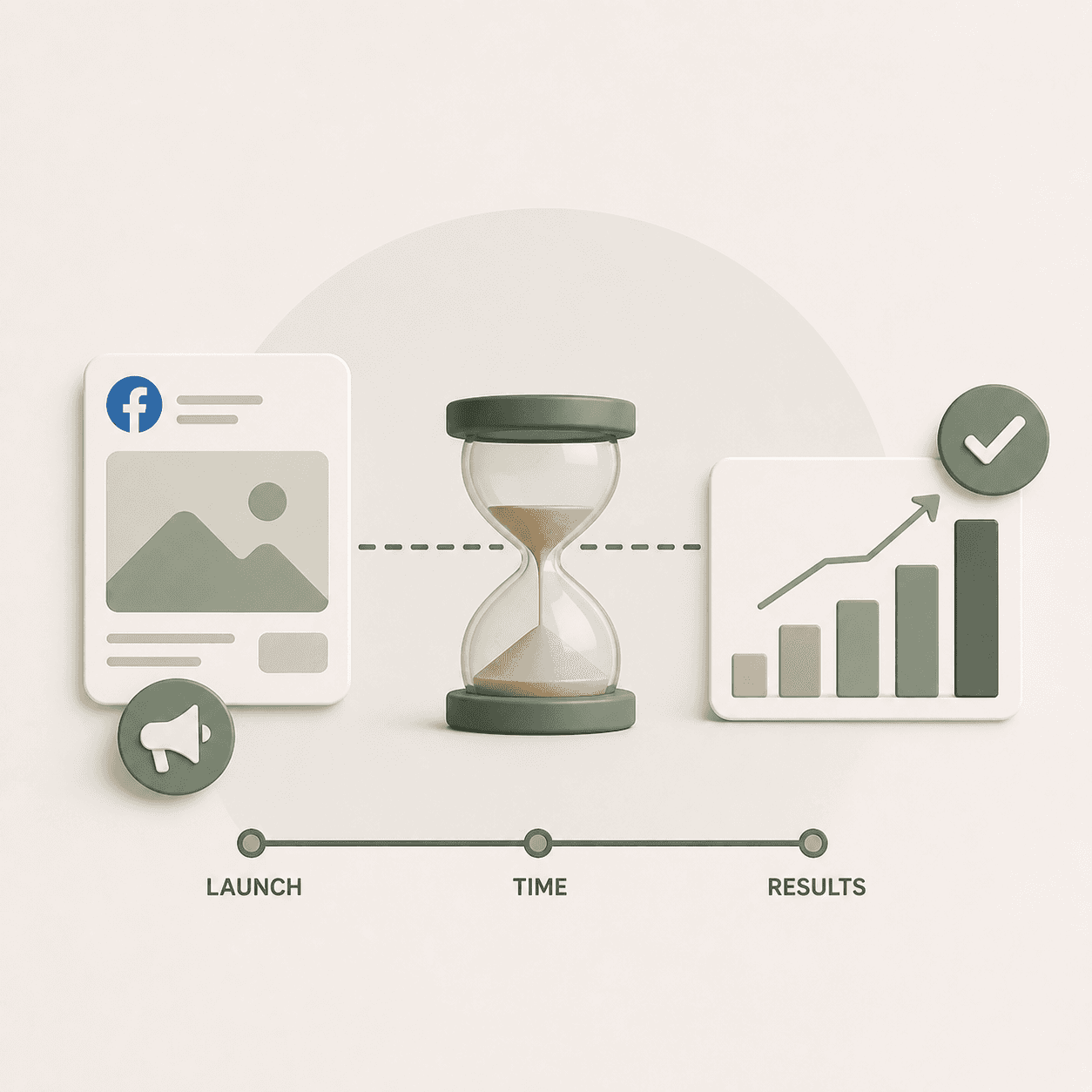
Expect an initial testing phase of 4-8 weeks before performance stabilizes. B2B SaaS sales cycles are longer than DTC — the median is now 84 days — so attribution takes time. Most teams see directional signal within the first few weeks but typically require several months to optimize fully.
Can you run Meta Ads for B2B SaaS with a small monthly budget?
Yes, though smaller budgets limit testing velocity and audience reach. Starting with a focused ICP and a small set of creative variants allows you to gather learnings before scaling.
How do you attribute Meta Ads conversions in a long B2B SaaS sales cycle?
A combination of platform attribution, UTM tracking, and CRM data connects ad clicks to pipeline and closed revenue. Multi-touch attribution models help assign credit across the full funnel, though no model is perfect. The key is having CRM integration in place from day one so you can track leads through to closed deals.
Related Posts
Related Posts
Related Posts
Related Posts























Ready to talk?
Book A Call
New York, NY 11217
hello@flighted.co
© Flighted, 2026
Ready to talk?
Book A Call
New York, NY 11217
hello@flighted.co
© Flighted, 2026