The B2B SaaS Meta Ads Offer & Lead Magnet Playbook: Whitepapers, Free Tools, Audits & Webinars
Meta Ads
May 28, 2026
Table Of Contents
Key Takeaways
Offer > Creative: The offer is the only variable that improves both Cost Per Lead (CPL) and lead quality simultaneously.
Algorithm Stability: Meta requires ~50 conversions per week to exit the learning phase; high-converting offers are mandatory for budgets under $25k/month.
ACV Alignment: Match lead magnets to deal size—Free Tools for sub-$25k ACV, Audits for $10k-$50k, and Data Reports for $50k+.
Intent Filtering: Interactive demos and audits provide higher SQL rates (25-60%) compared to generic whitepapers (1-3%).
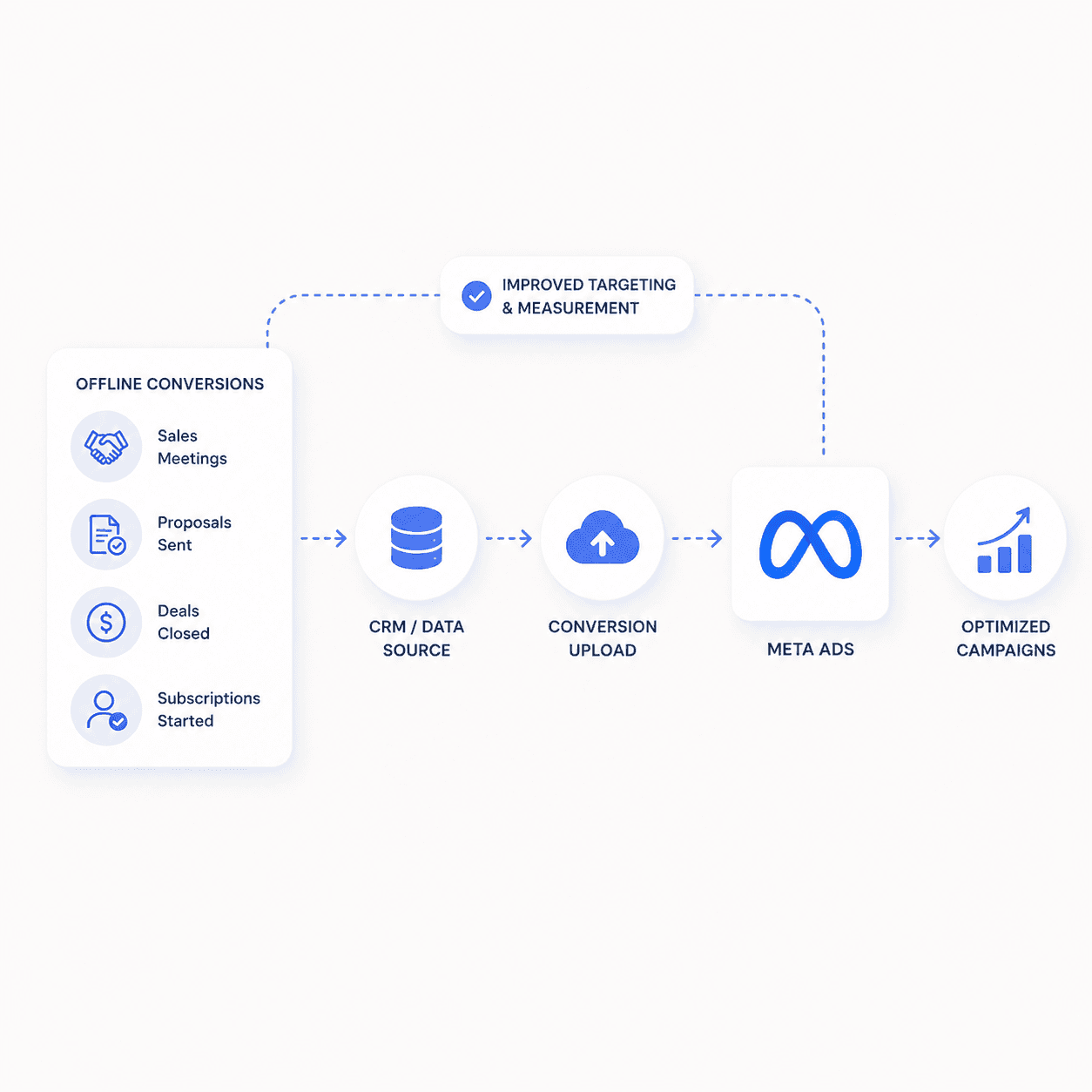
Tracking is Mandatory: Use the Conversions API or Offline Conversion uploads to optimize for pipeline rather than just cheap clicks.
Lead magnet archetype | CPL range | Lead quality | Time to build | Best for |
|---|---|---|---|---|
Free tools & calculators | $20–$80 | High | 2–6 weeks | Sub-$25K ACV, PLG motion |
Free audits & assessments | $80–$250 | Very high | 1–2 weeks | $10K–$50K ACV, service-adjacent SaaS |
Interactive demos & product tours | $60–$200 | Very high | 1–3 weeks | PLG SaaS, sub-$50K ACV |
Webinars & live workshops | $100–$400 | Medium | 2–4 weeks | $50K+ ACV, multi-stakeholder |
Whitepapers, ebooks & reports | $40–$150 | Low–Medium | 3–8 weeks | $50K+ ACV with proprietary data |
Newsletter & community sign-ups | $5–$30 | Low (slow burn) | 1 week | Founder-led, category creation |
Why your offer matters more than your creative, audience, or budget
If you fixate on one variable in your Meta ads account, fixate on the offer.
Creative changes CPL but not lead quality. Audience changes lead quality but not CPL in any reliable way (Meta's algorithm overrides most of what you do at the targeting layer anyway — we covered why in our beginner Meta ads strategy guide). Budget changes how fast you learn, but doesn't change what you learn. The offer is the only variable in the system that changes both CPL and lead quality at the same time, in the same direction.
There's also a brutal practical reason the offer matters more than anything else at early-stage. Meta's algorithm needs roughly 50 conversions per ad set per week to exit the learning phase and stabilize. On a $5K–$25K/month budget — where almost every early-stage B2B SaaS account lives — you can only hit that threshold if your offer converts. If your CPL is $200 and you're spending $7K/month, you're getting 35 leads. Meta's learning model is starving. Performance never stabilizes, and you're constantly chasing your tail. Move to an offer that converts at $80 and the same budget gets you 87 leads. The algorithm finally has something to work with.
Most early-stage B2B SaaS founders pick the wrong offer first, and they pick it for the same reason every time: they copy what the enterprise SaaS brands they admire are doing. "Snowflake runs gated whitepapers, so we should run gated whitepapers." Snowflake also has a $50M ad budget, a 30-person SDR team, and a six-month sales cycle that can absorb a 2% MQL→SQL rate. You probably don't. The right offer at startup scale almost always looks different from the right offer at enterprise scale.
Two questions to answer before you go any further:
What's your ACV? Sub-$10K, $10K–$50K, $50K+. These are different worlds.
How long is your sales cycle? Two weeks, two months, two quarters. This dictates how patient your offer can afford to be.
Hold those two answers in your head as you read the rest of this post. The whole framework hinges on them.
The 6 lead magnet archetypes for B2B SaaS on Meta (ranked)
There are dozens of "lead magnet types" floating around online, but on Meta specifically — for B2B SaaS specifically — almost every offer that consistently works falls into one of six categories. We've ranked them roughly in order of how often we see them outperform on accounts we've audited or managed, with the caveat that the right pick for your account depends on the ACV and cycle-length filters above.
1. Free tools & calculators
A free tool or calculator is exactly what it sounds like: a small, useful piece of standalone software that someone can use without ever touching your main product. ROI calculators, free audit dashboards (the automated kind, not a human-run audit), benchmark generators, free Chrome extensions, free templates that run inside Google Sheets.
A few examples that have worked well: HubSpot's Website Grader, Ahrefs' free backlink checker, Northbeam's old free attribution dashboard. None of those are the actual paid product. All of them require an email to use. All of them put the prospect inside a workflow that's adjacent to the real product, which is exactly what you want.
CPLs for free tool offers consistently come in under what gated content can hit on cold Meta traffic, often in the $20–$80 range for the right ICP. The reason is that the perceived value is high (someone is getting something useful) and the email "cost" is low (they're not committing to a sales call, just a software interaction). That's a much easier sell on cold paid social than "give us your email and we'll send you a 32-page PDF."
When to use: sub-$25K ACV, product-led growth motion, sub-$25K/mo Meta budget. The free tool works best when the ICP's "aha moment" can happen in the tool itself, and there's a natural path from the tool to the paid product.
When NOT to use: enterprise sales with multi-stakeholder buying committees and no product hook. If your buyer is a CISO who will never touch the product directly, a free tool doesn't serve them.
Build vs. buy: if you can ship a free tool in under two weeks, build it. Most ROI calculators and benchmark generators can be built on top of Tally, Softr, or a single Webflow page with some JavaScript. The trap is over-engineering the tool. Cheaper, uglier, working version this month beats polished version next quarter.
2. Free audits & assessments
The free audit is the highest-intent lead magnet on this list, full stop. It's also the one most B2B SaaS teams underestimate.
It works for any SaaS where there's a service-adjacent layer to the product — SEO tools, ad platforms, security software, analytics, observability. The offer is straightforward: "Send us your [thing] and we'll send back a free [analysis]." Someone fills out a form, gives you access to whatever asset you need to audit, and gets a deliverable back within a few days.
The reason it converts so well on the back end is that it filters for intent at the form-fill stage. To get the audit, the prospect has to grant access to something real — their ad account, their site, their codebase, their data warehouse. People with no actual buying interest don't do that. The form completion rate is lower than for an ungated piece of content, but the MQL→SQL rate is dramatically higher. We've seen audit offers hit 40–60% SQL rates on Meta-sourced leads, which is unheard of from gated PDFs.
Sales handoff matters more than the audit itself. This is the part that kills the play when it goes wrong. If the audit deliverable lands in a queue at an offshore VA shop and comes back in two weeks with generic recommendations, your conversion rates collapse. The audit needs to either be auto-generated (in which case it should look more like a free tool — see archetype #1) or done by an actual AE who's going to be on the resulting sales call. Anywhere in between is a graveyard.
Realistic CPL: $80–$250 on Meta, depending on ICP. Higher than free tool CPL, but the down-funnel economics usually justify it on $10K+ ACV deals.
3. Interactive demos & product tours
A self-serve interactive product tour built with a tool like Navattic, Storylane, or Arcade is, in our opinion, the single highest-quality lead magnet a PLG B2B SaaS company can run on Meta in 2026.
The pitch is simple. Instead of asking the prospect to book a demo with sales, you give them a guided walkthrough of the product right in the browser. They click through a couple of key flows. They see exactly what the product does. By the time they reach the "request a demo" or "start a trial" CTA at the end, they've already self-qualified - interactive demo visitors convert at 8x the rate of non-demo visitors.
The tradeoff is that CPL is higher than for a free tool or a calculator — usually $60–$200 on cold Meta traffic. But the sales cycle that follows is dramatically shorter. We've seen clients move time-to-close from 45 days to under 20 just by inserting a product tour between the ad and the sales call. The prospect shows up to the first call already understanding the product, which collapses the discovery phase.
Structure the demo flow to capture intent signals. A common mistake is treating the product tour as one monolithic experience. The better play: split it into 2–3 micro-tours that each cover a different use case, gate the second one behind an email, and route prospects who complete different tours into different nurture tracks. The tour someone chose to walk through tells you which pain point matters to them.
This is the archetype we recommend most often for PLG SaaS in the $10K–$50K ACV range. It also works as a top-of-funnel offer for higher-ACV products, where the goal is to seed the prospect with enough product understanding to make the eventual sales conversation meaningful.
4. Webinars & live workshops
Webinars still work in 2026 — but only in specific situations, and only if you're willing to fix the show-up rate problem.
Where webinars work: high-ACV ($50K+) deals with multi-stakeholder buying committees, where the buyer needs to be able to forward the recording to three other people internally. Categories where prospects are still figuring out the problem (not just the solution) — newer or evolving categories like AI governance, AI agent orchestration, the more emerging slices of security. Founder-led SaaS where the founder is genuinely a thought leader and not just doing a talking-head demo of the product.
Where webinars don't work: low-ACV PLG products where the buyer just wants to use the tool. Mature categories where everyone already knows what the product does. Anything where the buyer can self-serve to value in the product faster than they can sit through a 45-minute webinar.
Live vs. evergreen: advertise the live version on Meta, even if you also have an evergreen on-demand recording. The live event has urgency the on-demand doesn't, and Meta's algorithm rewards offers with a tight CTA. Promote evergreen content separately, via your own list or organic distribution.
Webinar registration ads on Meta have gotten meaningfully more expensive over the last 18 months. Part of that is just paid media inflation, but a bigger part is that the gold-rush of pandemic-era "everyone runs webinars" has matured the channel. Expect $100–$400 per registration depending on ICP.
The show-up rate problem. Most B2B webinar funnels see 20–35% of registrants actually attend. The fix is a 3-touch nurture: a confirmation email immediately, a reminder 24 hours before, and an SMS or push 30 minutes before. Tools like Goldcast and Zuddl handle this natively. Show-up rate north of 50% is achievable but takes deliberate work.
5. Whitepapers, ebooks & reports
The honest take: most B2B SaaS whitepapers don't work on Meta, but a narrow subset of them work extremely well.
The ones that don't work are the "Ultimate Guide to [Category]" ebooks that read like SEO content with a download form bolted on. We've watched dozens of those die at sub-2% MQL→SQL rates. Meta will happily give you cheap leads on a gated PDF — that's the easy part — but the leads are tire-kickers downloading something to consume later (which they usually don't), not buyers signaling intent.
The ones that do work share two characteristics: they contain proprietary data the prospect can't get anywhere else, and they take a contrarian or sharply-pointed POV that's hard to argue with at the headline level.
The data-report play is the strongest version of this. Run an original survey, partner with a research firm, or analyze your own anonymized customer data. Package the findings as a "State of [Category]" report or a benchmark study. You now have a defensible asset that:
Generates link-worthy stats that fuel content, social, and PR for the next 12 months
Gives your sales team specific data points to reference on every call
Carries enough perceived value to justify the email exchange
The Pavilion-LinkedIn revenue benchmark reports, Hampton's salary report, the Lenny's Newsletter / First Round B2B sales report — these are templates worth studying. Each one became a Meta-paid lead magnet that funded itself many times over.
Form-length tradeoffs: for top-of-funnel data reports, keep the form to 3 fields max (name, email, company). Asking for phone, employee count, or job title at the cold-traffic stage will tank your conversion rate by 40–60% with minimal lead quality lift. Save the qualification questions for the next conversion event in your funnel.
CPLs on data reports tend to fall in the $40–$150 range on Meta. Lead quality is lower than free tools or audits, but the volume can be useful at the top of the funnel.
6. Newsletter & community sign-ups
The slow-burn play. Cheapest CPL on this list — often $5–$30 — and the longest cycle to actual pipeline.
Newsletter sign-ups don't generate "leads" in the traditional sense. They generate subscribers, who consume content for weeks or months before they ever raise their hand for a sales conversation. Most B2B SaaS attribution models can't track that, which is why most teams underinvest in this play.
When it makes sense: founder-led SaaS where the founder has thought-leader pull (think Lenny Rachitsky, Anthony Pierri, Adam Robinson), or category-creation SaaS where you need to teach the market what you do before you can sell it. In both cases, a newsletter or community functions as the brand asset that earns trust over time, and the eventual sales motion is downstream.
Tracking value without a "lead" event. The trick here is to instrument your funnel to give Meta a deeper-in-funnel signal even if there's no immediate lead. Configure the Meta pixel to fire a Subscribe event on newsletter sign-up, then a separate Lead event when that subscriber clicks through to a product page or books a demo weeks later. Use offline conversion uploads or the Conversions API to tie eventual demo bookings back to the original ad. Without that wiring, Meta is optimizing toward a vanity event and the channel will look unprofitable on paper even if it's working.
This is a play to layer in once your other lead magnets are humming, not your first offer.
Meta Instant Forms vs. Landing Pages: Which Should You Use to Capture the Lead?
Picking the offer is only half the decision. The other half is where the form lives — inside Meta (Instant Forms) or on your own domain (a dedicated landing page) — and it's a separate trade-off from anything covered above: volume and cost versus intent and qualification.
Instant Forms remove friction. The form pre-fills with the user's Meta profile data, loads instantly with no page-load lag, and never leaves the platform. That combination consistently produces a lower cost per lead than sending the same audience to an external page. The tradeoff is qualification: you get name, email, and phone, and nothing else, so you can't ask the questions that separate a real buyer from someone who tapped through on their commute.
Landing pages do the opposite. The extra step of leaving Meta and loading an external page filters out low-intent taps before they ever become a lead. You also get room to add qualifying fields, show social proof, and drop a pixel that reads far more than a name-and-email exchange — critical if you're feeding Conversions API events back into Meta for optimization (see the tracking section above).
Match the mechanism to the offer, not to whichever is easier to set up:
Instant Forms for the lower-commitment offers on this list — webinars, data reports, gated content, newsletter sign-ups. The friction reduction matters most when the ask is already low-stakes.
Landing pages for the higher-intent offers — free audits, interactive product tours, and anything feeding directly into a sales conversation. The extra qualification step pays for itself once a human sales rep is on the other end.
If you're straddling the line — a free tool offer sitting right at the boundary — test both formats for two weeks before locking in. The CPL gap will tell you how much intent you're trading away, and whether that trade is worth it for your ACV.
The decision framework: which offer should you run?
Two variables drive the right pick: your ACV and your sales cycle length. A third — your monthly Meta budget — sets a hard floor on how many offers you can realistically test at once.
Quick rules of thumb:
Scenario | Recommended Offer |
|---|---|
Sub-$10K ACV, PLG motion | Free tool or interactive product tour |
$10K–$50K ACV, mid-length cycle | Free audit or interactive product tour |
$50K+ ACV, multi-stakeholder | Original-data report + webinar combo |
Sub-$5K/mo Meta budget | Pick ONE offer only to maximize learning signal |
The "second offer" question. Once your first offer is stable — meaning it's been profitable for 60+ days and you've graduated through Meta's learning phase — the temptation is to layer in a second lead magnet to keep things fresh. Don't, unless your first offer is genuinely capped on volume. The signal you'd get from doubling down on the proven offer (more budget, more creative variations) is almost always cleaner than splitting attention between two. We talk through how to think about this in more detail in our budget guide for early-stage B2B SaaS.
The exception: when your first offer is genuinely saturating a small ICP and Meta is showing climbing frequency with no headroom. That's a real reason to introduce a second offer, usually one positioned earlier in the funnel to expand the addressable audience.
How to launch a new lead magnet on Meta (the first 30 days)
Once you've picked the offer, the launch playbook is straightforward. Most failed lead-magnet launches we audit fail at the structural level, not the creative level.
Pre-launch. Make sure your Meta pixel and Conversions API are firing for both the top-of-funnel event (form submit, sign-up, registration) and a deeper qualification event. Pick the standard event names — don't invent your own. Build a seed audience from your existing customer list, enriched for personal emails through a tool like Clay so your match rate isn't capped at 20%.
Week 1. Launch one campaign, one ad set, three to five creatives testing the offer angle, not visual design variants. The hook is what you're testing — "free audit," "10-minute product walkthrough," "industry benchmark report" — each framed in a meaningfully different way. Daily budget should be at least 5x your target CPL so you actually generate enough conversions for Meta to exit the learning phase within a week.
Week 2. Read CPL and form completion rate. If CPL is more than 2x your target and form completion rate is below 30%, the offer itself is mispositioned — kill the launch and rework the offer page before spending more. If CPL is in range, let it ride and look at scaled spend.
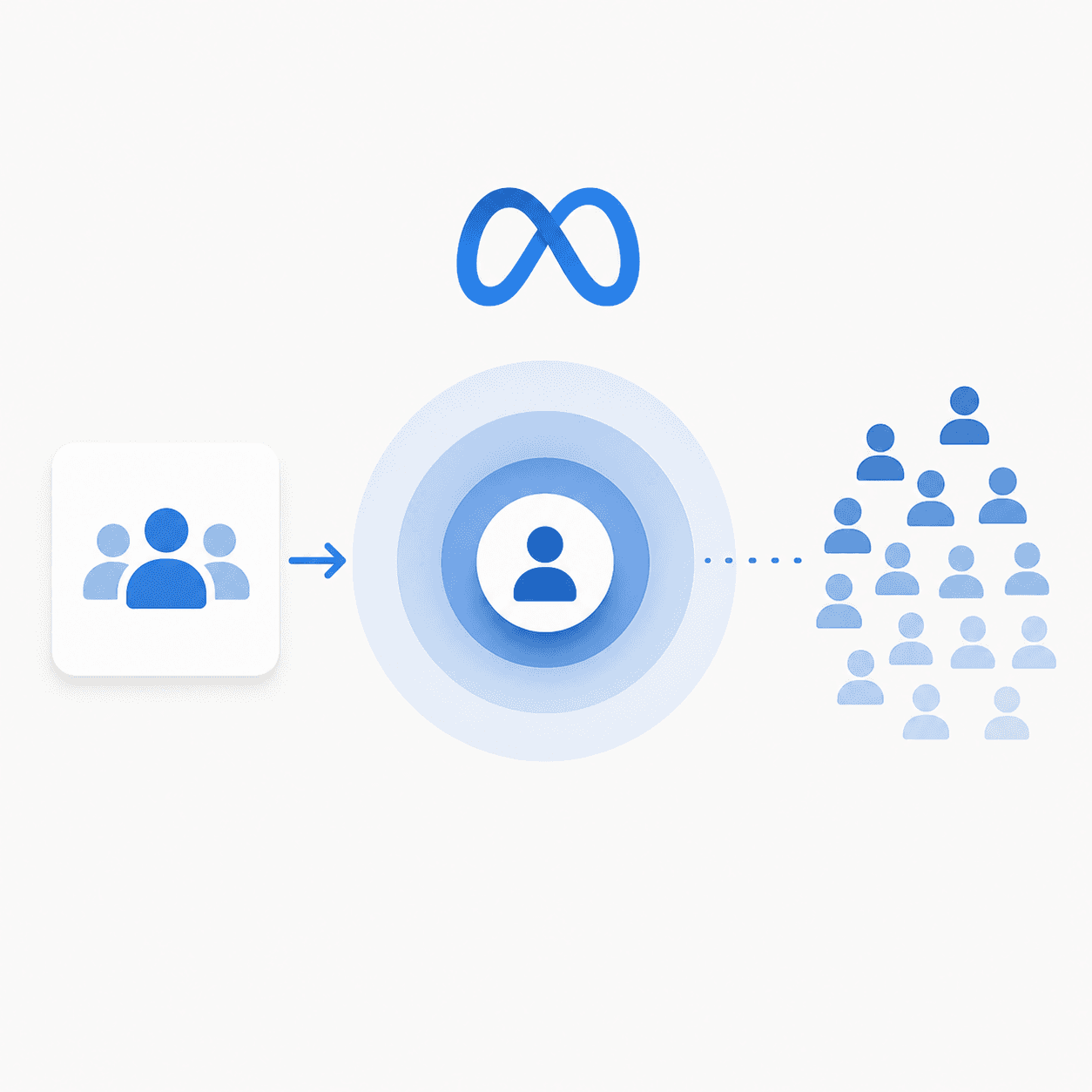
Week 3–4. Layer in lookalike audiences off the lead-form completers (1% and 3% LAL, separately). Introduce a second batch of creative variants that hit different ICP angles within the same offer. Resist the urge to optimize toward MQL or SQL yet — your conversion volume is too low to give Meta useful signal at the qualified-lead level until you've accumulated 50+ qualified leads.
Common launch killers we see repeatedly:
Under-budgeting below the 50-conversion threshold. Meta's learning phase needs volume. If your budget can't produce 50 conversions a week, you'll never get out of learning, missing the 19% lower cost per conversion that stabilized campaigns achieve.
Judging quality before the sales cycle completes. A B2B sales cycle is 30–90 days. Killing an offer at week 2 because "the leads don't look qualified yet" is killing it before any data exists. Let the cycle run.
Optimizing for CPL instead of MQL or pipeline. Cheap leads are easy. Cheap leads that close are the actual goal. The offers that look most expensive on a CPL basis are often the most profitable down-funnel.
Measuring lead-magnet performance beyond CPL
CPL is the noisiest metric in your account, and it's also the one everyone reports on. The four metrics that actually tell you whether an offer is working:
CPL. Top-of-funnel volume signal. Useful for diagnosing whether the offer + ad creative is resonating at all.
MQL rate. What percentage of the leads from this offer meet your qualification criteria? This is your first real quality check. Set a baseline benchmark per offer type and measure against it.
SQL rate. What percentage of MQLs make it to a sales-accepted opportunity? This is the metric that exposes whether your sales team trusts the leads or not.
Pipeline-sourced revenue. The end of the line. Which offer actually generates the most closed-won revenue per dollar spent?
If you're not feeding the down-funnel signals back to Meta, the algorithm is flying blind. Offline conversion uploads (or server-side events via the Conversions API) are non-negotiable for B2B SaaS lead magnets. This is the single biggest gap we see in B2B Meta accounts, and we walk through the implementation in our B2B conversion tracking guide.
MQL→SQL benchmarks by offer type (rough heuristics from accounts we've managed):
Free audits: 40–60% MQL→SQL
Interactive product tours: 25–45% MQL→SQL
Free tools / calculators: 15–30% MQL→SQL
Webinars: 10–25% MQL→SQL
Data reports: 5–15% MQL→SQL
Generic ebooks / whitepapers: 1–3% MQL→SQL
When to declare an offer dead vs. iterate the creative: if your CPL is in range but MQL→SQL is below the bottom of these benchmarks after 60 days and one full creative refresh, the offer itself is the problem, not the ads. If CPL is high but MQL→SQL is strong, the offer is fine — your creative is the problem.
4 lead-magnet creative templates that consistently win
The offer carries 70% of the weight. The remaining 30% is in how you frame it. These four templates show up over and over in the accounts we run.
Template 1: "Steal our [thing]" — direct-value angle. Hook: "Steal our exact 30-day Meta ads testing framework." Visual: a screenshot of the actual asset with the "download" CTA overlaid. The angle works because it telegraphs exactly what the prospect is going to get, and "steal" implies they're getting something insider-y.
Template 2: Founder-to-founder POV video. A talking-head video from your founder addressing the ICP directly: "I'm Peter, I run a Meta ads agency, and I'm tired of watching B2B SaaS teams waste $10K on the wrong lead magnet. Here's the playbook." Vertical, low-fi, ideally shot on an iPhone. Founder POV consistently outperforms polished brand video on cold B2B traffic.
Template 3: Before/after dashboard or screenshot reveal. Visual: a split image showing a "before" state (messy data, low-performing dashboard, ugly funnel) and an "after" state (clean, optimized). Works particularly well for analytics, observability, and any SaaS where the value is visual. Pair with a hook like "What our clients' Meta accounts look like after 90 days."
Template 4: Contrarian stat hook from your own data report. Hook: "We analyzed 200 B2B SaaS Meta accounts. 73% of them are optimizing toward the wrong conversion event." This template only works if you have proprietary data to back the claim, but when you do, it's one of the highest-converting hooks available. It works because it makes the prospect curious and immediately positions your report as the answer.
For more on how to construct creative around these templates, our B2B SaaS creative strategy guide breaks down the messaging matrix in more depth.
Common mistakes early-stage B2B SaaS makes with Meta lead magnets
A short list of patterns we see across audits — each one quietly kneecaps performance:
Low-Value Gates: Don't gate 12-page blog compilations; the friction isn't worth the email.
Budget Fragmentation: Avoid testing 4 offers on a $7k budget; you'll never exit the learning phase.
Offer Mismatch: Use low-commitment offers (tools/reports) for cold traffic and high-intent offers (audits/demos) for retargeting.
Slow Follow-up: Lead value drops significantly after the first hour; aim for sub-5 minute response times.
Objective Trap: Avoid the "Leads" objective; use "Sales/Conversions" to find higher-quality prospects.
Frequently Asked Questions
What's the average CPL for a B2B SaaS lead magnet on Meta? It varies more than any other metric in your account, but a reasonable range for B2B SaaS on Meta in 2026 is $30–$250 depending on offer type, ICP narrowness, and how much friction sits on your form. Free tools and tour CPLs tend to land at the low end of that range; webinars and audits at the high end. Numbers below $30 usually mean your lead quality is poor, not that you've cracked the code.
Should I gate my lead magnet or make it ungated? Gate it if Meta is paying for the click — you need the email to retarget and to feed the algorithm a conversion event. Ungate organic content. The exception is when you're running a free tool: gate the result (the calculation, the audit output, the report PDF), not the use of the tool itself.
How long should I test a lead magnet before killing it? Minimum 30 days of running. Minimum 50 conversions in the account. And ideally, you should wait for at least one full sales cycle to pass before judging quality — killing an offer at day 14 because "no one's closed yet" is a recipe for killing offers that would have worked.
Do whitepapers still work in 2026? Generic "ultimate guide" ebooks, no — those are largely dead on cold Meta traffic. Proprietary data reports and sharply-pointed contrarian POV pieces, yes — those still work and in some cases work better than ever.
Can I use the same lead magnet on LinkedIn and Meta? You can run the same offer, but you'll want different creative. LinkedIn audiences expect more polish and longer-form copy. Meta audiences scroll past anything that looks too formal. The most-shared LinkedIn ad and the highest-performing Meta ad rarely look anything like each other, even when they're promoting the same asset.
How much budget do I need to test a new lead magnet? Roughly 5x your target CPL per day, sustained for 30 days. If your target CPL is $80, that's $400/day or $12K for a full testing cycle. Anything less and you risk never exiting Meta's learning phase, in which case the results aren't a real read on the offer.
Next steps
The offer is the most important decision you'll make in your Meta ads account. Get it right and the rest of the system gets easier — your creative tests resolve faster, your CPL stabilizes, your sales team stops asking why the leads are bad. Get it wrong and there's no amount of clever targeting or polished creative that fixes it.
If you'd rather have someone else figure out which offer is right for your account — or if you've been running one of the offers above and can't tell whether it's working — we'd be happy to do a free audit of your Meta account. Book a call with our team.
Key Takeaways
Offer > Creative: The offer is the only variable that improves both Cost Per Lead (CPL) and lead quality simultaneously.
Algorithm Stability: Meta requires ~50 conversions per week to exit the learning phase; high-converting offers are mandatory for budgets under $25k/month.
ACV Alignment: Match lead magnets to deal size—Free Tools for sub-$25k ACV, Audits for $10k-$50k, and Data Reports for $50k+.
Intent Filtering: Interactive demos and audits provide higher SQL rates (25-60%) compared to generic whitepapers (1-3%).
Tracking is Mandatory: Use the Conversions API or Offline Conversion uploads to optimize for pipeline rather than just cheap clicks.
Lead magnet archetype | CPL range | Lead quality | Time to build | Best for |
|---|---|---|---|---|
Free tools & calculators | $20–$80 | High | 2–6 weeks | Sub-$25K ACV, PLG motion |
Free audits & assessments | $80–$250 | Very high | 1–2 weeks | $10K–$50K ACV, service-adjacent SaaS |
Interactive demos & product tours | $60–$200 | Very high | 1–3 weeks | PLG SaaS, sub-$50K ACV |
Webinars & live workshops | $100–$400 | Medium | 2–4 weeks | $50K+ ACV, multi-stakeholder |
Whitepapers, ebooks & reports | $40–$150 | Low–Medium | 3–8 weeks | $50K+ ACV with proprietary data |
Newsletter & community sign-ups | $5–$30 | Low (slow burn) | 1 week | Founder-led, category creation |
Why your offer matters more than your creative, audience, or budget
If you fixate on one variable in your Meta ads account, fixate on the offer.
Creative changes CPL but not lead quality. Audience changes lead quality but not CPL in any reliable way (Meta's algorithm overrides most of what you do at the targeting layer anyway — we covered why in our beginner Meta ads strategy guide). Budget changes how fast you learn, but doesn't change what you learn. The offer is the only variable in the system that changes both CPL and lead quality at the same time, in the same direction.
There's also a brutal practical reason the offer matters more than anything else at early-stage. Meta's algorithm needs roughly 50 conversions per ad set per week to exit the learning phase and stabilize. On a $5K–$25K/month budget — where almost every early-stage B2B SaaS account lives — you can only hit that threshold if your offer converts. If your CPL is $200 and you're spending $7K/month, you're getting 35 leads. Meta's learning model is starving. Performance never stabilizes, and you're constantly chasing your tail. Move to an offer that converts at $80 and the same budget gets you 87 leads. The algorithm finally has something to work with.
Most early-stage B2B SaaS founders pick the wrong offer first, and they pick it for the same reason every time: they copy what the enterprise SaaS brands they admire are doing. "Snowflake runs gated whitepapers, so we should run gated whitepapers." Snowflake also has a $50M ad budget, a 30-person SDR team, and a six-month sales cycle that can absorb a 2% MQL→SQL rate. You probably don't. The right offer at startup scale almost always looks different from the right offer at enterprise scale.
Two questions to answer before you go any further:
What's your ACV? Sub-$10K, $10K–$50K, $50K+. These are different worlds.
How long is your sales cycle? Two weeks, two months, two quarters. This dictates how patient your offer can afford to be.
Hold those two answers in your head as you read the rest of this post. The whole framework hinges on them.
The 6 lead magnet archetypes for B2B SaaS on Meta (ranked)
There are dozens of "lead magnet types" floating around online, but on Meta specifically — for B2B SaaS specifically — almost every offer that consistently works falls into one of six categories. We've ranked them roughly in order of how often we see them outperform on accounts we've audited or managed, with the caveat that the right pick for your account depends on the ACV and cycle-length filters above.
1. Free tools & calculators
A free tool or calculator is exactly what it sounds like: a small, useful piece of standalone software that someone can use without ever touching your main product. ROI calculators, free audit dashboards (the automated kind, not a human-run audit), benchmark generators, free Chrome extensions, free templates that run inside Google Sheets.
A few examples that have worked well: HubSpot's Website Grader, Ahrefs' free backlink checker, Northbeam's old free attribution dashboard. None of those are the actual paid product. All of them require an email to use. All of them put the prospect inside a workflow that's adjacent to the real product, which is exactly what you want.
CPLs for free tool offers consistently come in under what gated content can hit on cold Meta traffic, often in the $20–$80 range for the right ICP. The reason is that the perceived value is high (someone is getting something useful) and the email "cost" is low (they're not committing to a sales call, just a software interaction). That's a much easier sell on cold paid social than "give us your email and we'll send you a 32-page PDF."
When to use: sub-$25K ACV, product-led growth motion, sub-$25K/mo Meta budget. The free tool works best when the ICP's "aha moment" can happen in the tool itself, and there's a natural path from the tool to the paid product.
When NOT to use: enterprise sales with multi-stakeholder buying committees and no product hook. If your buyer is a CISO who will never touch the product directly, a free tool doesn't serve them.
Build vs. buy: if you can ship a free tool in under two weeks, build it. Most ROI calculators and benchmark generators can be built on top of Tally, Softr, or a single Webflow page with some JavaScript. The trap is over-engineering the tool. Cheaper, uglier, working version this month beats polished version next quarter.
2. Free audits & assessments
The free audit is the highest-intent lead magnet on this list, full stop. It's also the one most B2B SaaS teams underestimate.
It works for any SaaS where there's a service-adjacent layer to the product — SEO tools, ad platforms, security software, analytics, observability. The offer is straightforward: "Send us your [thing] and we'll send back a free [analysis]." Someone fills out a form, gives you access to whatever asset you need to audit, and gets a deliverable back within a few days.
The reason it converts so well on the back end is that it filters for intent at the form-fill stage. To get the audit, the prospect has to grant access to something real — their ad account, their site, their codebase, their data warehouse. People with no actual buying interest don't do that. The form completion rate is lower than for an ungated piece of content, but the MQL→SQL rate is dramatically higher. We've seen audit offers hit 40–60% SQL rates on Meta-sourced leads, which is unheard of from gated PDFs.
Sales handoff matters more than the audit itself. This is the part that kills the play when it goes wrong. If the audit deliverable lands in a queue at an offshore VA shop and comes back in two weeks with generic recommendations, your conversion rates collapse. The audit needs to either be auto-generated (in which case it should look more like a free tool — see archetype #1) or done by an actual AE who's going to be on the resulting sales call. Anywhere in between is a graveyard.
Realistic CPL: $80–$250 on Meta, depending on ICP. Higher than free tool CPL, but the down-funnel economics usually justify it on $10K+ ACV deals.
3. Interactive demos & product tours
A self-serve interactive product tour built with a tool like Navattic, Storylane, or Arcade is, in our opinion, the single highest-quality lead magnet a PLG B2B SaaS company can run on Meta in 2026.
The pitch is simple. Instead of asking the prospect to book a demo with sales, you give them a guided walkthrough of the product right in the browser. They click through a couple of key flows. They see exactly what the product does. By the time they reach the "request a demo" or "start a trial" CTA at the end, they've already self-qualified - interactive demo visitors convert at 8x the rate of non-demo visitors.
The tradeoff is that CPL is higher than for a free tool or a calculator — usually $60–$200 on cold Meta traffic. But the sales cycle that follows is dramatically shorter. We've seen clients move time-to-close from 45 days to under 20 just by inserting a product tour between the ad and the sales call. The prospect shows up to the first call already understanding the product, which collapses the discovery phase.
Structure the demo flow to capture intent signals. A common mistake is treating the product tour as one monolithic experience. The better play: split it into 2–3 micro-tours that each cover a different use case, gate the second one behind an email, and route prospects who complete different tours into different nurture tracks. The tour someone chose to walk through tells you which pain point matters to them.
This is the archetype we recommend most often for PLG SaaS in the $10K–$50K ACV range. It also works as a top-of-funnel offer for higher-ACV products, where the goal is to seed the prospect with enough product understanding to make the eventual sales conversation meaningful.
4. Webinars & live workshops
Webinars still work in 2026 — but only in specific situations, and only if you're willing to fix the show-up rate problem.
Where webinars work: high-ACV ($50K+) deals with multi-stakeholder buying committees, where the buyer needs to be able to forward the recording to three other people internally. Categories where prospects are still figuring out the problem (not just the solution) — newer or evolving categories like AI governance, AI agent orchestration, the more emerging slices of security. Founder-led SaaS where the founder is genuinely a thought leader and not just doing a talking-head demo of the product.
Where webinars don't work: low-ACV PLG products where the buyer just wants to use the tool. Mature categories where everyone already knows what the product does. Anything where the buyer can self-serve to value in the product faster than they can sit through a 45-minute webinar.
Live vs. evergreen: advertise the live version on Meta, even if you also have an evergreen on-demand recording. The live event has urgency the on-demand doesn't, and Meta's algorithm rewards offers with a tight CTA. Promote evergreen content separately, via your own list or organic distribution.
Webinar registration ads on Meta have gotten meaningfully more expensive over the last 18 months. Part of that is just paid media inflation, but a bigger part is that the gold-rush of pandemic-era "everyone runs webinars" has matured the channel. Expect $100–$400 per registration depending on ICP.
The show-up rate problem. Most B2B webinar funnels see 20–35% of registrants actually attend. The fix is a 3-touch nurture: a confirmation email immediately, a reminder 24 hours before, and an SMS or push 30 minutes before. Tools like Goldcast and Zuddl handle this natively. Show-up rate north of 50% is achievable but takes deliberate work.
5. Whitepapers, ebooks & reports
The honest take: most B2B SaaS whitepapers don't work on Meta, but a narrow subset of them work extremely well.
The ones that don't work are the "Ultimate Guide to [Category]" ebooks that read like SEO content with a download form bolted on. We've watched dozens of those die at sub-2% MQL→SQL rates. Meta will happily give you cheap leads on a gated PDF — that's the easy part — but the leads are tire-kickers downloading something to consume later (which they usually don't), not buyers signaling intent.
The ones that do work share two characteristics: they contain proprietary data the prospect can't get anywhere else, and they take a contrarian or sharply-pointed POV that's hard to argue with at the headline level.
The data-report play is the strongest version of this. Run an original survey, partner with a research firm, or analyze your own anonymized customer data. Package the findings as a "State of [Category]" report or a benchmark study. You now have a defensible asset that:
Generates link-worthy stats that fuel content, social, and PR for the next 12 months
Gives your sales team specific data points to reference on every call
Carries enough perceived value to justify the email exchange
The Pavilion-LinkedIn revenue benchmark reports, Hampton's salary report, the Lenny's Newsletter / First Round B2B sales report — these are templates worth studying. Each one became a Meta-paid lead magnet that funded itself many times over.
Form-length tradeoffs: for top-of-funnel data reports, keep the form to 3 fields max (name, email, company). Asking for phone, employee count, or job title at the cold-traffic stage will tank your conversion rate by 40–60% with minimal lead quality lift. Save the qualification questions for the next conversion event in your funnel.
CPLs on data reports tend to fall in the $40–$150 range on Meta. Lead quality is lower than free tools or audits, but the volume can be useful at the top of the funnel.
6. Newsletter & community sign-ups
The slow-burn play. Cheapest CPL on this list — often $5–$30 — and the longest cycle to actual pipeline.
Newsletter sign-ups don't generate "leads" in the traditional sense. They generate subscribers, who consume content for weeks or months before they ever raise their hand for a sales conversation. Most B2B SaaS attribution models can't track that, which is why most teams underinvest in this play.
When it makes sense: founder-led SaaS where the founder has thought-leader pull (think Lenny Rachitsky, Anthony Pierri, Adam Robinson), or category-creation SaaS where you need to teach the market what you do before you can sell it. In both cases, a newsletter or community functions as the brand asset that earns trust over time, and the eventual sales motion is downstream.
Tracking value without a "lead" event. The trick here is to instrument your funnel to give Meta a deeper-in-funnel signal even if there's no immediate lead. Configure the Meta pixel to fire a Subscribe event on newsletter sign-up, then a separate Lead event when that subscriber clicks through to a product page or books a demo weeks later. Use offline conversion uploads or the Conversions API to tie eventual demo bookings back to the original ad. Without that wiring, Meta is optimizing toward a vanity event and the channel will look unprofitable on paper even if it's working.
This is a play to layer in once your other lead magnets are humming, not your first offer.
Meta Instant Forms vs. Landing Pages: Which Should You Use to Capture the Lead?
Picking the offer is only half the decision. The other half is where the form lives — inside Meta (Instant Forms) or on your own domain (a dedicated landing page) — and it's a separate trade-off from anything covered above: volume and cost versus intent and qualification.
Instant Forms remove friction. The form pre-fills with the user's Meta profile data, loads instantly with no page-load lag, and never leaves the platform. That combination consistently produces a lower cost per lead than sending the same audience to an external page. The tradeoff is qualification: you get name, email, and phone, and nothing else, so you can't ask the questions that separate a real buyer from someone who tapped through on their commute.
Landing pages do the opposite. The extra step of leaving Meta and loading an external page filters out low-intent taps before they ever become a lead. You also get room to add qualifying fields, show social proof, and drop a pixel that reads far more than a name-and-email exchange — critical if you're feeding Conversions API events back into Meta for optimization (see the tracking section above).
Match the mechanism to the offer, not to whichever is easier to set up:
Instant Forms for the lower-commitment offers on this list — webinars, data reports, gated content, newsletter sign-ups. The friction reduction matters most when the ask is already low-stakes.
Landing pages for the higher-intent offers — free audits, interactive product tours, and anything feeding directly into a sales conversation. The extra qualification step pays for itself once a human sales rep is on the other end.
If you're straddling the line — a free tool offer sitting right at the boundary — test both formats for two weeks before locking in. The CPL gap will tell you how much intent you're trading away, and whether that trade is worth it for your ACV.
The decision framework: which offer should you run?
Two variables drive the right pick: your ACV and your sales cycle length. A third — your monthly Meta budget — sets a hard floor on how many offers you can realistically test at once.
Quick rules of thumb:
Scenario | Recommended Offer |
|---|---|
Sub-$10K ACV, PLG motion | Free tool or interactive product tour |
$10K–$50K ACV, mid-length cycle | Free audit or interactive product tour |
$50K+ ACV, multi-stakeholder | Original-data report + webinar combo |
Sub-$5K/mo Meta budget | Pick ONE offer only to maximize learning signal |
The "second offer" question. Once your first offer is stable — meaning it's been profitable for 60+ days and you've graduated through Meta's learning phase — the temptation is to layer in a second lead magnet to keep things fresh. Don't, unless your first offer is genuinely capped on volume. The signal you'd get from doubling down on the proven offer (more budget, more creative variations) is almost always cleaner than splitting attention between two. We talk through how to think about this in more detail in our budget guide for early-stage B2B SaaS.
The exception: when your first offer is genuinely saturating a small ICP and Meta is showing climbing frequency with no headroom. That's a real reason to introduce a second offer, usually one positioned earlier in the funnel to expand the addressable audience.
How to launch a new lead magnet on Meta (the first 30 days)
Once you've picked the offer, the launch playbook is straightforward. Most failed lead-magnet launches we audit fail at the structural level, not the creative level.
Pre-launch. Make sure your Meta pixel and Conversions API are firing for both the top-of-funnel event (form submit, sign-up, registration) and a deeper qualification event. Pick the standard event names — don't invent your own. Build a seed audience from your existing customer list, enriched for personal emails through a tool like Clay so your match rate isn't capped at 20%.
Week 1. Launch one campaign, one ad set, three to five creatives testing the offer angle, not visual design variants. The hook is what you're testing — "free audit," "10-minute product walkthrough," "industry benchmark report" — each framed in a meaningfully different way. Daily budget should be at least 5x your target CPL so you actually generate enough conversions for Meta to exit the learning phase within a week.
Week 2. Read CPL and form completion rate. If CPL is more than 2x your target and form completion rate is below 30%, the offer itself is mispositioned — kill the launch and rework the offer page before spending more. If CPL is in range, let it ride and look at scaled spend.
Week 3–4. Layer in lookalike audiences off the lead-form completers (1% and 3% LAL, separately). Introduce a second batch of creative variants that hit different ICP angles within the same offer. Resist the urge to optimize toward MQL or SQL yet — your conversion volume is too low to give Meta useful signal at the qualified-lead level until you've accumulated 50+ qualified leads.
Common launch killers we see repeatedly:
Under-budgeting below the 50-conversion threshold. Meta's learning phase needs volume. If your budget can't produce 50 conversions a week, you'll never get out of learning, missing the 19% lower cost per conversion that stabilized campaigns achieve.
Judging quality before the sales cycle completes. A B2B sales cycle is 30–90 days. Killing an offer at week 2 because "the leads don't look qualified yet" is killing it before any data exists. Let the cycle run.
Optimizing for CPL instead of MQL or pipeline. Cheap leads are easy. Cheap leads that close are the actual goal. The offers that look most expensive on a CPL basis are often the most profitable down-funnel.
Measuring lead-magnet performance beyond CPL
CPL is the noisiest metric in your account, and it's also the one everyone reports on. The four metrics that actually tell you whether an offer is working:
CPL. Top-of-funnel volume signal. Useful for diagnosing whether the offer + ad creative is resonating at all.
MQL rate. What percentage of the leads from this offer meet your qualification criteria? This is your first real quality check. Set a baseline benchmark per offer type and measure against it.
SQL rate. What percentage of MQLs make it to a sales-accepted opportunity? This is the metric that exposes whether your sales team trusts the leads or not.
Pipeline-sourced revenue. The end of the line. Which offer actually generates the most closed-won revenue per dollar spent?
If you're not feeding the down-funnel signals back to Meta, the algorithm is flying blind. Offline conversion uploads (or server-side events via the Conversions API) are non-negotiable for B2B SaaS lead magnets. This is the single biggest gap we see in B2B Meta accounts, and we walk through the implementation in our B2B conversion tracking guide.
MQL→SQL benchmarks by offer type (rough heuristics from accounts we've managed):
Free audits: 40–60% MQL→SQL
Interactive product tours: 25–45% MQL→SQL
Free tools / calculators: 15–30% MQL→SQL
Webinars: 10–25% MQL→SQL
Data reports: 5–15% MQL→SQL
Generic ebooks / whitepapers: 1–3% MQL→SQL
When to declare an offer dead vs. iterate the creative: if your CPL is in range but MQL→SQL is below the bottom of these benchmarks after 60 days and one full creative refresh, the offer itself is the problem, not the ads. If CPL is high but MQL→SQL is strong, the offer is fine — your creative is the problem.
4 lead-magnet creative templates that consistently win
The offer carries 70% of the weight. The remaining 30% is in how you frame it. These four templates show up over and over in the accounts we run.
Template 1: "Steal our [thing]" — direct-value angle. Hook: "Steal our exact 30-day Meta ads testing framework." Visual: a screenshot of the actual asset with the "download" CTA overlaid. The angle works because it telegraphs exactly what the prospect is going to get, and "steal" implies they're getting something insider-y.
Template 2: Founder-to-founder POV video. A talking-head video from your founder addressing the ICP directly: "I'm Peter, I run a Meta ads agency, and I'm tired of watching B2B SaaS teams waste $10K on the wrong lead magnet. Here's the playbook." Vertical, low-fi, ideally shot on an iPhone. Founder POV consistently outperforms polished brand video on cold B2B traffic.
Template 3: Before/after dashboard or screenshot reveal. Visual: a split image showing a "before" state (messy data, low-performing dashboard, ugly funnel) and an "after" state (clean, optimized). Works particularly well for analytics, observability, and any SaaS where the value is visual. Pair with a hook like "What our clients' Meta accounts look like after 90 days."
Template 4: Contrarian stat hook from your own data report. Hook: "We analyzed 200 B2B SaaS Meta accounts. 73% of them are optimizing toward the wrong conversion event." This template only works if you have proprietary data to back the claim, but when you do, it's one of the highest-converting hooks available. It works because it makes the prospect curious and immediately positions your report as the answer.
For more on how to construct creative around these templates, our B2B SaaS creative strategy guide breaks down the messaging matrix in more depth.
Common mistakes early-stage B2B SaaS makes with Meta lead magnets
A short list of patterns we see across audits — each one quietly kneecaps performance:
Low-Value Gates: Don't gate 12-page blog compilations; the friction isn't worth the email.
Budget Fragmentation: Avoid testing 4 offers on a $7k budget; you'll never exit the learning phase.
Offer Mismatch: Use low-commitment offers (tools/reports) for cold traffic and high-intent offers (audits/demos) for retargeting.
Slow Follow-up: Lead value drops significantly after the first hour; aim for sub-5 minute response times.
Objective Trap: Avoid the "Leads" objective; use "Sales/Conversions" to find higher-quality prospects.
Frequently Asked Questions
What's the average CPL for a B2B SaaS lead magnet on Meta? It varies more than any other metric in your account, but a reasonable range for B2B SaaS on Meta in 2026 is $30–$250 depending on offer type, ICP narrowness, and how much friction sits on your form. Free tools and tour CPLs tend to land at the low end of that range; webinars and audits at the high end. Numbers below $30 usually mean your lead quality is poor, not that you've cracked the code.
Should I gate my lead magnet or make it ungated? Gate it if Meta is paying for the click — you need the email to retarget and to feed the algorithm a conversion event. Ungate organic content. The exception is when you're running a free tool: gate the result (the calculation, the audit output, the report PDF), not the use of the tool itself.
How long should I test a lead magnet before killing it? Minimum 30 days of running. Minimum 50 conversions in the account. And ideally, you should wait for at least one full sales cycle to pass before judging quality — killing an offer at day 14 because "no one's closed yet" is a recipe for killing offers that would have worked.
Do whitepapers still work in 2026? Generic "ultimate guide" ebooks, no — those are largely dead on cold Meta traffic. Proprietary data reports and sharply-pointed contrarian POV pieces, yes — those still work and in some cases work better than ever.
Can I use the same lead magnet on LinkedIn and Meta? You can run the same offer, but you'll want different creative. LinkedIn audiences expect more polish and longer-form copy. Meta audiences scroll past anything that looks too formal. The most-shared LinkedIn ad and the highest-performing Meta ad rarely look anything like each other, even when they're promoting the same asset.
How much budget do I need to test a new lead magnet? Roughly 5x your target CPL per day, sustained for 30 days. If your target CPL is $80, that's $400/day or $12K for a full testing cycle. Anything less and you risk never exiting Meta's learning phase, in which case the results aren't a real read on the offer.
Next steps
The offer is the most important decision you'll make in your Meta ads account. Get it right and the rest of the system gets easier — your creative tests resolve faster, your CPL stabilizes, your sales team stops asking why the leads are bad. Get it wrong and there's no amount of clever targeting or polished creative that fixes it.
If you'd rather have someone else figure out which offer is right for your account — or if you've been running one of the offers above and can't tell whether it's working — we'd be happy to do a free audit of your Meta account. Book a call with our team.
Related Posts
Related Posts
Related Posts
Related Posts


























Ready to talk?
New York, NY 11217
hello@flighted.co
© Flighted, 2026
Ready to talk?
New York, NY 11217
hello@flighted.co
© Flighted, 2026