Best Meta Ads Account Structure for Small Brands
Meta Ads
July 1, 2026

Table Of Contents
Looking for Meta ads support?
We're a small, hardworking, US-based team. Book a call and get a free audit today.
4. Testing Budget Math
Here is the formula for setting your daily test budget per adset:
Daily test budget = target conversions multiplied by expected CPA, divided by test duration in days.
You want at least 3 conversions before you judge a test. Use a 7-day test window as the minimum.
Example: Your target CPA is $50. You want 3 conversions to decide. Your test window is 7 days.
$50 multiplied by 3, divided by 7 equals roughly $21 per day per adset.
If you are running 4 concept adsets simultaneously, your daily testing budget is $21 multiplied by 4, which equals $84 per day, or about $2,520 per month on testing alone.
That is realistic for a brand spending $10,000-$50,000 per month total. If your total budget is $5,000/month, you may only be able to test 2 concepts at a time. That is fine. Fewer tests run properly beat more tests run poorly.
For a deeper breakdown on starting budget allocation, read our guide on how to determine your starting Meta Ads budget.
5. How to KPI at This Spend Tier
Do not judge creatives on a single day's performance. Use a rolling window with a minimum of 5 days.
The Process
Set your target CPA or target ROAS before you start. If you do not have a target, you cannot make decisions. Your target CPA should be derived from your unit economics: what can you afford to pay per customer and still be profitable?
Evaluate at the adset level. Campaign-level metrics blend winners and losers together. Adset-level data tells you which concepts are actually working.
Hitting your KPI over the rolling window? Raise the budget by 20% per day. Do not double it overnight; that shocks the algorithm.
Missing your KPI? Diagnose the creative. Low CTR (Click-Through Rate, meaning the percentage of people who click your ad after seeing it) means the hook or visual is not stopping the scroll. Low conversion rate on-site means your landing page or offer is the bottleneck. Then build more concepts. Do not just tweak the existing ones.
Judging new concepts: Compare them against your fixed target CPA, not against your current best performer. Your incumbent winners carry social proof (likes, comments, shares) that new ads cannot match. A new ad hitting $60 CPA against a $50 target is underperforming. A new ad hitting $55 when your best ad runs at $35 is not necessarily bad if $55 is still profitable.
Need help building the right account structure, testing framework, and creative system for your Meta Ads? At Flighted, we bring together Paid Media expertise, Creative Strategy, and Landing Page Optimization under one team so every piece works together. Book a call to see how we can help.
6. What to Skip at This Spend Level
Not every Meta Ads feature is appropriate for every budget tier. These are the tools and tactics you should avoid until you are spending significantly more.
Cost caps and bid caps. These constrain delivery and are not the right optimization tool under roughly $200,000 per month. At lower spend, they usually just throttle your campaigns without improving efficiency.
Multiple ad accounts. One ad account is enough until you are past $250,000 per month. Multiple accounts fragment your pixel data and make attribution messier.
Complex bidding strategies. Stick with lowest-cost bidding. Manual bid strategies require enough data volume to be reliable, and you do not have it yet.
1-day-view attribution for budget decisions. Use 7-day click attribution. One-day view attribution inflates numbers and gives you a false read on what is actually driving purchases.
Flexible ads. These let Meta remix your creative elements. The problem: you lose data integrity. You cannot tell which combination actually performed because Meta does not break out results by variation.
Advantage+ creative optimizations. Turn these off at the advertiser-settings level. Features like automatic text enhancements, brightness adjustments, and background generation modify your creative without your approval. At this spend level, you need clean data on what is working, not algorithmically altered versions of your ads.
Conclusion
Account structure is not a strategy exercise at this spend level. It is a data math problem.
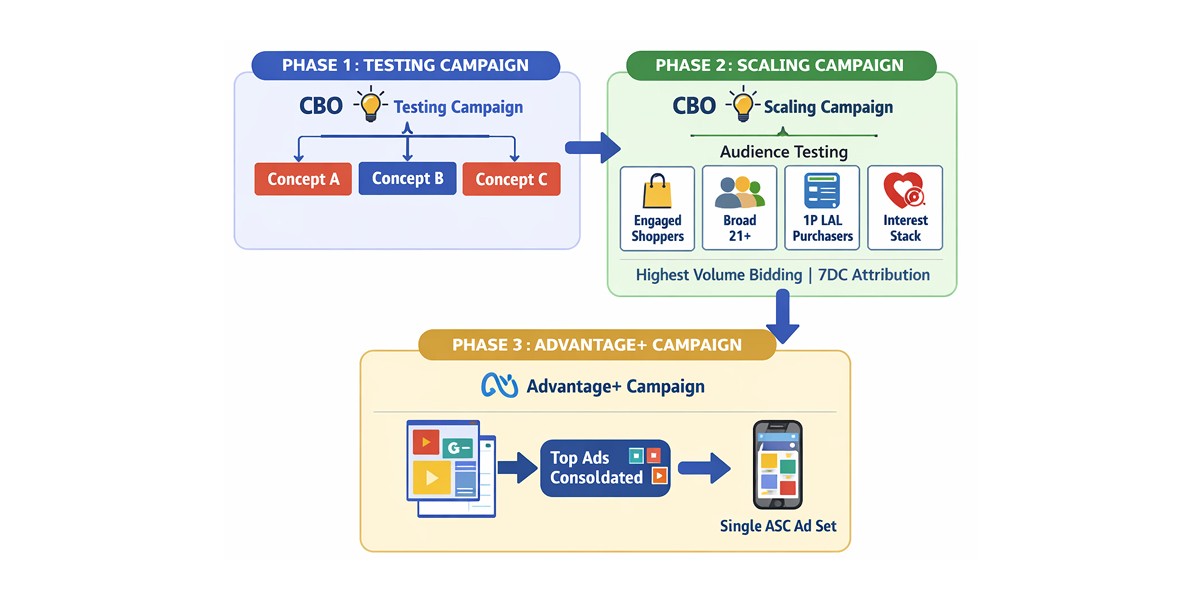
Under $50k/month, consolidate into 1-2 campaigns, segment adsets by concept, budget tests at 3x your target CPA over 7 days, and KPI on a rolling 5-day window at the adset level. Skip cost caps, multiple accounts, and flexible ads. They are distractions that add complexity without adding performance.