How Long Do Facebook Ads Take to Work?

Meta Ads

May 5, 2026

Table Of Contents

No headings found on page


You launched your first Facebook ads, and now you're refreshing Ads Manager every hour wondering why the results look erratic. That anxiety is normal—but acting on it too early is one of the most expensive mistakes advertisers make.

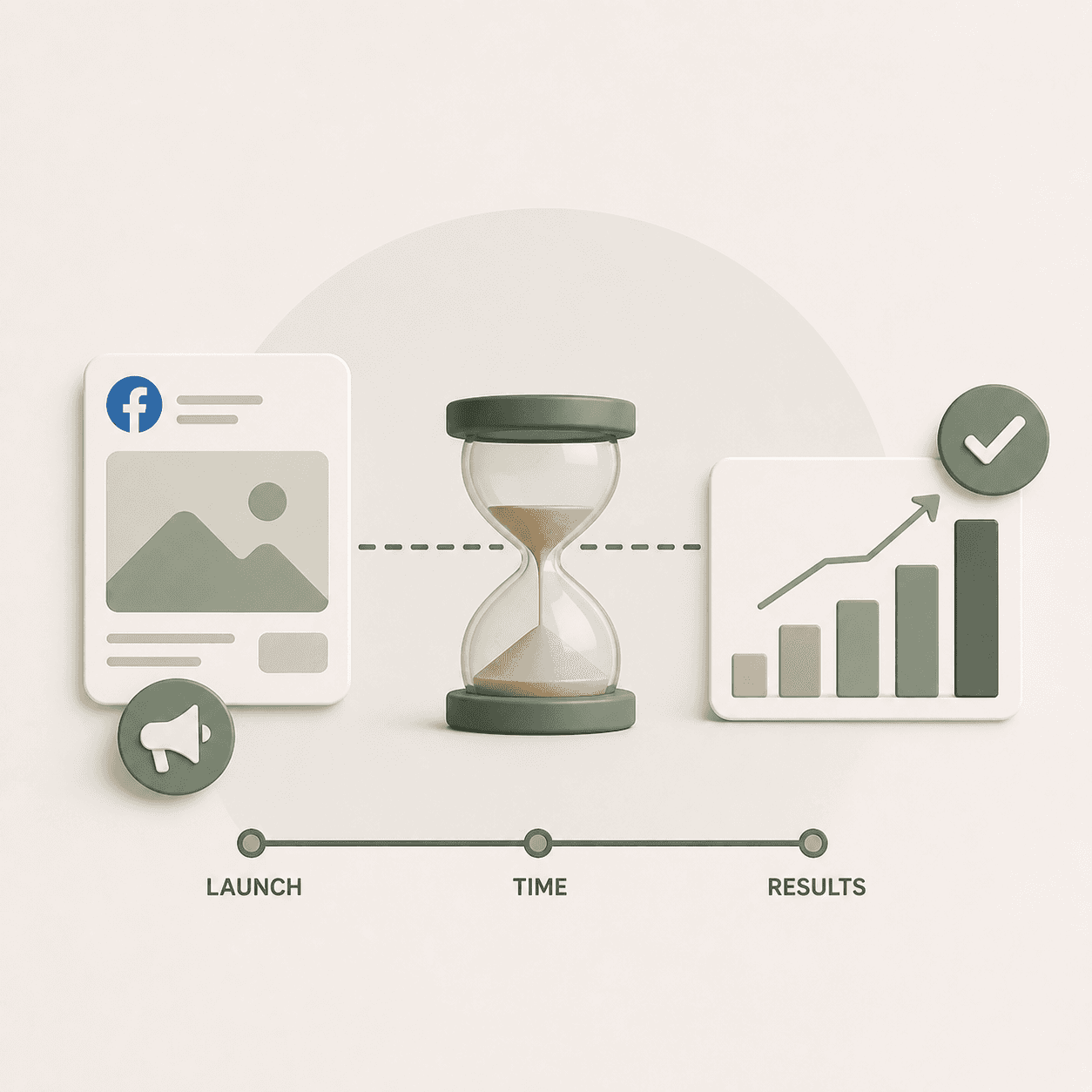
Wondering how long do Facebook ads take to work? Facebook ads typically take 3-7 days to exit the learning phase and start delivering consistent, optimized results. This guide covers exactly what happens during that window, what affects your timeline, and when you actually have enough data to make decisions.

Key takeaways

  • Timeline: Facebook ads typically take 3-7 days to exit the learning phase and start delivering consistent results.

  • Optimization events: The algorithm requires approximately 50 optimization events within 7 days on the adset level before performance stabilizes.

  • Early metrics: Early metrics in the first 72 hours are directional only—avoid making optimization decisions based on this data.

  • Budget impact: Spending below your target CPA extends the learning phase significantly.

  • Long-term success: Long-term profitable performance depends on paid media expertise, creative strategy, and landing page optimization working together.

How the Facebook ads learning phase works

When you launch a new campaign, Meta's algorithm enters what it calls the learning phase. During this period, the system tests your ad against different audience segments to figure out who is most likely to complete your optimization event.

Performance will fluctuate, sometimes dramatically. This is expected behavior, not a sign that something is broken.

The learning phase ends when your ad set accumulates roughly 50 optimization events within a 7-day window. Learn more about Meta ads best practices to set your campaigns up for success from day one.

An optimization event is whatever action you've told Meta to optimize for—purchases, leads, add-to-carts, or link clicks. Until you hit that threshold, the algorithm is still gathering information.

  • Learning phase: Initial period where Meta's algorithm collects data to optimize ad delivery, typically lasting 3-7 days.

  • Optimization event: Specific action (purchase, lead, etc.) you've selected as your campaign goal.

  • Learning limited: Status indicating insufficient optimization events to exit learning.

If your ad set shows "learning limited," the algorithm cannot optimize effectively. You'll see inconsistent delivery and higher costs until you address the underlying constraint, whether that's budget, audience size, or conversion rate.

What to expect in the first 72 hours

The first three days are about data collection, not performance evaluation. Your ads will start delivering impressions within hours of approval, but the metrics you see during this window are preliminary at best.

CPMs (cost per 1,000 impressions) may spike. CTRs (click-through rates) may swing wildly from hour to hour. Conversion data will be sparse.

All of this happens because the algorithm is testing different placements, times of day, and audience segments to find what works.

Do not make changes during this period. Editing your budget, creative, or targeting resets the learning phase and wastes the data you've already paid for. Watch the numbers, take notes, but keep your hands off the account.

What to expect after 7 days

By day seven, most ad sets with adequate budget will exit the learning phase. You'll see "Active" status in Ads Manager instead of "Learning," and performance metrics will stabilize into a more predictable pattern.

This is when you can start making directional judgments about performance. Are your CPAs (cost per acquisition) within acceptable range? Is your ROAS (return on ad spend, calculated as revenue divided by ad spend) trending toward your target?

If the answer is no after a full week of stable delivery, the issue is typically creative, offer, or landing page—not the algorithm. One week gives you enough data to identify which ads are working and which are not, though it's still too early for confident scaling decisions.

What results look like after 30 days

The first month is where you transition from learning to optimization. By now, you've accumulated enough conversion data to understand true performance patterns rather than just early signals.

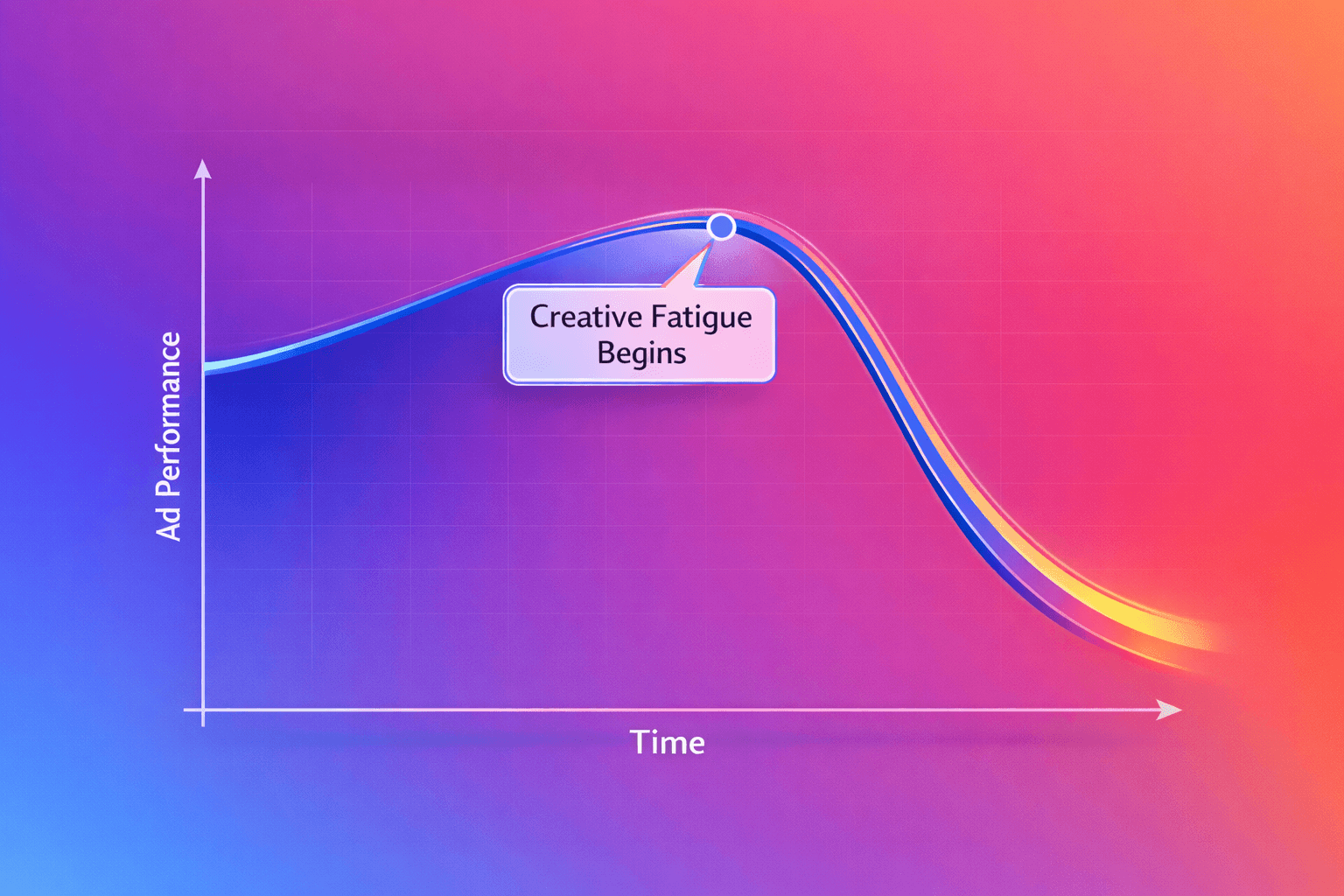
This is also when creative fatigue begins to appear. Ads that performed well in week one may show declining CTRs and rising CPAs by week four.

The audience has seen your ads multiple times, and the novelty has worn off. Plan for creative refresh cycles every 2-4 weeks, depending on your audience size and how quickly frequency builds.

After 30 days, you can evaluate whether your unit economics actually work. If your MER is healthy and your blended CPA is sustainable, you're ready to scale. See our guide on determining your target ROAS for help setting the right benchmarks.

If not, the answer is rarely "spend more." It's usually "fix the creative or the landing page."

How budget affects your Facebook ads timeline

Your daily budget determines how quickly you accumulate optimization events. The math here is straightforward.

If your target CPA is $50 and you're spending $25 per day, you might get one conversion per day on a good day. At that rate, reaching 50 optimization events takes nearly two months. Meanwhile, you're paying for inefficient delivery the entire time.

Daily Budget Relative to Target CPA

Expected Timeline to Exit Learning

Below target CPA

2-4 weeks or longer

1-2x target CPA

7-14 days

3x+ target CPA

3-7 days

A general guideline: budget at least 1-2x your target CPA per day to exit learning within a reasonable timeframe. Anything less extends the period of inefficiency and delays your ability to make informed decisions.


You launched your first Facebook ads, and now you're refreshing Ads Manager every hour wondering why the results look erratic. That anxiety is normal—but acting on it too early is one of the most expensive mistakes advertisers make.

Wondering how long do Facebook ads take to work? Facebook ads typically take 3-7 days to exit the learning phase and start delivering consistent, optimized results. This guide covers exactly what happens during that window, what affects your timeline, and when you actually have enough data to make decisions.

Key takeaways

  • Timeline: Facebook ads typically take 3-7 days to exit the learning phase and start delivering consistent results.

  • Optimization events: The algorithm requires approximately 50 optimization events within 7 days on the adset level before performance stabilizes.

  • Early metrics: Early metrics in the first 72 hours are directional only—avoid making optimization decisions based on this data.

  • Budget impact: Spending below your target CPA extends the learning phase significantly.

  • Long-term success: Long-term profitable performance depends on paid media expertise, creative strategy, and landing page optimization working together.

How the Facebook ads learning phase works

When you launch a new campaign, Meta's algorithm enters what it calls the learning phase. During this period, the system tests your ad against different audience segments to figure out who is most likely to complete your optimization event.

Performance will fluctuate, sometimes dramatically. This is expected behavior, not a sign that something is broken.

The learning phase ends when your ad set accumulates roughly 50 optimization events within a 7-day window. Learn more about Meta ads best practices to set your campaigns up for success from day one.

An optimization event is whatever action you've told Meta to optimize for—purchases, leads, add-to-carts, or link clicks. Until you hit that threshold, the algorithm is still gathering information.

  • Learning phase: Initial period where Meta's algorithm collects data to optimize ad delivery, typically lasting 3-7 days.

  • Optimization event: Specific action (purchase, lead, etc.) you've selected as your campaign goal.

  • Learning limited: Status indicating insufficient optimization events to exit learning.

If your ad set shows "learning limited," the algorithm cannot optimize effectively. You'll see inconsistent delivery and higher costs until you address the underlying constraint, whether that's budget, audience size, or conversion rate.

What to expect in the first 72 hours

The first three days are about data collection, not performance evaluation. Your ads will start delivering impressions within hours of approval, but the metrics you see during this window are preliminary at best.

CPMs (cost per 1,000 impressions) may spike. CTRs (click-through rates) may swing wildly from hour to hour. Conversion data will be sparse.

All of this happens because the algorithm is testing different placements, times of day, and audience segments to find what works.

Do not make changes during this period. Editing your budget, creative, or targeting resets the learning phase and wastes the data you've already paid for. Watch the numbers, take notes, but keep your hands off the account.

What to expect after 7 days

By day seven, most ad sets with adequate budget will exit the learning phase. You'll see "Active" status in Ads Manager instead of "Learning," and performance metrics will stabilize into a more predictable pattern.

This is when you can start making directional judgments about performance. Are your CPAs (cost per acquisition) within acceptable range? Is your ROAS (return on ad spend, calculated as revenue divided by ad spend) trending toward your target?

If the answer is no after a full week of stable delivery, the issue is typically creative, offer, or landing page—not the algorithm. One week gives you enough data to identify which ads are working and which are not, though it's still too early for confident scaling decisions.

What results look like after 30 days

The first month is where you transition from learning to optimization. By now, you've accumulated enough conversion data to understand true performance patterns rather than just early signals.

This is also when creative fatigue begins to appear. Ads that performed well in week one may show declining CTRs and rising CPAs by week four.

The audience has seen your ads multiple times, and the novelty has worn off. Plan for creative refresh cycles every 2-4 weeks, depending on your audience size and how quickly frequency builds.

After 30 days, you can evaluate whether your unit economics actually work. If your MER is healthy and your blended CPA is sustainable, you're ready to scale. See our guide on determining your target ROAS for help setting the right benchmarks.

If not, the answer is rarely "spend more." It's usually "fix the creative or the landing page."

How budget affects your Facebook ads timeline

Your daily budget determines how quickly you accumulate optimization events. The math here is straightforward.

If your target CPA is $50 and you're spending $25 per day, you might get one conversion per day on a good day. At that rate, reaching 50 optimization events takes nearly two months. Meanwhile, you're paying for inefficient delivery the entire time.

Daily Budget Relative to Target CPA

Expected Timeline to Exit Learning

Below target CPA

2-4 weeks or longer

1-2x target CPA

7-14 days

3x+ target CPA

3-7 days

A general guideline: budget at least 1-2x your target CPA per day to exit learning within a reasonable timeframe. Anything less extends the period of inefficiency and delays your ability to make informed decisions.

Want this playbook run for you?

Book a call and get a free audit today.

What slows down Facebook ad performance

Several common mistakes delay results or prevent ads from ever reaching stable performance. Most of them are avoidable with the right setup from the start.

Running weak creative without a testing framework

Creative is the single largest lever in Meta advertising, with 70–80% of ad performance driven by creative quality. Our guide to Meta ads creative strategies covers the frameworks that drive results. Yet many advertisers upload a handful of ads and hope for the best.

Without structured hook testing—systematically varying the first 2-3 seconds of video or the headline of static ads—you're essentially guessing.

The fix is a testing methodology grounded in a strong creative brief. Launch 3-5 creative variations per concept. Measure hook rate (watch past the first few seconds) and hold rate (how long they continue watching), then iterate on winners.

Random creative uploads lead to random results.

Ignoring landing page conversion rates

Your ads can drive qualified traffic all day, but if your landing page converts at 1% instead of 3%, your CPA triples. We've seen accounts where the "ad problem" was actually a landing page problem—slow load times—a 1-second delay reduces conversions by 7%—unclear value propositions, or unnecessary friction in the checkout flow.

Landing page optimization is not separate from ad performance. The two are interdependent, and ignoring one undermines the other.

Editing campaigns too frequently

Every significant edit restarts the learning phase. This includes:

  • Changing bid strategy or optimization event

  • Adjusting budget by more than 20% in a single day

  • Adding new creative to an existing ad set

  • Pausing for more than 7 days

  • Making significant audience changes

If you're making daily tweaks, you're perpetually resetting the algorithm and never reaching stable performance. Patience during the learning phase pays off.

Underspending relative to your audience size

Small budgets with broad audiences mean the algorithm never gathers enough signal to optimize effectively. On the flip side, small budgets with narrow audiences lead to rapid frequency buildup and audience exhaustion. Match your budget to your audience size and conversion expectations.

Metrics to watch in the first week

Early indicators help you understand whether your ads are directionally sound, even before you have meaningful conversion data. Here's what to pay attention to and what each metric tells you.

  • CTR (Click-Through Rate) Percentage of impressions resulting in clicks. Above 1% indicates creative resonance; below 0.5% suggests weak hook.

  • CPC (Cost Per Click) Cost per click. Compare to expected CPA to validate unit economics.

  • CPM (Cost Per Mille) Cost per 1,000 impressions. High CPMs indicate competitive auctions or low relevance.

  • Frequency Average times each person sees your ad. Above 2-3 in week one suggests narrow audience or high budget.

  • First-Time Impression Ratio Percentage of impressions to new viewers. Declining ratio indicates audience saturation.

How long to test a Facebook ad before turning it off

Premature kill decisions waste data and budget. Turning off an ad too early means you never learn whether it could have worked with more time or spend.

Here's a framework for minimum thresholds before making a decision:

  • Minimum time: 3-5 days of stable delivery, not counting learning phase fluctuations

  • Minimum spend: At least 2-3x your target CPA per ad variation

  • Minimum impressions: 1,000+ impressions before judging CTR

If an ad hasn't spent at least 2x your target CPA, you don't have enough data to confidently call it a loser. Patience here prevents false negatives and helps you avoid killing ads that might have become winners.

A realistic timeline: how long do Facebook ads take to work

Timeframe

What to Expect

What to Do

First 72 hours

Volatile metrics, algorithm testing

Monitor only—do not edit

Days 4-7

Stabilizing delivery, learning phase ending

Begin directional analysis

Weeks 2-4

True performance patterns emerge

Optimize based on data, refresh creative

Months 2-3

Scaling or iteration decisions

Scale winners, test new angles, improve landing pages

What separates fast results from wasted spend

Speed to results depends on three factors: paid media expertise, creative strategy, and landing page optimization. Each must work together—structuring campaigns correctly, testing hooks and angles, and converting the traffic you're paying for.

When any one of these operates in isolation—or worse, when one is ignored entirely—you get slow learning phases, inconsistent performance, and wasted budget. When all three work together, you compress timelines and scale profitably.

At Flighted, we bring paid media expertise, creative strategy, and landing page optimization under one team. See our Facebook ads management services to learn how we work. If you're spending $20K-$500K per month on Meta and want to stop guessing, book a call to talk through your setup.

FAQs about Facebook ads timelines

Is $20 a day enough budget for Facebook ads to work?

Understanding how long Facebook ads take to work helps set realistic expectations for budget planning.

It depends on your target CPA. If you're aiming for $50 conversions, $20 per day means roughly one conversion every 2-3 days, which extends your learning phase to several weeks. For faster results, budget at least 1-2x your target CPA daily.

What happens if my Facebook ad set never exits the learning phase?

You'll see "learning limited" status, which means the algorithm can't optimize effectively. The typical fixes are consolidating ad sets to concentrate spend, increasing budget, or broadening your audience to give the algorithm more room to find converters.

How does Advantage+ affect how long Facebook ads take to work?

Advantage+ campaigns often exit learning faster because they use broader targeting and let the algorithm find converters across Meta's full inventory, delivering approximately 32% lower CPA than manually configured campaigns. Read our breakdown of the best Meta ads account structure to see how to set this up correctly. However, results still depend on creative quality and landing page performance.

Advantage+ doesn't fix weak fundamentals.

Do Facebook ads work faster for retargeting than prospecting?

How long Facebook ads take to work varies by audience type. Retargeting typically shows faster initial results because you're reaching people who already know your brand. But retargeting audiences are small and exhaust quickly.

Prospecting is slower to stabilize but required for sustainable scale over time.

Related Posts

Related Posts

Related Posts

Related Posts

Ready to talk?

Book A Call

We are a Paid Media agency based in New York, NY.
Flighted

New York, NY 11217

hello@flighted.co

© Flighted, 2026

Ready to talk?

Book A Call

We are a Paid Media agency based in New York, NY.

Flighted

New York, NY 11217

hello@flighted.co

© Flighted, 2026