Upper Funnel Meta Ads Strategy: A 2026 Guide
Meta Ads
July 16, 2026

Table Of Contents
Most Meta advertisers pour budget into bottom-funnel campaigns, then wonder why CPAs keep climbing and retargeting pools keep shrinking. A sound upper funnel meta ads strategy fixes this. The math is simple: without consistent prospecting, you're fishing in an ever-smaller pond.
Upper funnel Meta ads solve this by reaching cold audiences who've never heard of you. The goal is not to convert them today, but to fill the pipeline that feeds tomorrow's sales. This guide covers the objectives, targeting, creative, and measurement approaches that make TOFU campaigns actually work in 2026.
Key Takeaways
Focus on discovery and education: Allocate 10–20% of total ad spend to TOFU campaigns.
Choose awareness objectives: Use Awareness, Reach, or Video Views instead of conversion optimization.
Leverage broad targeting: Advantage+ audiences often outperform hyper-specific interest stacking.
Measure with MER lift: Track retargeting pool growth and first-time impression ratio.
Prioritize creative: Cold audiences need stronger hooks, higher volume, and faster refresh cycles.
What Upper Funnel Meta Ads Actually Mean Right Now
Upper funnel Meta ads focus on discovery and education rather than immediate purchases. You're reaching cold audiences—people who have never seen your brand before—and the goal is introducing your product, not closing a sale today.
The funnel breaks down into three stages. Upper funnel (TOFU) introduces your brand to strangers. Middle funnel (MOFU) engages people who've shown some interest.
Bottom funnel (BOFU) converts warm prospects into customers.
Cold traffic: Users with zero prior exposure to your brand
Warm traffic: Users who've visited your site, watched a video, or engaged with an ad
Prospecting: Finding and reaching new potential customers who don't know you yet
Why Upper Funnel Meta Ads Matter More Than Ever
Without consistent prospecting, your retargeting pools shrink. When you only target warm audiences, CPAs rise because you're competing for a smaller and smaller group of people who already know you.
iOS privacy changes made retargeting audiences smaller and less accurate than they were a few years ago. Meanwhile, Meta's algorithm performs better when it has signal volume from broader reach campaigns feeding downstream conversions. For a broader look at full-funnel Meta ads strategy, see this overview of how TOFU fits the larger picture.
Think of TOFU as pipeline health. Starve it, and your entire funnel suffers within 4–6 weeks.
How Advantage+ and Broad Targeting Changed the Playbook
Meta's Advantage+ audience expansion has shifted TOFU strategy away from hyper-specific interest stacking. Advantage+ Audience allows Meta to expand beyond your targeting inputs when it predicts better results.
In practice, the algorithm often outperforms manual targeting for cold prospecting. However, this only works when you give it enough creative variation and strong pixel data. If you're running three creatives to a narrow interest stack, you're fighting the platform instead of working with it.
When does Advantage+ make sense? You have 5+ active creatives, your pixel has 50+ weekly conversions, and you're willing to let Meta find pockets you wouldn't have targeted manually.
How to Build Your Upper Funnel Meta Ads Strategy Step by Step
1. Define Your Upper Funnel Goal Beyond ROAS
ROAS (Return on Ad Spend) is the wrong primary KPI for TOFU. You're not optimizing for immediate purchases—you're filling the top of your funnel. Read our guide on how to calculate target ROAS to set the right benchmarks for each funnel stage.
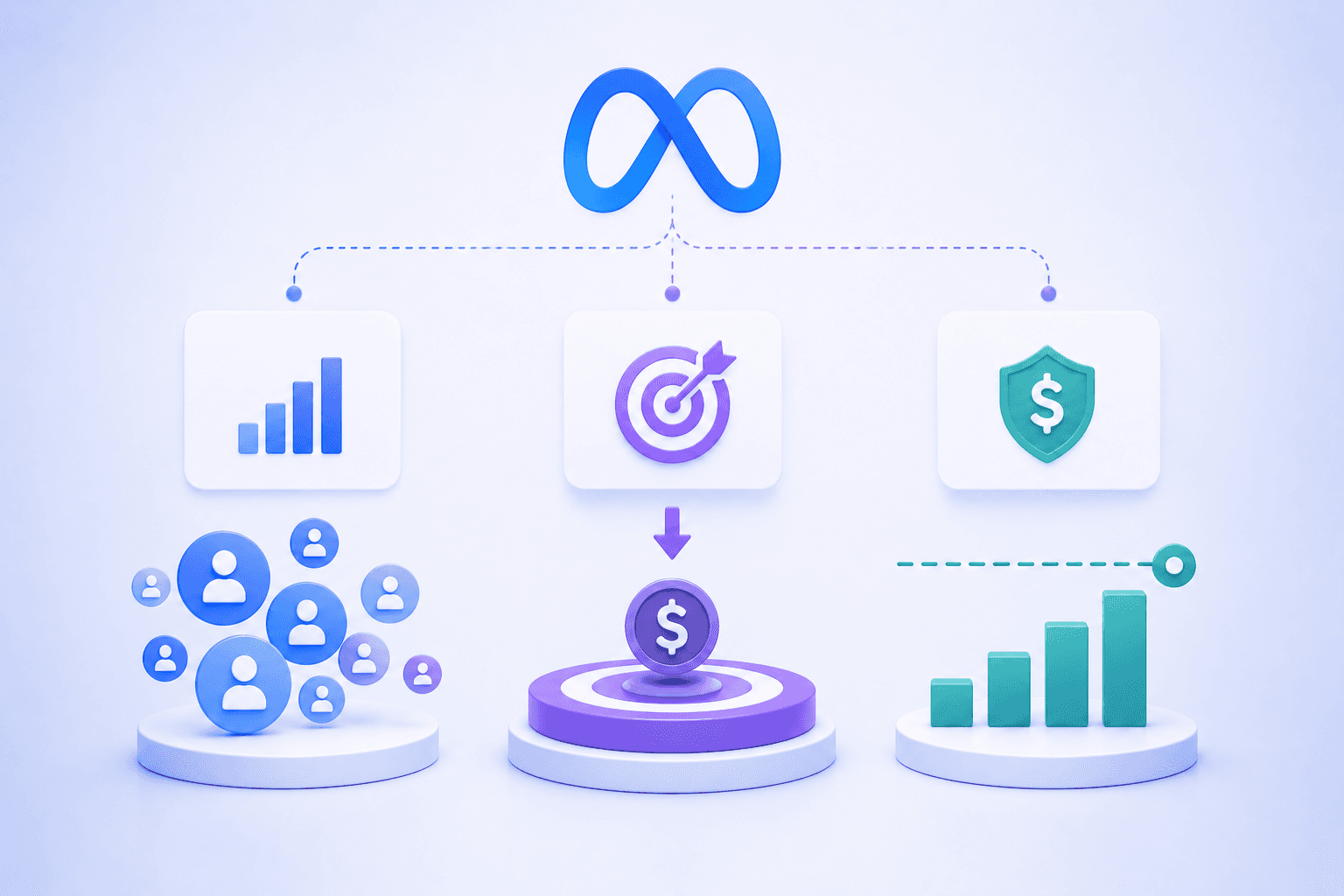
Better goals include reach efficiency, retargeting pool growth, and MER lift. MER stands for Marketing Efficiency Ratio, which measures total revenue divided by total ad spend across all channels. MER shows whether your TOFU investment improves overall efficiency even when campaign-level ROAS looks weak.
2. Choose the Right Campaign Objective
Objective selection determines how Meta's algorithm optimizes delivery. For upper funnel, you want reach and engagement rather than purchases. The next section covers specific objectives in detail.
3. Set Your Audience Structure
Audience targeting for cold traffic differs fundamentally from retargeting. You're finding new people, not re-engaging existing prospects. The audience section below walks through each targeting type.
4. Build Your Creative Testing Pool
Upper funnel requires higher creative volume because cold audiences scroll faster and require more hooks to stop. Plan for 5–10 active creatives minimum, with new concepts shipping every 2–3 weeks.
5. Ship a Mobile-First Landing Page for Cold Traffic
Cold traffic landing pages do more educational work than retargeting pages. Visitors don't know you yet. Aim for fast load speed (under 3 seconds), a clear value proposition above the fold, and social proof for unfamiliar visitors.
Our Meta ads best practices guide covers landing page alignment in more detail.
Paid media, creative, and landing page optimization work as an interdependent system here. A strong ad that sends cold traffic to a slow or confusing page wastes your prospecting budget.
6. Wire Measurement to MER and Incrementality
Upper funnel requires different measurement than BOFU. Incrementality testing uses holdout tests to measure true lift from your ads. Learn more in our guide to incrementality testing fundamentals.
It shows whether TOFU spend drives new customers or just captures people who would have converted anyway.
Track blended MER weekly. If MER improves as TOFU spend increases, your upper funnel is working even when campaign-level ROAS looks soft.
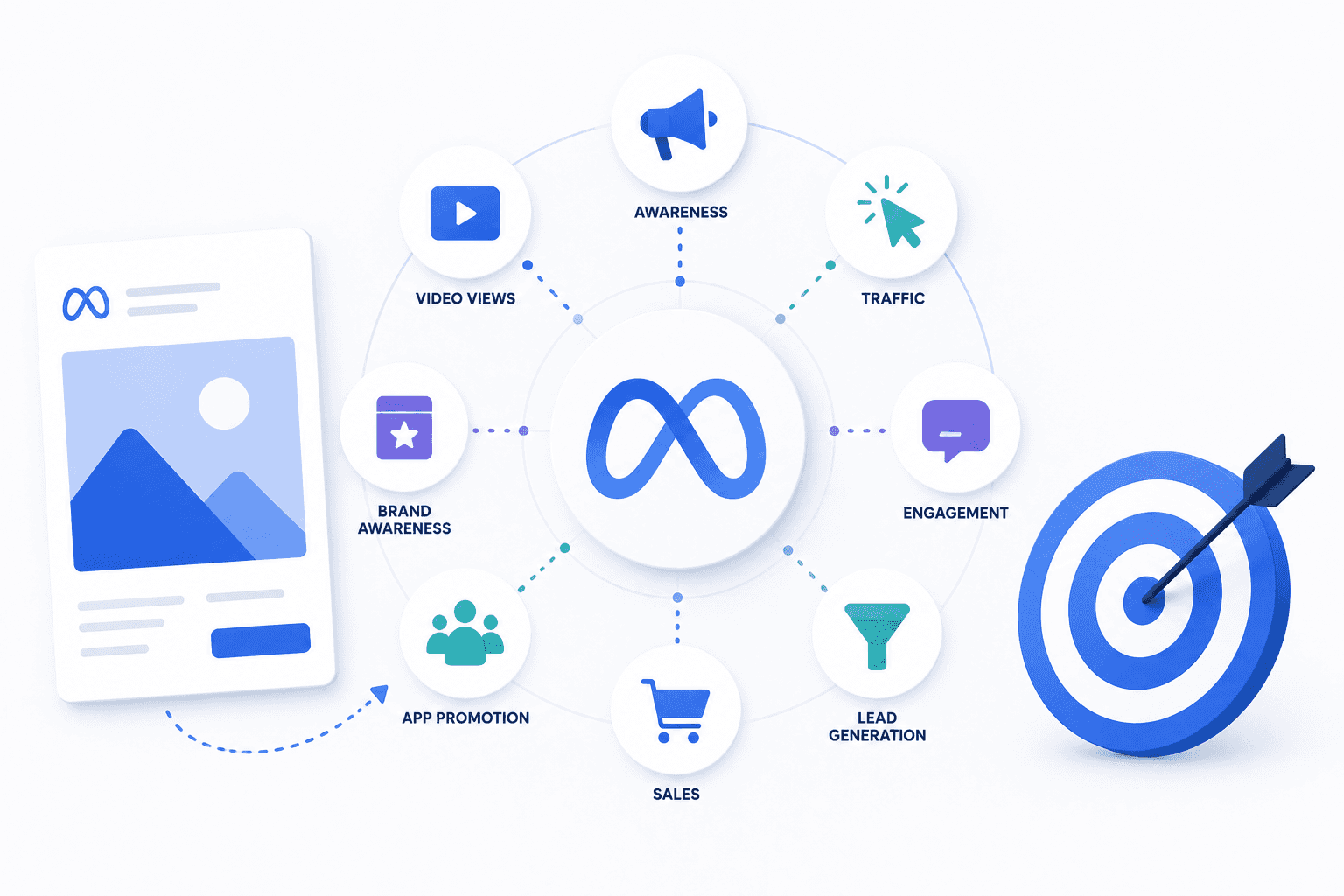
Campaign Objectives for Upper Funnel Meta Ads
Objective | Best For | Optimizes For | When to Use |
|---|---|---|---|
Awareness | Brand recall | Ad recall lift | Launching new products or entering new markets |
Reach | Maximum unique impressions | Unique reach within audience | Broad prospecting with frequency caps |
Video Views | Building retargeting pools | ThruPlay (15+ seconds) | When you have strong video creative |
Engagement | Social proof accumulation | Likes, comments, shares | Early-stage brands building credibility |
One note on Engagement: optimizing for vanity metrics can attract low-intent users. Use it sparingly and monitor downstream conversion rates.
Audience Targeting for Upper Funnel Meta Ads
Broad Audiences with Advantage+ Audience
Advantage+ Audience lets Meta expand beyond your inputs when it predicts better results. Trust it when you have sufficient creative volume and strong pixel data. Constrain it when you're testing specific hypotheses about who responds to your product.
Interest and Behavior Stacks
Stack multiple related interests rather than using single narrow interests. A stack of 5–8 related interests gives the algorithm room to find responsive pockets without over-segmenting your audience.
Lookalike Audiences Based on High-Value Customers
Build lookalikes from purchase or high-LTV customer seed lists rather than email subscribers or page visitors. Start with 1–3% lookalikes for tighter targeting, then expand to 5–10% as you scale.
Exclusion Audiences to Protect Efficiency
Exclude existing customers, recent purchasers (last 30–60 days), and current retargeting audiences from TOFU campaigns. See our guide to Facebook Ads retargeting strategy for how to structure those downstream campaigns. Otherwise, you're paying to reach people who already know you.
Creative Strategy for Upper Funnel Meta Ads
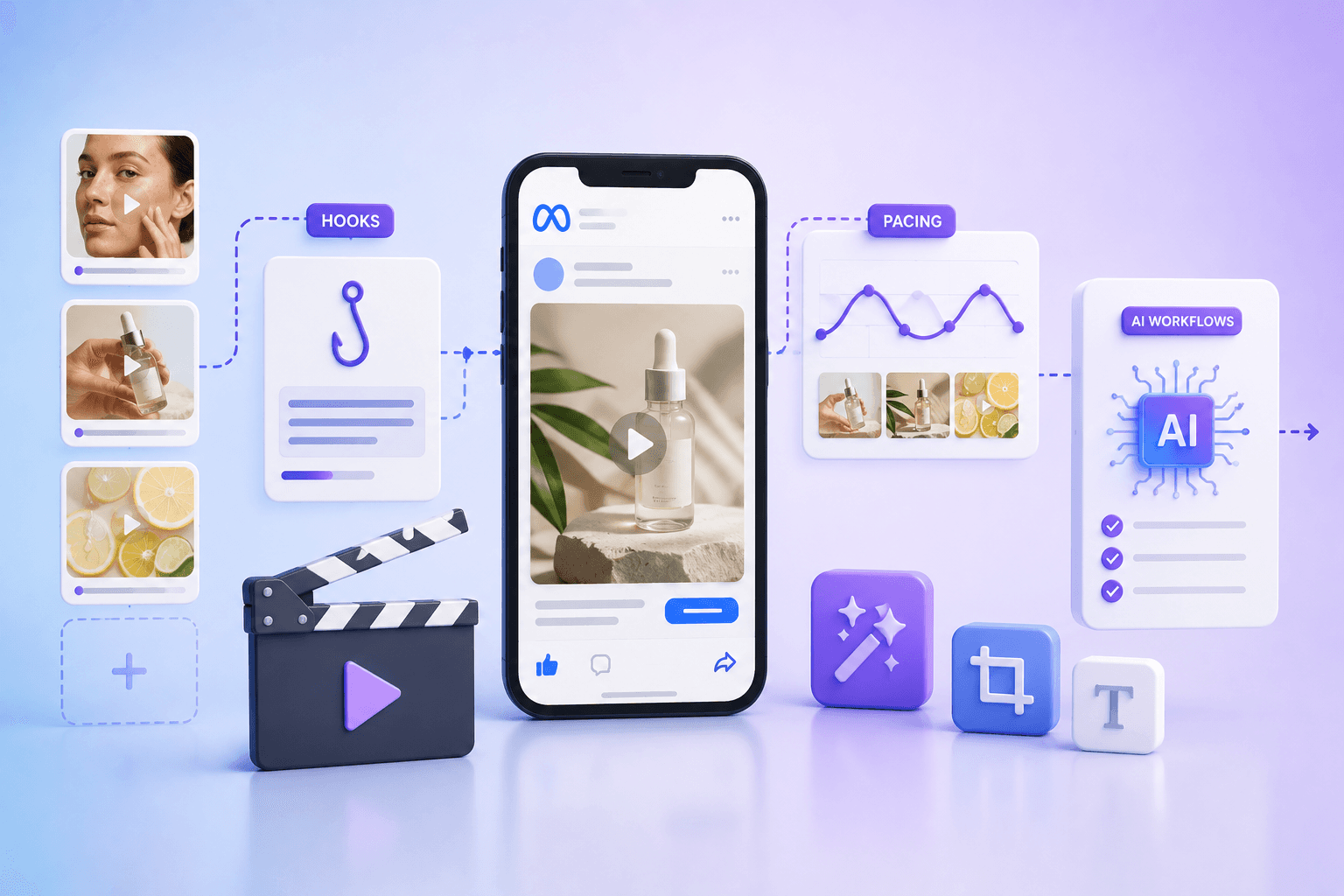
Creative is the primary lever for TOFU performance. The algorithm requires creative variety to find responsive pockets within broad audiences. See 7 Meta Ads Creative Strategies That Work for a deeper look at creative approaches.
Hook Rate and the First Two Seconds
Hook rate measures the percentage of viewers who watch past the first 2–3 seconds. Cold audiences scroll faster than warm audiences, so your hooks work harder here. Test multiple hook variations per concept—same body, different openings.
UGC and AI Voiceover VSLs
UGC-style video and AI voiceover VSLs (Video Sales Letters) perform well for TOFU because they feel native and build trust with unfamiliar viewers. They don't look like ads, which matters when someone has never heard of you.
Direct Response Statics and Carousels
Not all TOFU requires video. Static images with clear visual products and strong headlines work well. Educational carousel sequences can walk cold audiences through your value proposition in a swipeable format.
Creative Volume and Refresh Cadence
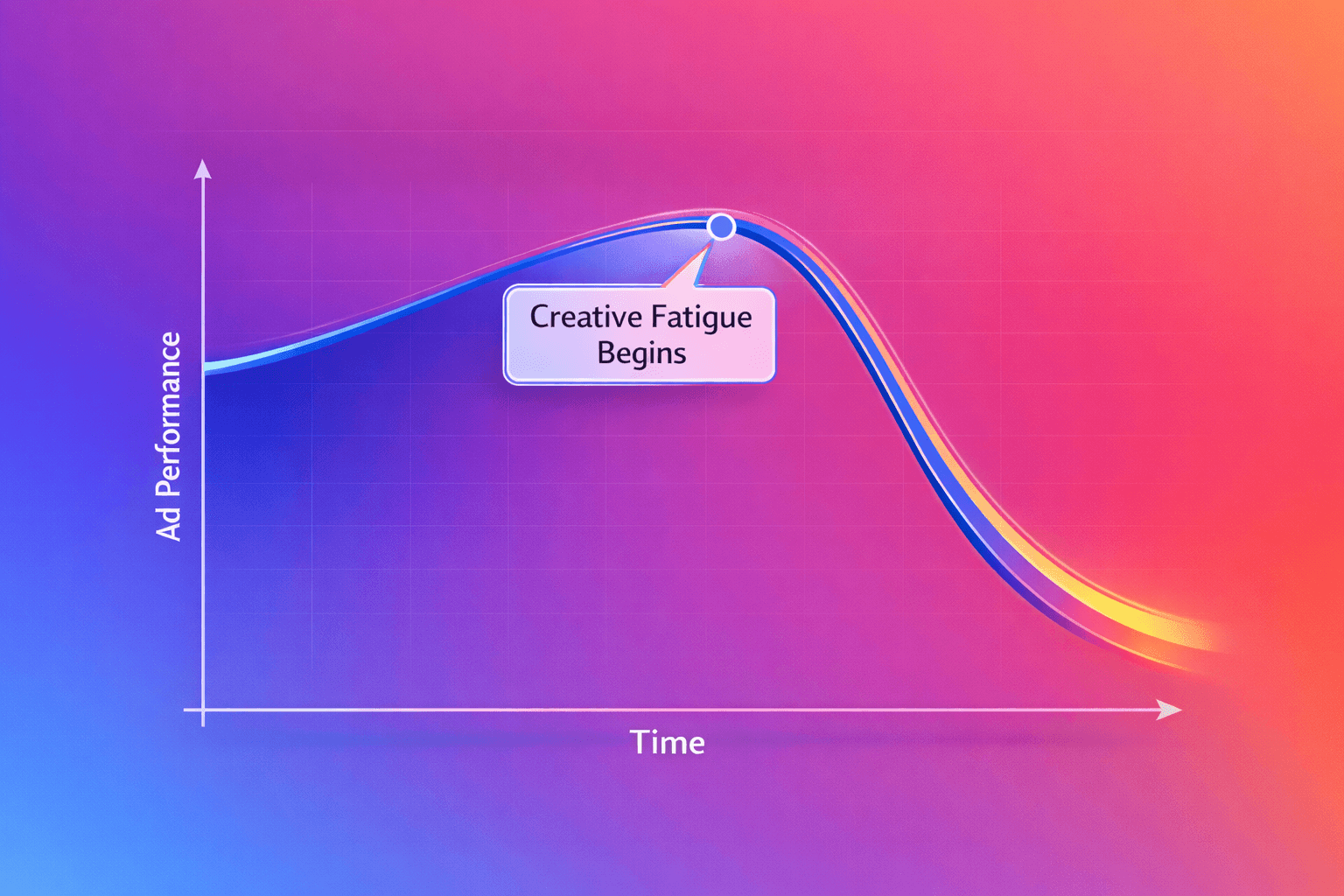
TOFU campaigns burn through creative faster due to broader reach. Plan for 5–10 active creatives with a 2–3 week refresh cycle. Watch for fatigue signals: rising frequency, declining CTR, and increasing CPM.
Most Meta advertisers pour budget into bottom-funnel campaigns, then wonder why CPAs keep climbing and retargeting pools keep shrinking. A sound upper funnel meta ads strategy fixes this. The math is simple: without consistent prospecting, you're fishing in an ever-smaller pond.
Upper funnel Meta ads solve this by reaching cold audiences who've never heard of you. The goal is not to convert them today, but to fill the pipeline that feeds tomorrow's sales. This guide covers the objectives, targeting, creative, and measurement approaches that make TOFU campaigns actually work in 2026.
Key Takeaways
Focus on discovery and education: Allocate 10–20% of total ad spend to TOFU campaigns.
Choose awareness objectives: Use Awareness, Reach, or Video Views instead of conversion optimization.
Leverage broad targeting: Advantage+ audiences often outperform hyper-specific interest stacking.
Measure with MER lift: Track retargeting pool growth and first-time impression ratio.
Prioritize creative: Cold audiences need stronger hooks, higher volume, and faster refresh cycles.
What Upper Funnel Meta Ads Actually Mean Right Now
Upper funnel Meta ads focus on discovery and education rather than immediate purchases. You're reaching cold audiences—people who have never seen your brand before—and the goal is introducing your product, not closing a sale today.
The funnel breaks down into three stages. Upper funnel (TOFU) introduces your brand to strangers. Middle funnel (MOFU) engages people who've shown some interest.
Bottom funnel (BOFU) converts warm prospects into customers.
Cold traffic: Users with zero prior exposure to your brand
Warm traffic: Users who've visited your site, watched a video, or engaged with an ad
Prospecting: Finding and reaching new potential customers who don't know you yet
Why Upper Funnel Meta Ads Matter More Than Ever
Without consistent prospecting, your retargeting pools shrink. When you only target warm audiences, CPAs rise because you're competing for a smaller and smaller group of people who already know you.
iOS privacy changes made retargeting audiences smaller and less accurate than they were a few years ago. Meanwhile, Meta's algorithm performs better when it has signal volume from broader reach campaigns feeding downstream conversions. For a broader look at full-funnel Meta ads strategy, see this overview of how TOFU fits the larger picture.
Think of TOFU as pipeline health. Starve it, and your entire funnel suffers within 4–6 weeks.
How Advantage+ and Broad Targeting Changed the Playbook
Meta's Advantage+ audience expansion has shifted TOFU strategy away from hyper-specific interest stacking. Advantage+ Audience allows Meta to expand beyond your targeting inputs when it predicts better results.
In practice, the algorithm often outperforms manual targeting for cold prospecting. However, this only works when you give it enough creative variation and strong pixel data. If you're running three creatives to a narrow interest stack, you're fighting the platform instead of working with it.
When does Advantage+ make sense? You have 5+ active creatives, your pixel has 50+ weekly conversions, and you're willing to let Meta find pockets you wouldn't have targeted manually.
How to Build Your Upper Funnel Meta Ads Strategy Step by Step
1. Define Your Upper Funnel Goal Beyond ROAS
ROAS (Return on Ad Spend) is the wrong primary KPI for TOFU. You're not optimizing for immediate purchases—you're filling the top of your funnel. Read our guide on how to calculate target ROAS to set the right benchmarks for each funnel stage.
Better goals include reach efficiency, retargeting pool growth, and MER lift. MER stands for Marketing Efficiency Ratio, which measures total revenue divided by total ad spend across all channels. MER shows whether your TOFU investment improves overall efficiency even when campaign-level ROAS looks weak.
2. Choose the Right Campaign Objective
Objective selection determines how Meta's algorithm optimizes delivery. For upper funnel, you want reach and engagement rather than purchases. The next section covers specific objectives in detail.
3. Set Your Audience Structure
Audience targeting for cold traffic differs fundamentally from retargeting. You're finding new people, not re-engaging existing prospects. The audience section below walks through each targeting type.
4. Build Your Creative Testing Pool
Upper funnel requires higher creative volume because cold audiences scroll faster and require more hooks to stop. Plan for 5–10 active creatives minimum, with new concepts shipping every 2–3 weeks.
5. Ship a Mobile-First Landing Page for Cold Traffic
Cold traffic landing pages do more educational work than retargeting pages. Visitors don't know you yet. Aim for fast load speed (under 3 seconds), a clear value proposition above the fold, and social proof for unfamiliar visitors.
Our Meta ads best practices guide covers landing page alignment in more detail.
Paid media, creative, and landing page optimization work as an interdependent system here. A strong ad that sends cold traffic to a slow or confusing page wastes your prospecting budget.
6. Wire Measurement to MER and Incrementality
Upper funnel requires different measurement than BOFU. Incrementality testing uses holdout tests to measure true lift from your ads. Learn more in our guide to incrementality testing fundamentals.
It shows whether TOFU spend drives new customers or just captures people who would have converted anyway.
Track blended MER weekly. If MER improves as TOFU spend increases, your upper funnel is working even when campaign-level ROAS looks soft.
Campaign Objectives for Upper Funnel Meta Ads
Objective | Best For | Optimizes For | When to Use |
|---|---|---|---|
Awareness | Brand recall | Ad recall lift | Launching new products or entering new markets |
Reach | Maximum unique impressions | Unique reach within audience | Broad prospecting with frequency caps |
Video Views | Building retargeting pools | ThruPlay (15+ seconds) | When you have strong video creative |
Engagement | Social proof accumulation | Likes, comments, shares | Early-stage brands building credibility |
One note on Engagement: optimizing for vanity metrics can attract low-intent users. Use it sparingly and monitor downstream conversion rates.
Audience Targeting for Upper Funnel Meta Ads
Broad Audiences with Advantage+ Audience
Advantage+ Audience lets Meta expand beyond your inputs when it predicts better results. Trust it when you have sufficient creative volume and strong pixel data. Constrain it when you're testing specific hypotheses about who responds to your product.
Interest and Behavior Stacks
Stack multiple related interests rather than using single narrow interests. A stack of 5–8 related interests gives the algorithm room to find responsive pockets without over-segmenting your audience.
Lookalike Audiences Based on High-Value Customers
Build lookalikes from purchase or high-LTV customer seed lists rather than email subscribers or page visitors. Start with 1–3% lookalikes for tighter targeting, then expand to 5–10% as you scale.
Exclusion Audiences to Protect Efficiency
Exclude existing customers, recent purchasers (last 30–60 days), and current retargeting audiences from TOFU campaigns. See our guide to Facebook Ads retargeting strategy for how to structure those downstream campaigns. Otherwise, you're paying to reach people who already know you.
Creative Strategy for Upper Funnel Meta Ads
Creative is the primary lever for TOFU performance. The algorithm requires creative variety to find responsive pockets within broad audiences. See 7 Meta Ads Creative Strategies That Work for a deeper look at creative approaches.
Hook Rate and the First Two Seconds
Hook rate measures the percentage of viewers who watch past the first 2–3 seconds. Cold audiences scroll faster than warm audiences, so your hooks work harder here. Test multiple hook variations per concept—same body, different openings.
UGC and AI Voiceover VSLs
UGC-style video and AI voiceover VSLs (Video Sales Letters) perform well for TOFU because they feel native and build trust with unfamiliar viewers. They don't look like ads, which matters when someone has never heard of you.
Direct Response Statics and Carousels
Not all TOFU requires video. Static images with clear visual products and strong headlines work well. Educational carousel sequences can walk cold audiences through your value proposition in a swipeable format.
Creative Volume and Refresh Cadence
TOFU campaigns burn through creative faster due to broader reach. Plan for 5–10 active creatives with a 2–3 week refresh cycle. Watch for fatigue signals: rising frequency, declining CTR, and increasing CPM.
Looking for Meta ads support?
We're a small, hardworking, US-based team. Book a call and get a free audit today.
How to Allocate Budget Across the Meta Funnel
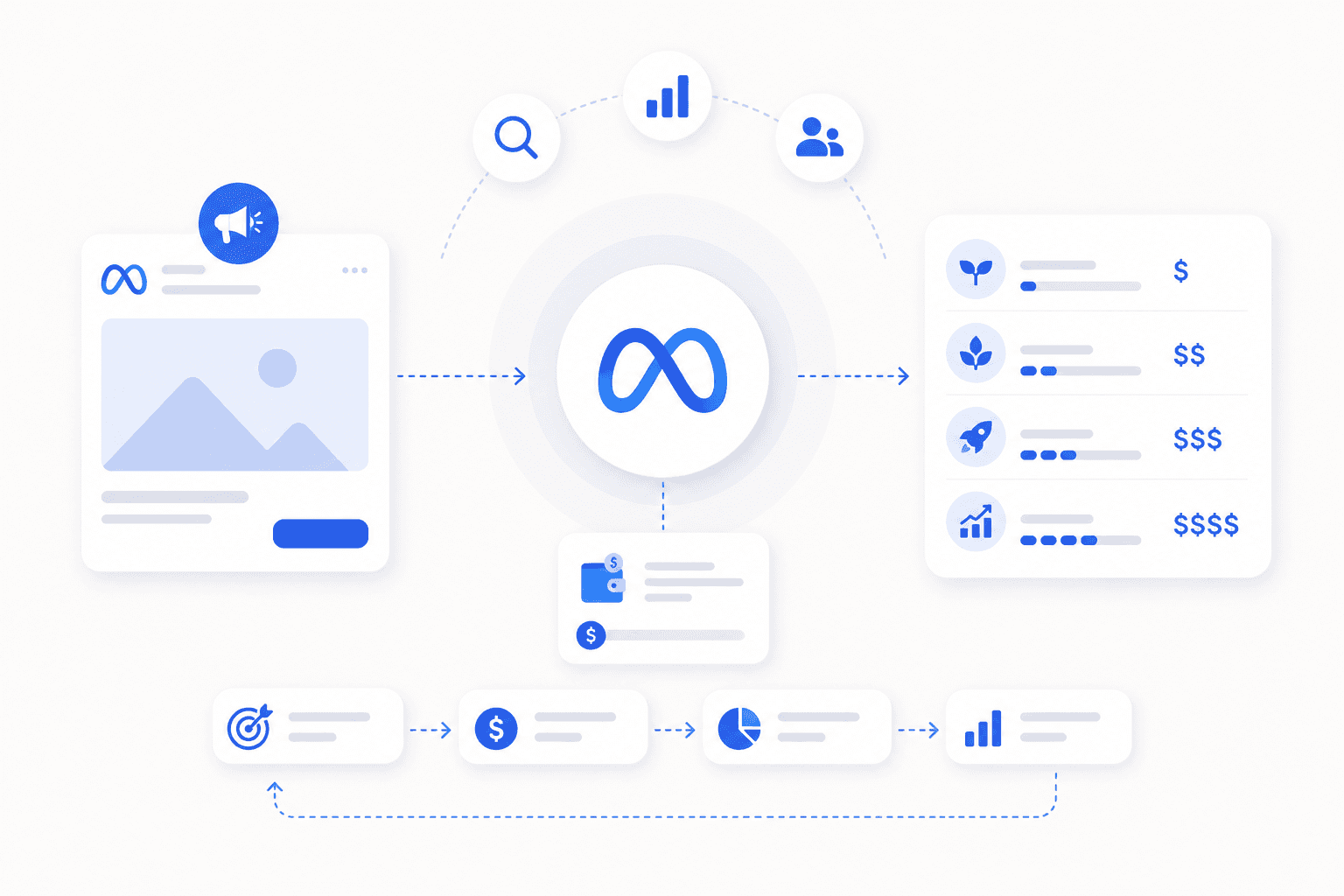
Budget allocation depends on business maturity:
New brand or product launch: 40–50% TOFU, 30% MOFU, 20–30% BOFU
Growth stage with established pixel data: 25–35% TOFU, 25–35% MOFU, 30–40% BOFU
Mature brand with strong retargeting pools: 15–25% TOFU, 25–35% MOFU, 40–50% BOFU
Do not starve TOFU to chase short-term ROAS. The efficiency gains disappear within 4–6 weeks as retargeting pools shrink.
Metrics That Prove Your Upper Funnel Is Working
CPM and Unique Reach
CPM (cost per thousand impressions) tells you whether you're reaching new people at a reasonable cost. Track unique reach alongside total impressions to see how many individual users you're actually hitting.
Hook Rate and Thumbstop Ratio
Thumbstop ratio equals 3-second video views divided by impressions. Aim for 25%+ on TOFU video creative. Below that threshold, your hooks aren't stopping cold scrollers.
First-Time Impression Ratio and Frequency
First-Time Impression Ratio measures the percentage of impressions shown to people seeing your ad for the first time. For TOFU, you want this above 70% with frequency under 2.0 per week.
Assisted Conversions and MER Lift
Track TOFU's downstream impact through assisted conversions in your attribution tool. Monitor whether overall MER improves as TOFU spend increases—this is how you prove value to stakeholders who question soft campaign-level ROAS.
Common Upper Funnel Meta Ads Strategy Mistakes to Avoid
Judging TOFU by direct ROAS: Upper funnel feeds downstream conversions, and direct attribution understates its value.
Running TOFU without exclusion audiences: You'll waste impressions on people who already know you.
Launching with insufficient creative volume: Three creatives isn't enough for broad prospecting.
Ignoring landing page experience: Cold traffic bounces faster from slow or confusing pages.
Scaling too fast without monitoring frequency: CPMs spike and first-time impression ratio drops.
When Upper Funnel Is a Waste of Budget
TOFU isn't always the right investment. Skip it if you can't track downstream impact or have no system to convert the traffic you generate. Products with zero market awareness requirement (rare) are also exceptions.
If your landing pages aren't ready or your MOFU/BOFU campaigns aren't converting, fix those first. Upper funnel spend without a functioning conversion path is just expensive reach.
Frequently Asked Questions
How much budget should go to upper funnel campaigns?
It depends on business maturity, but 10–20% is a reasonable starting range for established brands. New brands or product launches often allocate 30–50% to TOFU while building initial awareness.
Can I run upper funnel Meta ads on a limited budget?
Yes, though the tradeoff is slower retargeting pool growth. Prioritize creative testing over broad reach when budget is tight, and focus on building video view audiences you can retarget later.
How long before upper funnel Meta ads impact conversions?
Expect a 2–4 week delay. TOFU fills retargeting pools that convert over subsequent weeks rather than immediately, so patience and consistent measurement matter here.
Awareness objective or conversion objective for cold traffic?
Awareness optimizes for recall, while traffic or conversion objectives find people more likely to take action. Use awareness for pure brand-building and traffic for filling retargeting pools faster.
How do I justify upper funnel spend when ROAS looks low?
Point to MER lift, retargeting pool growth, and assisted conversion data. Show that overall efficiency improves even when TOFU campaign-level ROAS looks soft on its own.
Related Posts
Related Posts
Related Posts
Related Posts











































Ready to talk?
New York, NY 11217
hello@flighted.co
© Flighted, 2026
Ready to talk?
New York, NY 11217
hello@flighted.co
© Flighted, 2026