How to Calculate E-Commerce Marketing Efficiency Ratio: Complete Guide
Paid Media
April 15, 2026
Table Of Contents
How to Improve Your Marketing Efficiency Ratio
1. Improve ad creative performance
Better-performing creative drives higher click-through rates and conversion rates at the same spend level. That directly increases revenue and improves MER.
Improving creative performance involves structured testing, iterating on hooks and angles based on data, and treating creative strategy as a core performance lever. Creative isn't separate from media buying. The two work together, which is why scaling creative production is a direct lever on paid media efficiency.
2. Optimize landing page conversion rates
Improving your landing page conversion rate increases revenue without increasing ad spend. That's a direct lift to MER with no additional cost.
Focus on mobile-first design and continuous A/B testing — companies testing 10+ variations see 86% better results than single tests. Landing pages work best when treated as living assets that evolve alongside your creative and paid media strategy, not as static pages you set and forget.
3. Reduce spend on underperforming channels
Regularly analyze your marketing mix to identify which channels drag down your blended efficiency. The goal isn't just cutting spend. It's reallocating budget to higher-performing channels to maximize overall return.
4. Focus on high-intent campaigns
Retargeting, branded search, and CRM-based campaigns typically produce better efficiency than pure prospecting. However, your ad account structure needs to balance high-efficiency campaigns with top-of-funnel efforts needed for long-term scale.
Over-indexing on retargeting can shrink your audience pool over time.
5. Increase customer lifetime value
Increasing LTV improves the revenue side of the MER equation over time. Email and SMS marketing, subscription models, and post-purchase flows all encourage repeat purchases, with repeat purchase likelihood reaching 62% by the third order.
This is a longer-term lever than the others, but it's also one of the most powerful.
Metrics to Track Alongside MER
MER alone doesn't tell the full story. Pair it with complementary metrics for a complete view of business health.
Customer Acquisition Cost (CAC): Shows your per-customer efficiency and pairs with MER to give both a macro and micro view.
Return on Ad Spend (ROAS): Provides channel-level detail that MER intentionally ignores.
Customer Lifetime Value (LTV): Provides context for your MER target. The LTV:CAC ratio is a critical health metric.
Contribution Margin: Shows profit generated after variable costs. A high MER with poor margins can still result in a net loss.
MER Limitations and Common Calculation Mistakes
What MER does not tell you
MER has blind spots. It won't show you which specific channels are driving results because it's a blended metric by design. You can't use it to optimize individual campaigns.
MER also shows correlation between spend and revenue, not causation. And there's often a timing lag: brand-building spend in January may not show up in revenue until February or March.
Common MER calculation errors to avoid
Four mistakes come up repeatedly:
Mixing time periods: Always use revenue and spend from the exact same period.
Inconsistent revenue definitions: Pick gross or net and stick with it for accurate trend analysis.
Undercounting spend: Include agency fees, software, and creative production, not just platform ad spend.
Ignoring returns and refunds: Adjust revenue to reflect actual cash collected for a more accurate picture.
How to Use MER for E-Commerce Budget Planning
You can work backward from revenue goals to determine your required marketing budget. If your revenue goal is $200,000 and your target MER is 4.0, you can allocate a marketing budget of $50,000.
MER is also useful for evaluating promotional impact. During BFCM, analyze how discounting affects your marketing efficiency and profitability. Following Meta Ads best practices during promotional periods helps protect efficiency even when discounts compress margins. You'll likely see MER compress during heavy promotional periods, and that's expected. Evaluate promo-period MER separately from your baseline.
Turn MER Insights into Scalable Paid Media Growth
Calculating your MER is the starting point. Actually improving it requires integrated expertise across creative, landing pages, and paid media working together. At Flighted, we specialize in managing all three pillars in concert, with particular depth in Meta Ads management as part of a broader paid media strategy.
Ready to turn insights into growth? Book a call with our team.
FAQs About Marketing Efficiency Ratio
Should organic revenue be included when calculating MER?
Yes. MER is designed to measure total business output against total marketing input, capturing the halo effects and organic lift that paid media generates. Excluding organic revenue defeats the purpose of using a blended metric.
How does MER change during promotional periods like Black Friday?
MER typically compresses during heavy promotional periods because discounting reduces revenue per order while ad spend often increases. Evaluate promo-period MER separately from your baseline to avoid skewing your trend analysis.
What is the difference between MER and media efficiency ratio?
They're the same metric. "Media efficiency ratio" and "marketing efficiency ratio" are used interchangeably to refer to total revenue divided by total marketing spend.
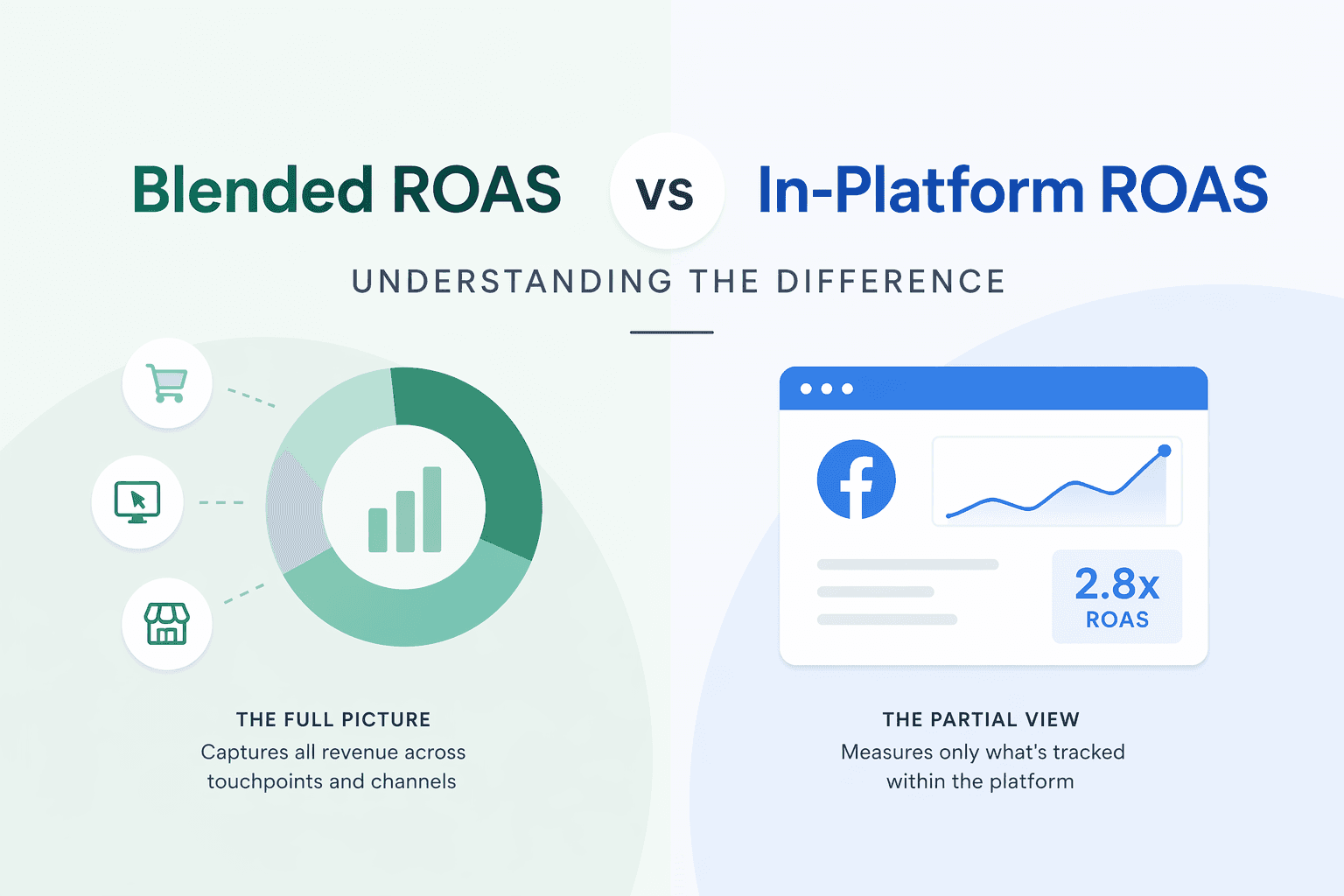
How can I explain MER to stakeholders who only understand ROAS?
Frame MER as "blended ROAS" or "total ROAS." It answers whether the overall marketing investment is generating profitable revenue for the business as a whole, rather than focusing on any single channel's performance.
Should e-commerce brands track MER weekly or monthly?
Monthly is standard for most brands because it smooths out daily fluctuations. Weekly tracking works for high-volume stores but may introduce more noise. Pick one cadence and stay consistent for meaningful trend analysis.