How to Calculate Your Meta Ads Creative Testing Budget
Meta Ads
July 1, 2026

Table Of Contents
Most performance teams know they need to test creative. Fewer know how to budget for it without either starving tests of signal or burning cash on inconclusive data.
If you are looking for the basics of how much to spend on Meta creative testing, start with our beginner-level breakdown. This post goes deeper. It covers the math behind setting a meta ads creative testing budget when you are running multiple concepts at the same time, how to structure tests at the adset level instead of the campaign level, and why Meta's own "50 conversions in 7 days" learning phase guidance is unrealistic for most advertisers.
The framework below is what we use at Flighted to plan creative testing budgets across accounts spending $10K to $500K+ per month on Meta. Every formula and threshold here comes from our proprietary testing methodology, refined through managing $50M+ in cumulative ad spend.
You will walk away with a repeatable formula, a worked example, and a scaling table you can drop into your next budget planning session.
Key Takeaways
Use the core formula: daily test budget = target conversions x expected CPA (cost per acquisition) / test duration.
Each concept needs a minimum of 3x your target CPA in total spend before you make a keep/cut decision. Use 5x CPA for a cleaner signal.
Do not divide a fixed budget across more concepts than it can support. Underpowered tests waste money.
Test concepts at the adset level, not the campaign level. Campaign-level splitting fragments conversion data.
Meta's "50 conversions per adset in 7 days" rule requires budgets that are disconnected from reality for 99% of brands.
1. The Core Formula for Meta Ads Creative Testing Budget
Start here.
Daily test budget = target conversions x expected CPA / test duration
Three variables drive this formula. Get any of them wrong and your test is either underpowered or overfunded.
Target conversions: The minimum number of conversions you need per concept before making a decision. The general rule is 3 conversions at your target CPA before you decide. Three or more conversions signals a keep. Two conversions is a yellow light -- run approximately 1x more CPA of spend before cutting. Zero to one conversions means cut.
Expected CPA: Your current or target cost per acquisition. If you are running a DTC brand with a $50 CPA target, that is your input. Do not use blended CPA across all campaigns. Use the CPA specific to the audience and objective you are testing against.
Test duration: Default to approximately one week (7 days). Fast-purchase businesses (impulse buys, low-AOV products) can compress to 3-4 days. If you have a small budget and a long purchase cycle (B2B, high-ticket DTC), extend to 10-14 days to accumulate enough signal.
Some teams prefer a 5x CPA threshold instead of 3x. The tradeoff is straightforward: 5x gives you a clean yes/no with no yellow-light zone, but it costs more per concept. If your budget allows it, 5x is the stronger standard.
This is a per-concept formula. If you are testing four concepts, you need to solve this equation four times.
2. How to Divide a Fixed Meta Ads Creative Testing Budget Across Multiple Concepts
You have a total testing budget. You have N concepts you want to test. The instinct is to divide the budget evenly and run them all.
Do not do this blindly.
Each concept needs its own minimum viable test spend. That floor is 3x CPA at minimum, with 5x CPA as the preferred target. If dividing your total budget by N drops the per-concept spend below that threshold, you are underpowering every test simultaneously.
Here is what that looks like in practice:
$10,000 total budget, $50 CPA, 4 concepts: Each concept gets $2,500 total. That is 50x CPA. More than sufficient.
$10,000 total budget, $50 CPA, 20 concepts: Each concept gets $500 total. That is 10x CPA. Technically above the 3x minimum, but spread across 10+ days, your daily budget per concept drops to $50/day. At $50 CPA, you are targeting one conversion per day per concept. Signal will be thin and noisy.
The rule: run fewer concepts with adequate budget rather than many concepts starved of signal. If you cannot fund at least 3x CPA per concept over your test window, reduce the number of concepts in the test round.
Prioritize ruthlessly. Test your highest-conviction concepts first.
3. Adset-Level vs. Campaign-Level Testing Structures
This is where most accounts get the structure wrong.
Test concepts at the adset level, not the campaign level.
Here is why: conversion data on Meta is siloed at the campaign level. When you split concepts into separate campaigns, you fragment your conversion data across multiple campaign-level learning containers. Each campaign optimizes independently, with a smaller data pool, which slows down Meta's delivery algorithm and dilutes your signal.
The adset-level approach preserves campaign-level data integrity while still isolating concept performance. Each adset runs a distinct creative concept. The campaign collects all conversion data in one place. Meta's algorithm benefits from the aggregate signal, and you can still compare concept-level performance by reading adset-level metrics.
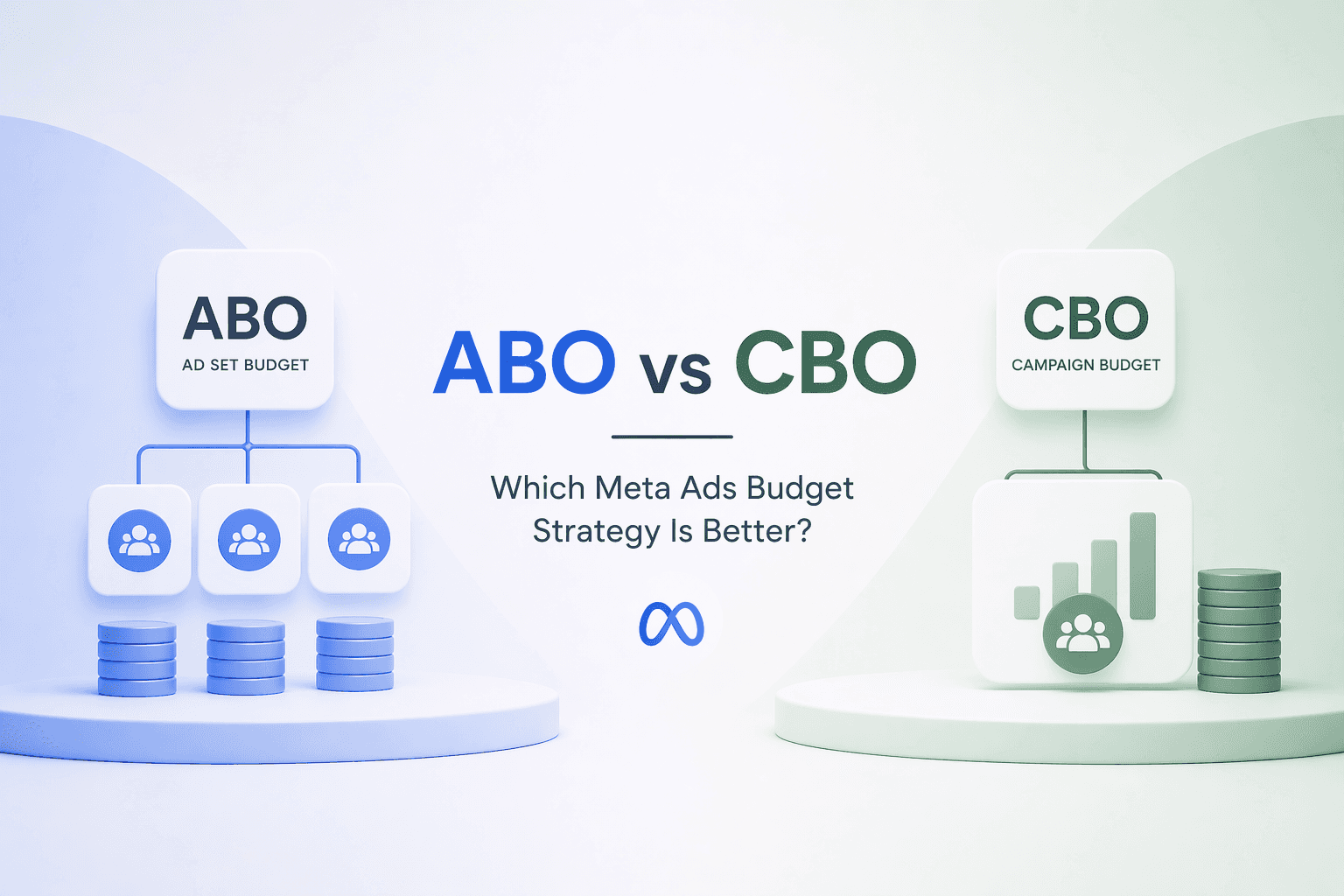
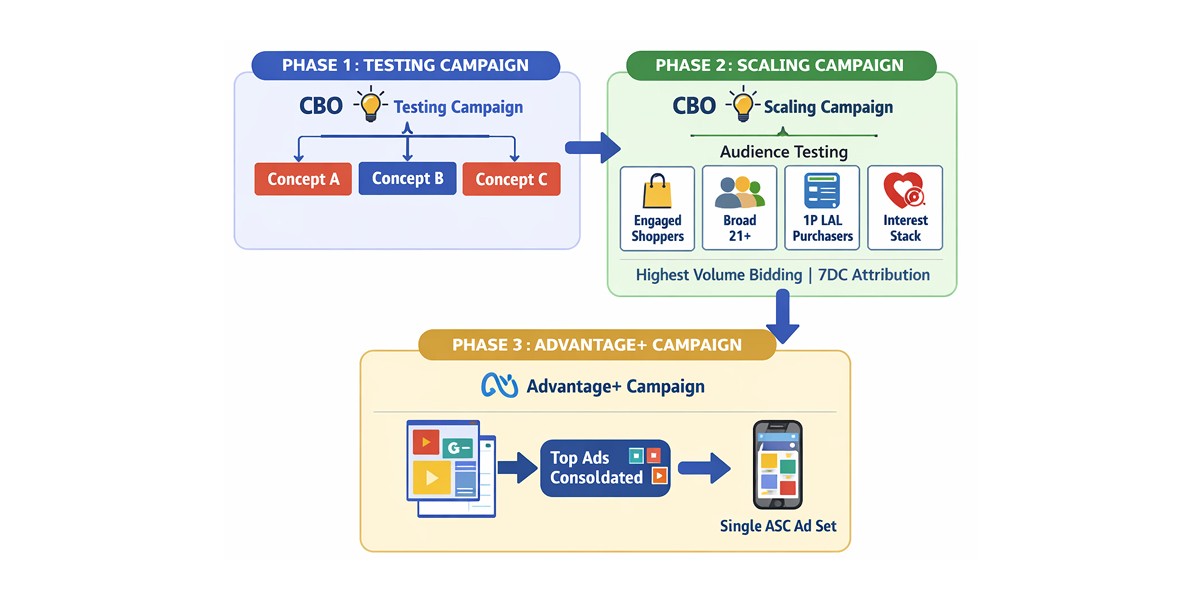
This is core to Flighted's account structure philosophy. We segment creative tests at the adset level within a dedicated testing campaign (typically using CBO -- campaign budget optimization -- to let Meta allocate spend toward the higher-performing adsets within the test).
Do not create a new campaign for every creative concept. You are paying for that mistake in fragmented data and slower optimization.
4. Worked Example: Multi-Concept Test on a $10K Budget
Here is a concrete scenario. All numbers are illustrative, built using Flighted's testing framework.
Setup:
Total testing budget: $10,000
Number of concepts: 4
Target CPA: $50
Test duration: 10 days
Step 1: Calculate minimum viable spend per concept.
3x CPA minimum: 3 x $50 = $150 per concept
5x CPA preferred: 5 x $50 = $250 per concept
Step 2: Calculate actual per-concept budget.
$10,000 / 4 concepts = $2,500 per concept
Step 3: Calculate per-concept daily budget.
$2,500 / 10 days = $250 per day per concept
Step 4: Check against the threshold.
$250/day x 10 days = $2,500 total per concept. That is 50x CPA. Well above the 3-5x minimum. This test is adequately funded.
What happens if you try 8 concepts instead?
$10,000 / 8 = $1,250 per concept. $1,250 / 10 days = $125/day per concept. That is still 25x CPA total -- above the minimum. But at $125/day with a $50 CPA, you are targeting 2.5 conversions per day per concept. Signal is thinner. You will likely need the full 10 days (or longer) to reach a confident decision on each concept.
The general guidance for DTC brands running Meta: start with 4 concepts per test round at this budget level. If all 4 produce signal quickly (within 5-7 days), you can rotate in a second batch.
5. Budget Scaling Table: Per-Concept Spend at Different Concept Counts
This table shows how your per-concept daily budget changes as you add more concepts to a single test round.
Assumptions: $10,000 total testing budget, 10-day test window, $50 target CPA.
Concepts | Per-Concept Daily Budget | Total Per-Concept Spend | Multiples of CPA | Verdict |
|---|---|---|---|---|
2 | $500/day | $5,000 | 100x | Strong signal. More budget than needed per concept. |
4 | $250/day | $2,500 | 50x | Strong signal. Recommended starting point. |
6 | $167/day | $1,667 | 33x | Adequate. Expect clear results within the 10-day window. |
8 | $125/day | $1,250 | 25x | Adequate but thinner. May need 1-2 extra days on borderline concepts. |
10 | $100/day | $1,000 | 20x | Usable, but daily conversion volume per concept drops. Risk of yellow-light results increases. |
12 | $83/day | $833 | 17x | Minimum viable. High chance of ambiguous results. Reduce concept count or extend the test window. |
Use this table during planning. If your per-concept spend falls below 10x CPA, you are almost certainly underfunding the test. Pull concepts from the round and test them in the next cycle.
Most performance teams know they need to test creative. Fewer know how to budget for it without either starving tests of signal or burning cash on inconclusive data.
If you are looking for the basics of how much to spend on Meta creative testing, start with our beginner-level breakdown. This post goes deeper. It covers the math behind setting a meta ads creative testing budget when you are running multiple concepts at the same time, how to structure tests at the adset level instead of the campaign level, and why Meta's own "50 conversions in 7 days" learning phase guidance is unrealistic for most advertisers.
The framework below is what we use at Flighted to plan creative testing budgets across accounts spending $10K to $500K+ per month on Meta. Every formula and threshold here comes from our proprietary testing methodology, refined through managing $50M+ in cumulative ad spend.
You will walk away with a repeatable formula, a worked example, and a scaling table you can drop into your next budget planning session.
Key Takeaways
Use the core formula: daily test budget = target conversions x expected CPA (cost per acquisition) / test duration.
Each concept needs a minimum of 3x your target CPA in total spend before you make a keep/cut decision. Use 5x CPA for a cleaner signal.
Do not divide a fixed budget across more concepts than it can support. Underpowered tests waste money.
Test concepts at the adset level, not the campaign level. Campaign-level splitting fragments conversion data.
Meta's "50 conversions per adset in 7 days" rule requires budgets that are disconnected from reality for 99% of brands.
1. The Core Formula for Meta Ads Creative Testing Budget
Start here.
Daily test budget = target conversions x expected CPA / test duration
Three variables drive this formula. Get any of them wrong and your test is either underpowered or overfunded.
Target conversions: The minimum number of conversions you need per concept before making a decision. The general rule is 3 conversions at your target CPA before you decide. Three or more conversions signals a keep. Two conversions is a yellow light -- run approximately 1x more CPA of spend before cutting. Zero to one conversions means cut.
Expected CPA: Your current or target cost per acquisition. If you are running a DTC brand with a $50 CPA target, that is your input. Do not use blended CPA across all campaigns. Use the CPA specific to the audience and objective you are testing against.
Test duration: Default to approximately one week (7 days). Fast-purchase businesses (impulse buys, low-AOV products) can compress to 3-4 days. If you have a small budget and a long purchase cycle (B2B, high-ticket DTC), extend to 10-14 days to accumulate enough signal.
Some teams prefer a 5x CPA threshold instead of 3x. The tradeoff is straightforward: 5x gives you a clean yes/no with no yellow-light zone, but it costs more per concept. If your budget allows it, 5x is the stronger standard.
This is a per-concept formula. If you are testing four concepts, you need to solve this equation four times.
2. How to Divide a Fixed Meta Ads Creative Testing Budget Across Multiple Concepts
You have a total testing budget. You have N concepts you want to test. The instinct is to divide the budget evenly and run them all.
Do not do this blindly.
Each concept needs its own minimum viable test spend. That floor is 3x CPA at minimum, with 5x CPA as the preferred target. If dividing your total budget by N drops the per-concept spend below that threshold, you are underpowering every test simultaneously.
Here is what that looks like in practice:
$10,000 total budget, $50 CPA, 4 concepts: Each concept gets $2,500 total. That is 50x CPA. More than sufficient.
$10,000 total budget, $50 CPA, 20 concepts: Each concept gets $500 total. That is 10x CPA. Technically above the 3x minimum, but spread across 10+ days, your daily budget per concept drops to $50/day. At $50 CPA, you are targeting one conversion per day per concept. Signal will be thin and noisy.
The rule: run fewer concepts with adequate budget rather than many concepts starved of signal. If you cannot fund at least 3x CPA per concept over your test window, reduce the number of concepts in the test round.
Prioritize ruthlessly. Test your highest-conviction concepts first.
3. Adset-Level vs. Campaign-Level Testing Structures
This is where most accounts get the structure wrong.
Test concepts at the adset level, not the campaign level.
Here is why: conversion data on Meta is siloed at the campaign level. When you split concepts into separate campaigns, you fragment your conversion data across multiple campaign-level learning containers. Each campaign optimizes independently, with a smaller data pool, which slows down Meta's delivery algorithm and dilutes your signal.
The adset-level approach preserves campaign-level data integrity while still isolating concept performance. Each adset runs a distinct creative concept. The campaign collects all conversion data in one place. Meta's algorithm benefits from the aggregate signal, and you can still compare concept-level performance by reading adset-level metrics.
This is core to Flighted's account structure philosophy. We segment creative tests at the adset level within a dedicated testing campaign (typically using CBO -- campaign budget optimization -- to let Meta allocate spend toward the higher-performing adsets within the test).
Do not create a new campaign for every creative concept. You are paying for that mistake in fragmented data and slower optimization.
4. Worked Example: Multi-Concept Test on a $10K Budget
Here is a concrete scenario. All numbers are illustrative, built using Flighted's testing framework.
Setup:
Total testing budget: $10,000
Number of concepts: 4
Target CPA: $50
Test duration: 10 days
Step 1: Calculate minimum viable spend per concept.
3x CPA minimum: 3 x $50 = $150 per concept
5x CPA preferred: 5 x $50 = $250 per concept
Step 2: Calculate actual per-concept budget.
$10,000 / 4 concepts = $2,500 per concept
Step 3: Calculate per-concept daily budget.
$2,500 / 10 days = $250 per day per concept
Step 4: Check against the threshold.
$250/day x 10 days = $2,500 total per concept. That is 50x CPA. Well above the 3-5x minimum. This test is adequately funded.
What happens if you try 8 concepts instead?
$10,000 / 8 = $1,250 per concept. $1,250 / 10 days = $125/day per concept. That is still 25x CPA total -- above the minimum. But at $125/day with a $50 CPA, you are targeting 2.5 conversions per day per concept. Signal is thinner. You will likely need the full 10 days (or longer) to reach a confident decision on each concept.
The general guidance for DTC brands running Meta: start with 4 concepts per test round at this budget level. If all 4 produce signal quickly (within 5-7 days), you can rotate in a second batch.
5. Budget Scaling Table: Per-Concept Spend at Different Concept Counts
This table shows how your per-concept daily budget changes as you add more concepts to a single test round.
Assumptions: $10,000 total testing budget, 10-day test window, $50 target CPA.
Concepts | Per-Concept Daily Budget | Total Per-Concept Spend | Multiples of CPA | Verdict |
|---|---|---|---|---|
2 | $500/day | $5,000 | 100x | Strong signal. More budget than needed per concept. |
4 | $250/day | $2,500 | 50x | Strong signal. Recommended starting point. |
6 | $167/day | $1,667 | 33x | Adequate. Expect clear results within the 10-day window. |
8 | $125/day | $1,250 | 25x | Adequate but thinner. May need 1-2 extra days on borderline concepts. |
10 | $100/day | $1,000 | 20x | Usable, but daily conversion volume per concept drops. Risk of yellow-light results increases. |
12 | $83/day | $833 | 17x | Minimum viable. High chance of ambiguous results. Reduce concept count or extend the test window. |
Use this table during planning. If your per-concept spend falls below 10x CPA, you are almost certainly underfunding the test. Pull concepts from the round and test them in the next cycle.
Looking for Meta ads support?
We're a small, hardworking, US-based team. Book a call and get a free audit today.
6. Why Meta's "50 Conversions in 7 Days" Learning Phase Rule Is Wrong for Most Advertisers
Meta's official guidance says each adset needs 50 conversions within a 7-day window to exit the learning phase and achieve stable delivery.
Here is what that actually requires in budget terms.
The formula: 50 x CPA / 7 = daily budget needed per adset.
At a $50 CPA, that is $357/day per adset. Run 10 adsets (a modest number for a creative testing structure) and you need $3,570/day. That is roughly $107,000 per month allocated to testing alone.
This is disconnected from reality for 99% of brands.
The 50-conversion threshold comes from Meta's machine learning optimization framework. It is the point where Meta's algorithm has enough data to stabilize delivery patterns. But "stable delivery" and "statistically useful signal for creative testing" are not the same thing.
You do not need 50 conversions per adset to know whether a creative concept is working. You need 3-5 conversions at your target CPA to separate winners from losers. The 3-5x CPA approach produces actionable signal at a fraction of the cost Meta's own documentation implies.
Here is the practical takeaway:
Do not wait for adsets to exit the learning phase before evaluating creative performance. Evaluate based on your CPA threshold framework (3x minimum, 5x preferred), not Meta's learning phase status.
Do not inflate budgets to chase the 50-conversion mark. That standard exists to optimize Meta's algorithm, not your testing budget.
Do treat Meta's learning phase as a delivery signal, not a testing signal. If an adset is still in learning but has accumulated 5x CPA of spend with strong results, that creative is a winner. Scale it.
7. Putting It All Together: Your Creative Testing Budget Checklist
Before you launch your next round of creative tests, run through this checklist:
Set your CPA target. Use your current CPA or your goal CPA for the specific audience and objective. Do not use a blended number.
Choose your decision threshold. 3x CPA for a faster read with a yellow-light zone, or 5x CPA for a clean yes/no.
Determine your test window. 7 days default. 3-4 days for fast-purchase products. 10-14 days for high-ticket or long-cycle products.
Count your concepts. Limit to a number where each concept gets at least 3x CPA (and ideally 5x+) in total spend.
Structure at the adset level. One concept per adset. One testing campaign. CBO on.
Ignore the learning phase for testing decisions. Evaluate on your CPA threshold, not Meta's 50-conversion rule.
Cut fast, scale faster. Zero to one conversions at 3x CPA spend means cut. Three or more means keep and graduate to a scaling campaign.
Conclusion
A meta ads creative testing budget is not a guess. It is a formula. Target conversions, expected CPA, and test duration give you the daily budget per concept. Multiply by the number of concepts to get your total testing budget for the round.
The most common mistake is spreading budget too thin across too many concepts. The second most common mistake is chasing Meta's 50-conversion learning phase threshold with budgets that do not match reality.
Start with 3-5x CPA per concept. Structure tests at the adset level. Cut losers quickly. Graduate winners to scaling campaigns. Repeat.
Related Posts
Related Posts
Related Posts
Related Posts




















































Ready to talk?
New York, NY 11217
hello@flighted.co
© Flighted, 2026
Ready to talk?
New York, NY 11217
hello@flighted.co
© Flighted, 2026