In-House vs. Agency for DTC Meta Ads: How to Choose
Meta Ads
June 10, 2026
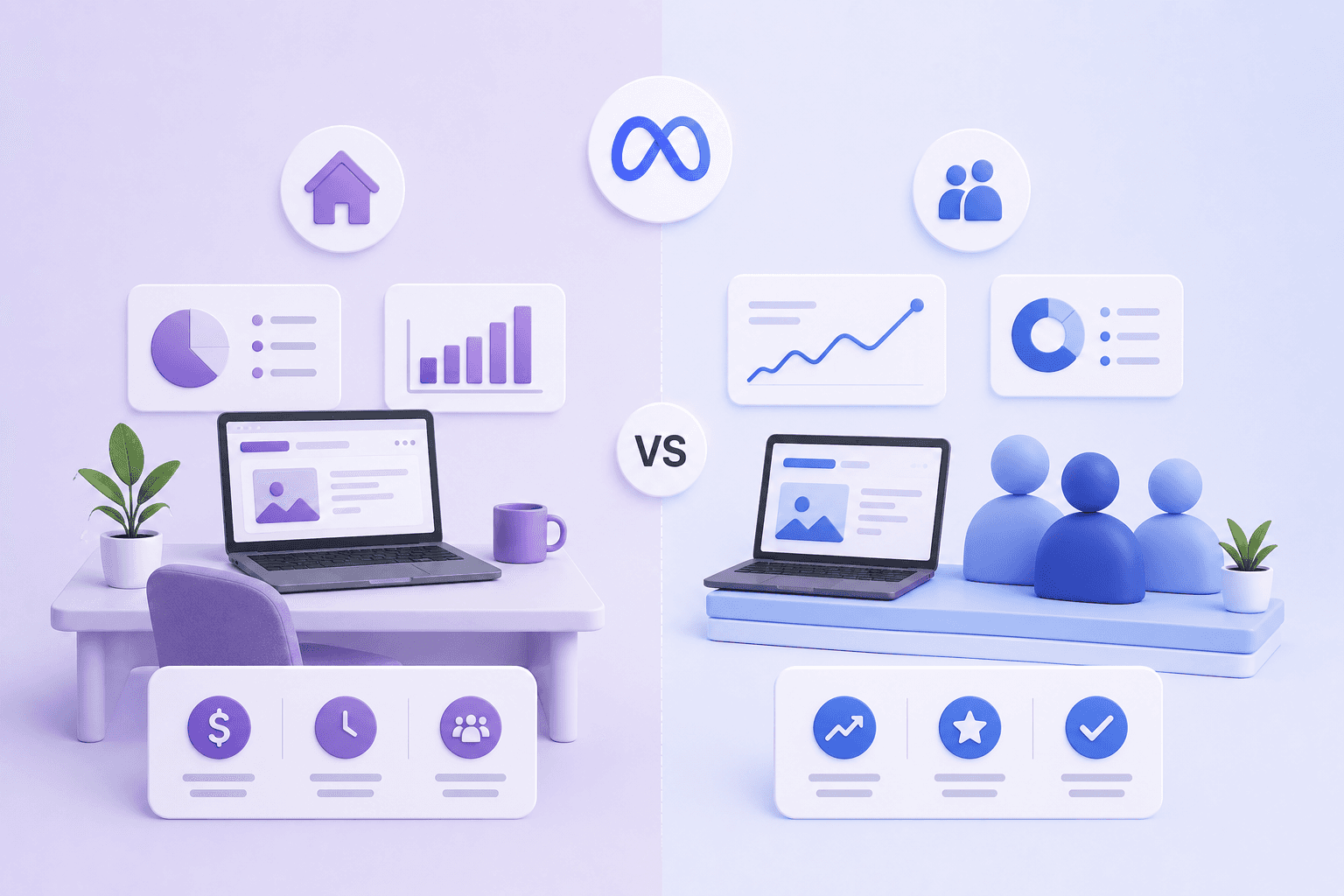
Table Of Contents
The decision between building an in-house Meta ads team and hiring an agency comes down to three factors: your monthly ad spend, your creative production capacity, and your growth stage. Get this wrong and you either overpay for resources you don't need or underinvest in capabilities that would unlock scale. With ecommerce CAC up 40–60% since 2023, the margin for error is thin.
Choosing between an in-house performance marketing team and an agency comes down to three factors regardless of channel: your monthly spend level, your creative production capacity, and your growth trajectory. As a rule of thumb, companies spending under $20K/month across paid channels typically get better returns from a freelancer or a lean agency retainer, since the fixed cost of a full in-house team doesn't pencil out yet. Past $30K–$50K/month, the math shifts — agencies win on speed and creative volume, while in-house becomes viable once you can staff a complete team (a buyer, a creative strategist, and someone who owns attribution) and your spend justifies the investment. The breakdown below uses Meta ads as the working example, but the same framework applies to performance marketing broadly.
This guide breaks down the true costs of each model, the specific scenarios where each one wins, and a framework for making the call based on where your brand is headed—not just where it is today.
Key Takeaways
The decision comes down to three factors: your monthly ad spend, your creative production capacity, and your growth stage. Brands spending under $20K/month often see better returns learning in-house or working with a freelancer. Brands scaling past $30K/month typically benefit from agency expertise.
True in-house cost runs 40-60% higher than salary alone. Factor in benefits, tools, management overhead, and the months it takes to hire and train someone who can perform at your spend level.
Creative velocity is usually the bottleneck. If you cannot produce 5-10 new ad variations per week, an agency with dedicated production capacity will likely outperform an in-house setup.
Data ownership is non-negotiable. You own your ad account, pixel, and historical data regardless of which model you choose. Any agency that restricts access is a pass.
This is a stage-dependent decision, not a permanent one. The right answer today may change as your spend scales and your internal resources evolve.
What Building an In-House Meta Ads Team Actually Costs
When people think about in-house costs, they usually think about salary. That's only part of the picture.
The fully loaded cost includes:
Benefits: Typically 20-30% on top of base salary.
Software: Subscriptions for creative, analytics, and attribution tools.
Management Overhead: Internal time required for oversight.
Ramp-up Time: The 2-4 months required to hire and train for your specific spend level.
Most DTC brands underestimate what it takes to run Meta profitably in-house. You're not in-house. Meta's average ad price rose 12% year-over-year in Q1 2026, and you're not just hiring one person—you're building a small team.
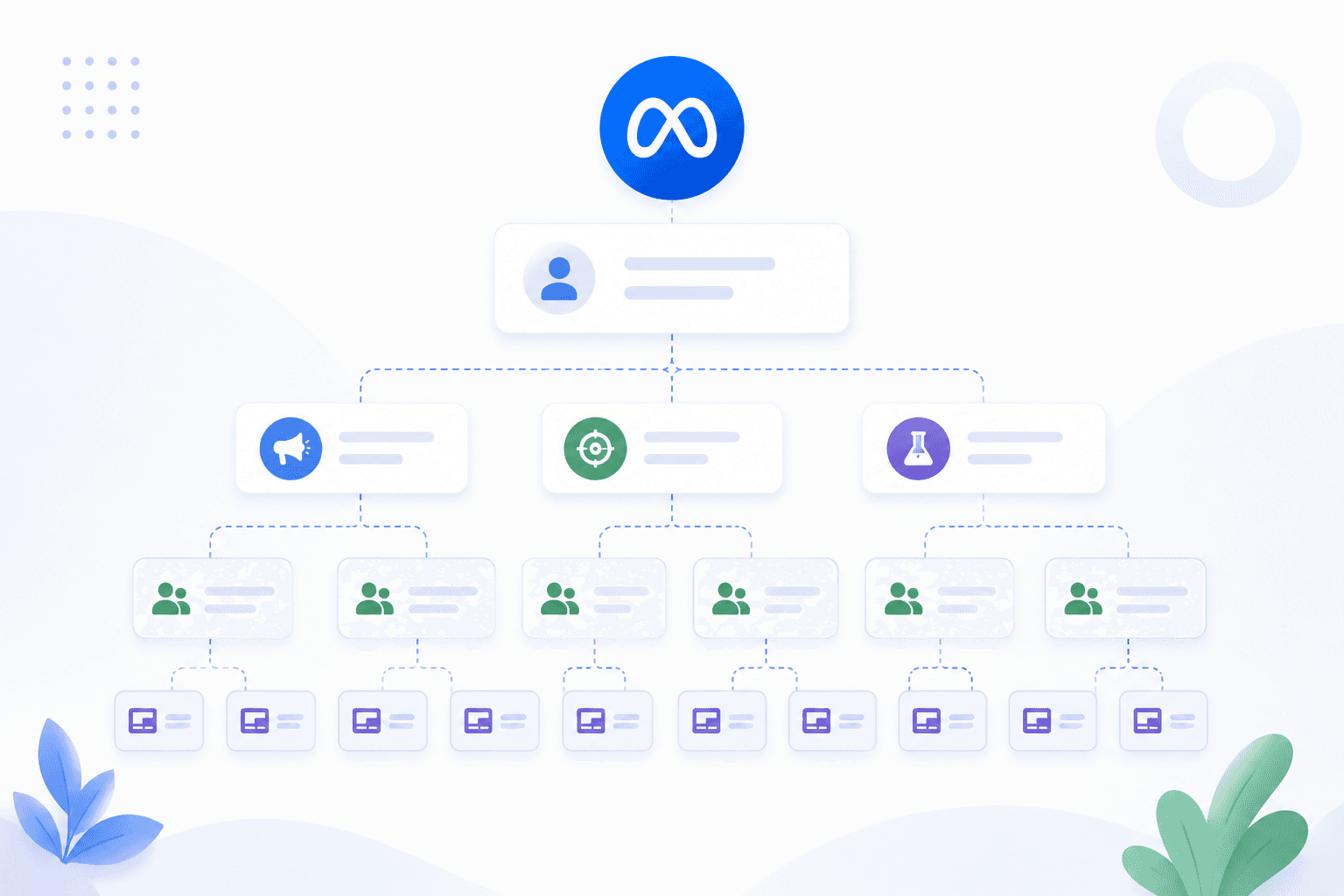
Meta Ads Buyer
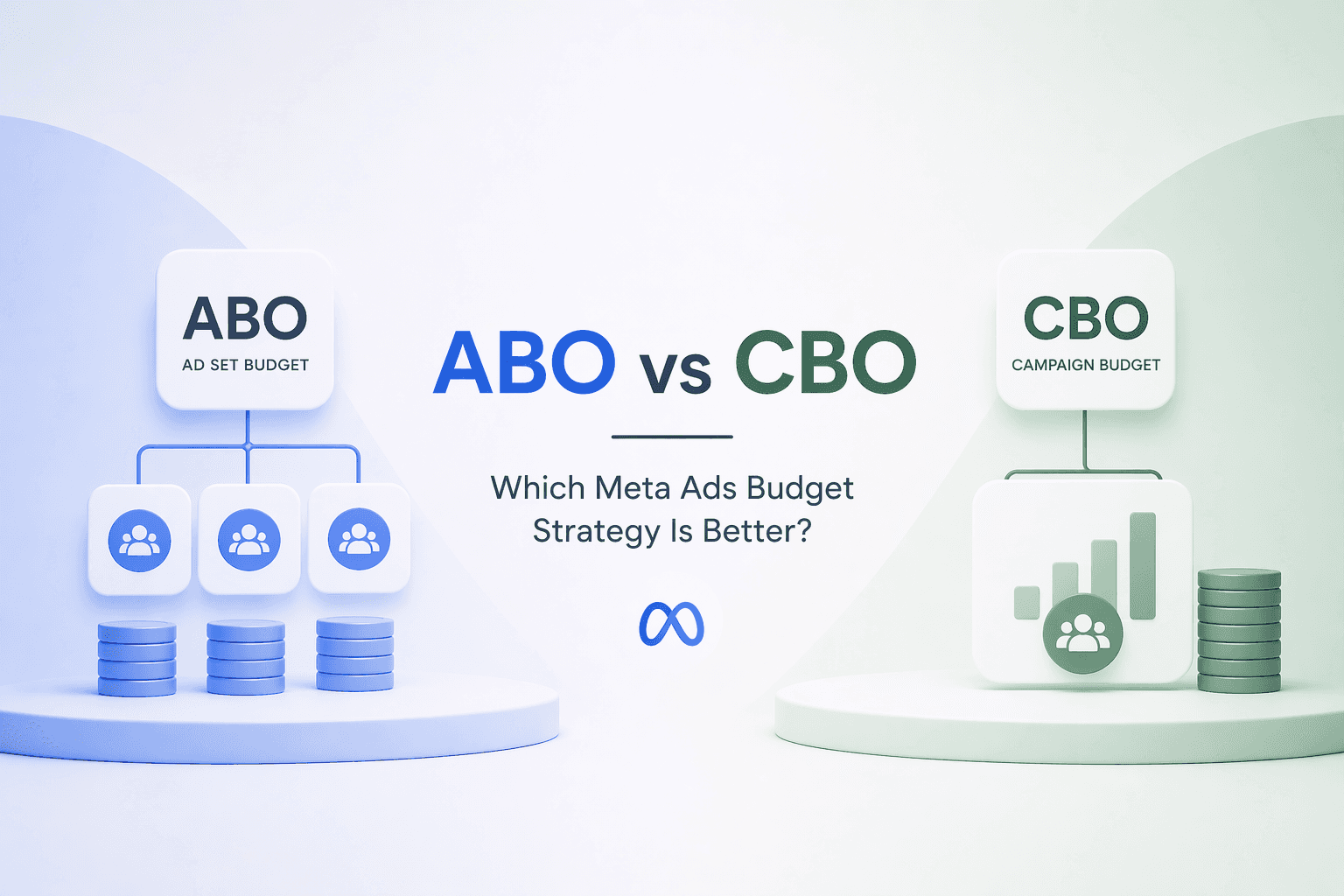
This is your day-to-day operator. The buyer handles campaign management, budget allocation, audience testing, and platform-specific setups like Advantage+ and CBO (Campaign Budget Optimization, where Meta distributes budget across ad sets automatically).
Expect to pay $70,000-$120,000+ in base salary depending on experience and location. The catch? You want someone who has managed spend at your current level and your target level. Deloitte found 66% of managers say recent hires were not fully prepared, with experience being the most common gap. A buyer who's only run $10K/month accounts will struggle at $50K/month.
Creative Strategist
Creative strategy is a separate discipline from media buying. This person owns messaging testing, hook development, brief writing, and performance analysis of creative assets.
Without a dedicated creative strategist, your buyer ends up doing both jobs poorly. Budget another $60,000-$100,000 for this role.
Video Editor and Motion Designer
DTC brands running Meta at scale require multiple new creatives per week to combat creative fatigue. One editor rarely keeps up with the testing velocity required.
You'll likely want 1.5-2 FTEs in production to sustain 8-12 new concepts weekly.
Analytics and Attribution Lead
Post-iOS 14.5, attribution setup requires dedicated expertise. This person handles pixel configuration, Conversion API (CAPI) implementation, reporting dashboards, and incrementality analysis.
Many brands skip this role and then wonder why their numbers don't match reality. Budget $80,000-$130,000 for someone who can actually solve attribution problems.
What a DTC Meta Ads Agency Actually Costs and Includes
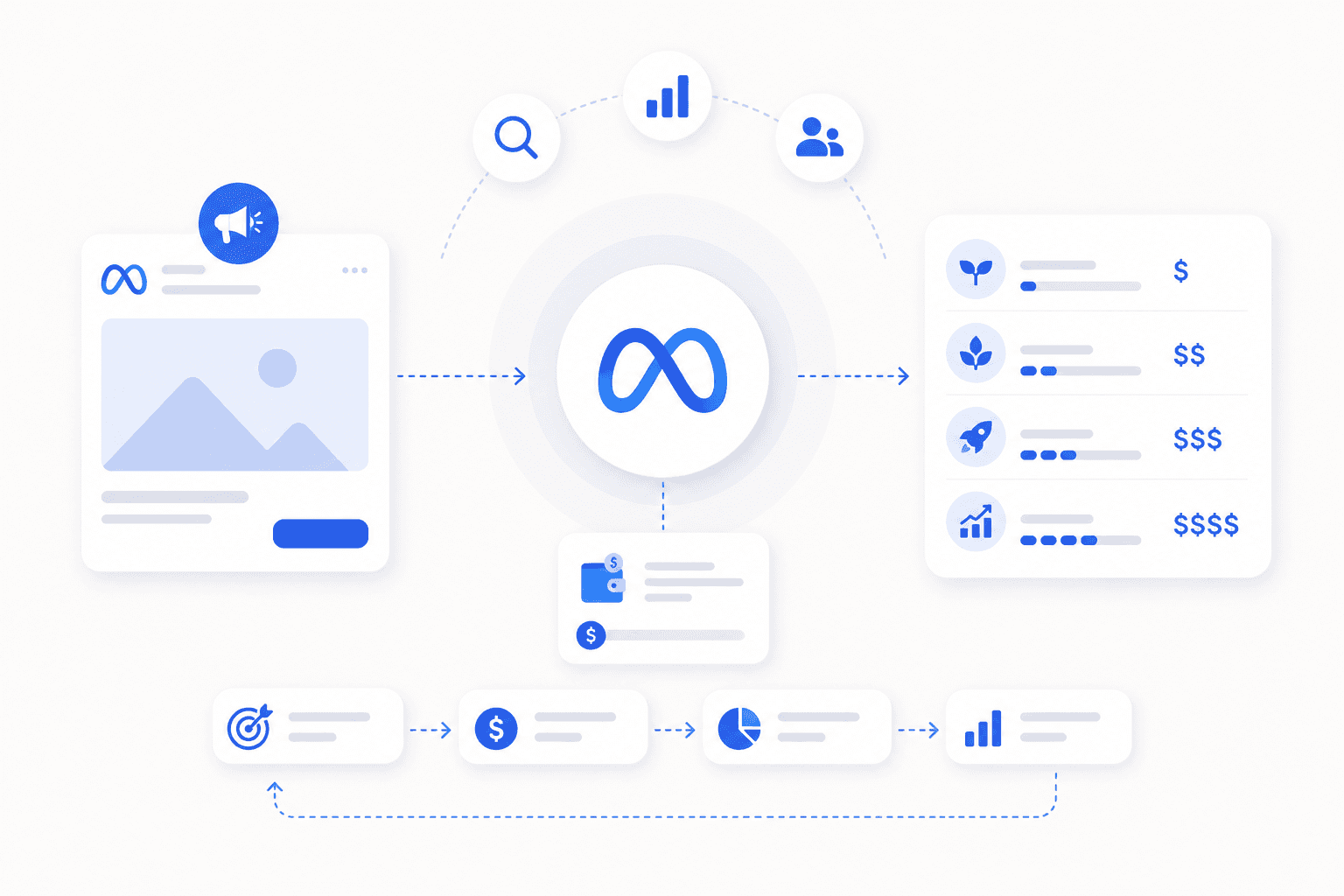
Agency pricing typically falls into three structures: flat monthly retainer ($3,000-$10,000+), percentage of ad spend (10-15%), or a hybrid of both. The right structure depends on your spend level and growth trajectory.
Here's what you can expect to be included versus what's often an add-on:
Typically included: Campaign management, reporting, strategy calls, basic creative iteration
Often extra: High-volume creative production, landing page builds, CRM integration, advanced attribution setup
The best agencies bundle paid media expertise, creative strategy, and landing page optimization together as interdependent services rather than separate line items. When all three work together, performance compounds. When they're siloed, you get finger-pointing about why results aren't improving.
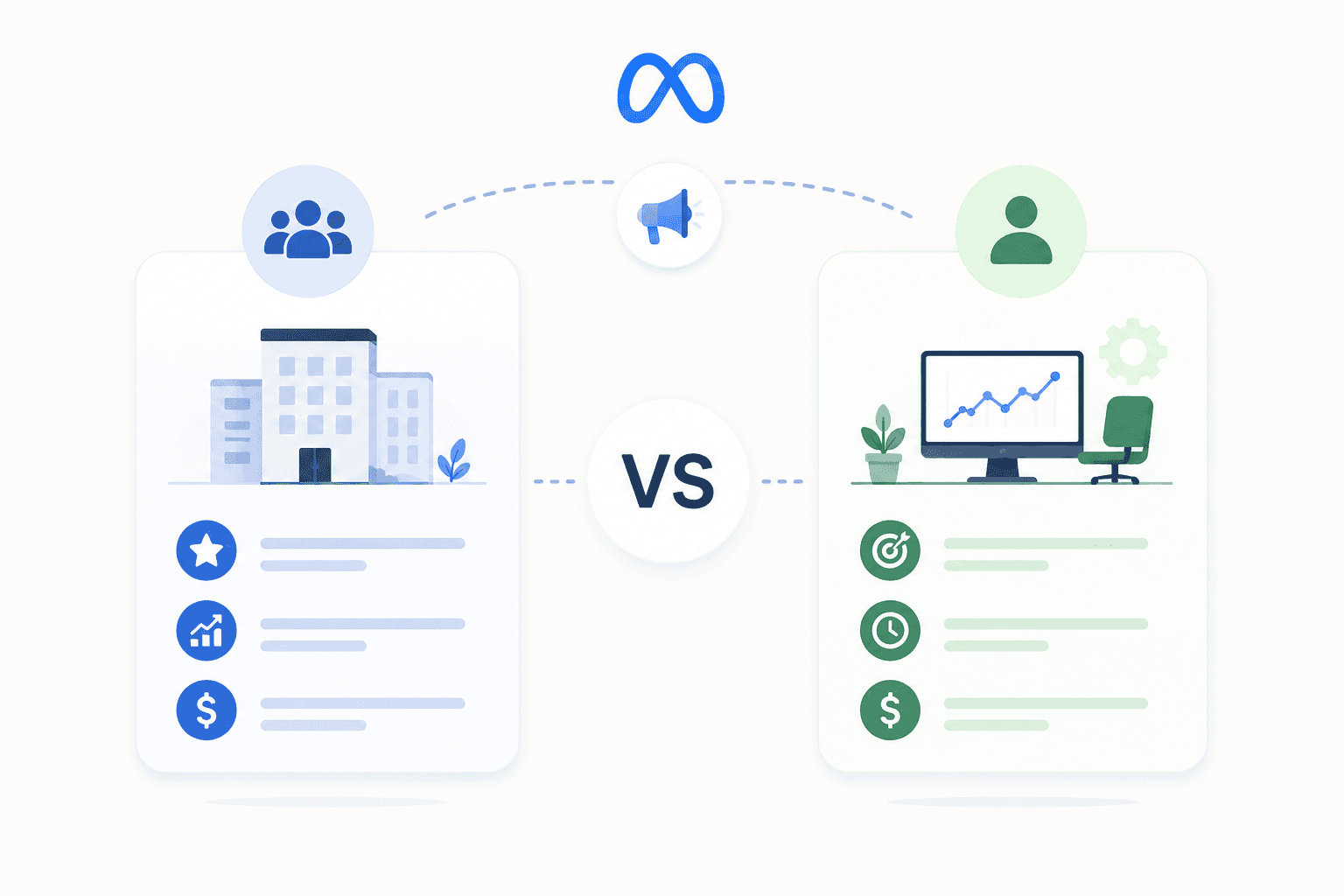
In-House vs Agency for DTC Meta Ads Comparison
Factor | In-House | Agency |
|---|---|---|
Time to first optimized campaign | 2-4 months (hiring + training + learning curve) | 2-4 weeks (onboarding) |
Creative output capacity | Limited by headcount | Higher volume, built-in production team |
Platform expertise depth | Depends on hire quality | Concentrated from managing multiple accounts |
Brand knowledge | Deep, always available | Requires ramp-up and ongoing communication |
Scalability | Fixed cost, harder to flex | Scales with spend tier |
Data ownership | Full control | Varies by contract—verify before signing |
Which Model Scales Better as Meta Spend Increases
The right model depends on where you are and where you're going. Scaling on Meta requires creative velocity and audience expansion simultaneously, and each spend tier has different bottlenecks.
Scaling From $20K to $50K Per Month
At this stage, you're transitioning from testing to early scaling. Creative volume requirements increase significantly because you want more hooks, angles, and formats to find winners.
Agencies often outperform here because creative production is the bottleneck, not media buying sophistication.
Scaling From $50K to $100K Per Month
Audience expansion becomes the challenge. Lookalikes plateau, and you want broader targeting plus Advantage+ optimization to find new pockets of demand.
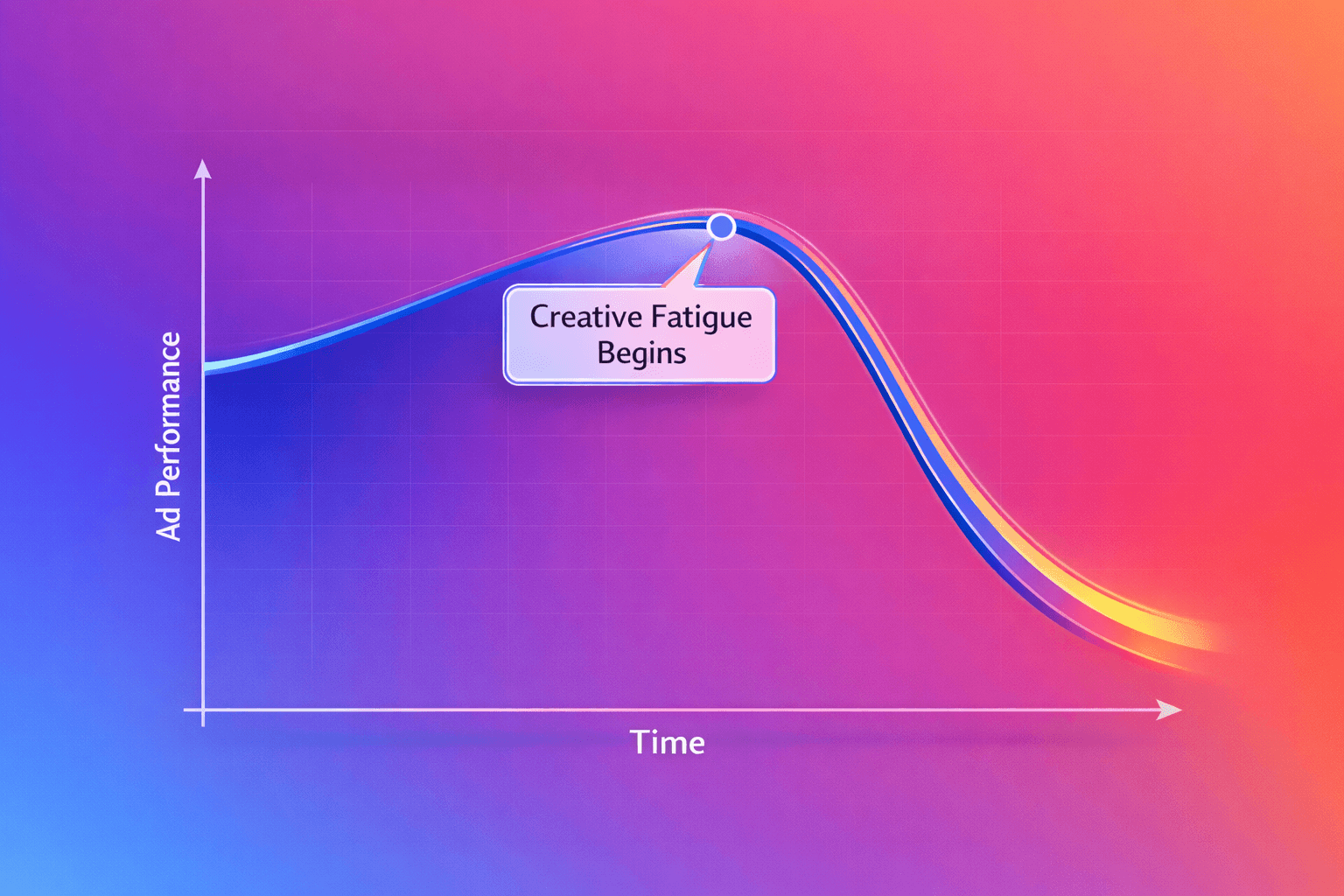
Creative fatigue management becomes critical at this level. Monitor first-time impression rate and frequency. When both metrics deteriorate, performance follows. In-house teams often hit capacity constraints here unless fully staffed across all four roles.
Scaling Past $100K Per Month
Hybrid models start to make sense at this level. The bottleneck shifts to strategic oversight and cross-channel coordination.
Some brands bring strategy in-house and keep agencies for execution and creative volume. Others do the reverse. The key is clear role delineation with no overlap.
Creative Production Capacity in Each Model
Meta performance is heavily dictated by creative fatigue. Without fresh creatives, performance sags and the algorithm has nothing new to test.
Here's what "good" testing velocity looks like:
Minimum: 5 new ad concepts per week
Ideal for scaling: 10+ variations across hooks, formats, and angles
Most in-house teams cannot sustain this output without dedicated production resources. Agencies with built-in creative teams can maintain higher volume because production is their core competency, not a side responsibility.
Account Ownership, Pixel Data, and Reporting Transparency
You own your ad account, pixel, and historical data. Full stop. This is true whether you run in-house or work with an agency.
Red flags in agency contracts:
Agency owns the ad account
Limited access to Ads Manager
No access to raw data exports
Vague language about data portability
Any agency that restricts access is a pass. Reporting transparency means real-time dashboard access, weekly performance reviews, and clear attribution methodology. A monthly PDF with vanity metrics doesn't count.
When In-House Meta Ads Makes Sense for a DTC Brand
In-house works when you can staff all four roles with experienced hires and your spend justifies the investment.
Specific scenarios where in-house wins:
High brand complexity: Products require deep internal knowledge to message correctly
Mature spend level: You're past $100K/month and want dedicated, always-on attention
Existing internal resources: You already have creative production and analytics in place
Long-term channel bet: Meta is your primary acquisition channel and you're building institutional knowledge
When a Meta Ads Agency Makes Sense for a DTC Brand
Agencies provide concentrated expertise from managing spend across multiple brands and categories. With U.S. paid social now exceeding $100 billion, that cross-pollination of learnings is hard to replicate in-house.
Specific scenarios where agencies win:
Speed to results: You want to launch or scale within weeks, not months
Creative bottleneck: You're experiencing creative fatigue and can't produce enough new concepts
Lack of internal expertise: You don't have someone who has managed spend at your target level
Plateau breaking: You've hit a performance wall and want outside perspective
The Hybrid Meta Ads Model and When It Actually Works
"Hybrid" typically means in-house strategy plus agency execution, or in-house media buying plus agency creative. It's not a default. It's a deliberate structure for specific situations.
Hybrid works when:
Clear role delineation exists with no overlap.
Strong internal project management coordinates both teams.
Spend is mature enough to justify both investments.
Hybrid creates friction when:
Ownership of performance outcomes is unclear.
Incentives between teams are misaligned.
Communication overhead slows iteration speed.
How to Evaluate a DTC Meta Ads Agency Before You Sign
Not all DTC Meta ads agencies are equal—Gartner's 2025 CMO Spend Survey found 39% of CMOs plan to cut agency budgets, with the top action being eliminating unproductive relationships. Here's what to vet before signing.
DTC Category Experience and Spend Range
Ask for client examples in your category, whether that's CPG, fashion, health/wellness, food/bev, or consumer tech. Verify the agency has managed spend at your current level and your target level.
Ask how many DTC accounts they currently manage and what average client tenure looks like. These are just the starting points—having a full list of questions to ask before you sign protects your budget and your data.
Creative Testing Volume and Methodology
Ask how many new creatives the agency produces and tests per month. Look for structured methodology: systematic testing of hooks, formats, and messaging angles.
"We try things and see what works" is not a methodology.
Account Structure and Attribution Setup
Ask about the agency's approach to Advantage+ campaigns, CBO vs. ABO (Ad Set Budget Optimization), and audience modeling.
Ask how they handle attribution. Do they rely on in-platform reporting, third-party tools, or blended metrics like MER? MER stands for Marketing Efficiency Ratio, which is total revenue divided by total marketing spend.
Reporting Cadence and Account Access
Confirm you will have full admin access to your ad account at all times. Ask what reporting looks like: dashboard access, weekly calls, monthly reviews.
Any hesitation on account access or data ownership is a red flag.
The decision between building an in-house Meta ads team and hiring an agency comes down to three factors: your monthly ad spend, your creative production capacity, and your growth stage. Get this wrong and you either overpay for resources you don't need or underinvest in capabilities that would unlock scale. With ecommerce CAC up 40–60% since 2023, the margin for error is thin.
Choosing between an in-house performance marketing team and an agency comes down to three factors regardless of channel: your monthly spend level, your creative production capacity, and your growth trajectory. As a rule of thumb, companies spending under $20K/month across paid channels typically get better returns from a freelancer or a lean agency retainer, since the fixed cost of a full in-house team doesn't pencil out yet. Past $30K–$50K/month, the math shifts — agencies win on speed and creative volume, while in-house becomes viable once you can staff a complete team (a buyer, a creative strategist, and someone who owns attribution) and your spend justifies the investment. The breakdown below uses Meta ads as the working example, but the same framework applies to performance marketing broadly.
This guide breaks down the true costs of each model, the specific scenarios where each one wins, and a framework for making the call based on where your brand is headed—not just where it is today.
Key Takeaways
The decision comes down to three factors: your monthly ad spend, your creative production capacity, and your growth stage. Brands spending under $20K/month often see better returns learning in-house or working with a freelancer. Brands scaling past $30K/month typically benefit from agency expertise.
True in-house cost runs 40-60% higher than salary alone. Factor in benefits, tools, management overhead, and the months it takes to hire and train someone who can perform at your spend level.
Creative velocity is usually the bottleneck. If you cannot produce 5-10 new ad variations per week, an agency with dedicated production capacity will likely outperform an in-house setup.
Data ownership is non-negotiable. You own your ad account, pixel, and historical data regardless of which model you choose. Any agency that restricts access is a pass.
This is a stage-dependent decision, not a permanent one. The right answer today may change as your spend scales and your internal resources evolve.
What Building an In-House Meta Ads Team Actually Costs
When people think about in-house costs, they usually think about salary. That's only part of the picture.
The fully loaded cost includes:
Benefits: Typically 20-30% on top of base salary.
Software: Subscriptions for creative, analytics, and attribution tools.
Management Overhead: Internal time required for oversight.
Ramp-up Time: The 2-4 months required to hire and train for your specific spend level.
Most DTC brands underestimate what it takes to run Meta profitably in-house. You're not in-house. Meta's average ad price rose 12% year-over-year in Q1 2026, and you're not just hiring one person—you're building a small team.
Meta Ads Buyer
This is your day-to-day operator. The buyer handles campaign management, budget allocation, audience testing, and platform-specific setups like Advantage+ and CBO (Campaign Budget Optimization, where Meta distributes budget across ad sets automatically).
Expect to pay $70,000-$120,000+ in base salary depending on experience and location. The catch? You want someone who has managed spend at your current level and your target level. Deloitte found 66% of managers say recent hires were not fully prepared, with experience being the most common gap. A buyer who's only run $10K/month accounts will struggle at $50K/month.
Creative Strategist
Creative strategy is a separate discipline from media buying. This person owns messaging testing, hook development, brief writing, and performance analysis of creative assets.
Without a dedicated creative strategist, your buyer ends up doing both jobs poorly. Budget another $60,000-$100,000 for this role.
Video Editor and Motion Designer
DTC brands running Meta at scale require multiple new creatives per week to combat creative fatigue. One editor rarely keeps up with the testing velocity required.
You'll likely want 1.5-2 FTEs in production to sustain 8-12 new concepts weekly.
Analytics and Attribution Lead
Post-iOS 14.5, attribution setup requires dedicated expertise. This person handles pixel configuration, Conversion API (CAPI) implementation, reporting dashboards, and incrementality analysis.
Many brands skip this role and then wonder why their numbers don't match reality. Budget $80,000-$130,000 for someone who can actually solve attribution problems.
What a DTC Meta Ads Agency Actually Costs and Includes
Agency pricing typically falls into three structures: flat monthly retainer ($3,000-$10,000+), percentage of ad spend (10-15%), or a hybrid of both. The right structure depends on your spend level and growth trajectory.
Here's what you can expect to be included versus what's often an add-on:
Typically included: Campaign management, reporting, strategy calls, basic creative iteration
Often extra: High-volume creative production, landing page builds, CRM integration, advanced attribution setup
The best agencies bundle paid media expertise, creative strategy, and landing page optimization together as interdependent services rather than separate line items. When all three work together, performance compounds. When they're siloed, you get finger-pointing about why results aren't improving.
In-House vs Agency for DTC Meta Ads Comparison
Factor | In-House | Agency |
|---|---|---|
Time to first optimized campaign | 2-4 months (hiring + training + learning curve) | 2-4 weeks (onboarding) |
Creative output capacity | Limited by headcount | Higher volume, built-in production team |
Platform expertise depth | Depends on hire quality | Concentrated from managing multiple accounts |
Brand knowledge | Deep, always available | Requires ramp-up and ongoing communication |
Scalability | Fixed cost, harder to flex | Scales with spend tier |
Data ownership | Full control | Varies by contract—verify before signing |
Which Model Scales Better as Meta Spend Increases
The right model depends on where you are and where you're going. Scaling on Meta requires creative velocity and audience expansion simultaneously, and each spend tier has different bottlenecks.
Scaling From $20K to $50K Per Month
At this stage, you're transitioning from testing to early scaling. Creative volume requirements increase significantly because you want more hooks, angles, and formats to find winners.
Agencies often outperform here because creative production is the bottleneck, not media buying sophistication.
Scaling From $50K to $100K Per Month
Audience expansion becomes the challenge. Lookalikes plateau, and you want broader targeting plus Advantage+ optimization to find new pockets of demand.
Creative fatigue management becomes critical at this level. Monitor first-time impression rate and frequency. When both metrics deteriorate, performance follows. In-house teams often hit capacity constraints here unless fully staffed across all four roles.
Scaling Past $100K Per Month
Hybrid models start to make sense at this level. The bottleneck shifts to strategic oversight and cross-channel coordination.
Some brands bring strategy in-house and keep agencies for execution and creative volume. Others do the reverse. The key is clear role delineation with no overlap.
Creative Production Capacity in Each Model
Meta performance is heavily dictated by creative fatigue. Without fresh creatives, performance sags and the algorithm has nothing new to test.
Here's what "good" testing velocity looks like:
Minimum: 5 new ad concepts per week
Ideal for scaling: 10+ variations across hooks, formats, and angles
Most in-house teams cannot sustain this output without dedicated production resources. Agencies with built-in creative teams can maintain higher volume because production is their core competency, not a side responsibility.
Account Ownership, Pixel Data, and Reporting Transparency
You own your ad account, pixel, and historical data. Full stop. This is true whether you run in-house or work with an agency.
Red flags in agency contracts:
Agency owns the ad account
Limited access to Ads Manager
No access to raw data exports
Vague language about data portability
Any agency that restricts access is a pass. Reporting transparency means real-time dashboard access, weekly performance reviews, and clear attribution methodology. A monthly PDF with vanity metrics doesn't count.
When In-House Meta Ads Makes Sense for a DTC Brand
In-house works when you can staff all four roles with experienced hires and your spend justifies the investment.
Specific scenarios where in-house wins:
High brand complexity: Products require deep internal knowledge to message correctly
Mature spend level: You're past $100K/month and want dedicated, always-on attention
Existing internal resources: You already have creative production and analytics in place
Long-term channel bet: Meta is your primary acquisition channel and you're building institutional knowledge
When a Meta Ads Agency Makes Sense for a DTC Brand
Agencies provide concentrated expertise from managing spend across multiple brands and categories. With U.S. paid social now exceeding $100 billion, that cross-pollination of learnings is hard to replicate in-house.
Specific scenarios where agencies win:
Speed to results: You want to launch or scale within weeks, not months
Creative bottleneck: You're experiencing creative fatigue and can't produce enough new concepts
Lack of internal expertise: You don't have someone who has managed spend at your target level
Plateau breaking: You've hit a performance wall and want outside perspective
The Hybrid Meta Ads Model and When It Actually Works
"Hybrid" typically means in-house strategy plus agency execution, or in-house media buying plus agency creative. It's not a default. It's a deliberate structure for specific situations.
Hybrid works when:
Clear role delineation exists with no overlap.
Strong internal project management coordinates both teams.
Spend is mature enough to justify both investments.
Hybrid creates friction when:
Ownership of performance outcomes is unclear.
Incentives between teams are misaligned.
Communication overhead slows iteration speed.
How to Evaluate a DTC Meta Ads Agency Before You Sign
Not all DTC Meta ads agencies are equal—Gartner's 2025 CMO Spend Survey found 39% of CMOs plan to cut agency budgets, with the top action being eliminating unproductive relationships. Here's what to vet before signing.
DTC Category Experience and Spend Range
Ask for client examples in your category, whether that's CPG, fashion, health/wellness, food/bev, or consumer tech. Verify the agency has managed spend at your current level and your target level.
Ask how many DTC accounts they currently manage and what average client tenure looks like. These are just the starting points—having a full list of questions to ask before you sign protects your budget and your data.
Creative Testing Volume and Methodology
Ask how many new creatives the agency produces and tests per month. Look for structured methodology: systematic testing of hooks, formats, and messaging angles.
"We try things and see what works" is not a methodology.
Account Structure and Attribution Setup
Ask about the agency's approach to Advantage+ campaigns, CBO vs. ABO (Ad Set Budget Optimization), and audience modeling.
Ask how they handle attribution. Do they rely on in-platform reporting, third-party tools, or blended metrics like MER? MER stands for Marketing Efficiency Ratio, which is total revenue divided by total marketing spend.
Reporting Cadence and Account Access
Confirm you will have full admin access to your ad account at all times. Ask what reporting looks like: dashboard access, weekly calls, monthly reviews.
Any hesitation on account access or data ownership is a red flag.
Looking for Meta ads support?
We're a small, hardworking, US-based team. Book a call and get a free audit today.
A Decision Framework for Choosing In-House or Agency
1. Audit Your True Loaded Cost
Calculate total in-house investment: salaries, benefits, tools (creative software, analytics platforms, attribution tools), management time, and training. Compare against agency retainer plus any add-on fees.Eightx's analysis of DTC benchmarks shows private brands at $5M–$50M typically allocate 20–35% of revenue to marketing, so your team structure has outsized impact on profitability.
Be honest about hidden costs on both sides.
2. Pressure Test Your Creative Output
Assess your current creative production capacity versus what you want to test effectively on Meta. If you cannot produce 5+ net-new creatives per week, that's your answer.
Creative velocity is the most common bottleneck for in-house teams.
3. Match the Model to Your Spend Trajectory
Align the decision with where you're headed, not just where you are today. If you plan to scale from $30K to $100K in the next two quarters, choose the model that supports that trajectory.
Do not optimize for current state. Optimize for growth path.
Make the Call That Matches Your Growth Stage
This is a stage-dependent decision, not a permanent one. Agencies win on speed, creative capacity, and specialized expertise for most DTC brands scaling Meta. In-house makes sense when you have the resources to staff a complete team and the spend to justify it.
Frequently Asked Questions About In-House vs Agency for DTC Meta Ads
How long does it take a Meta ads agency to ramp on a new DTC account?
Most agencies complete onboarding and launch optimized campaigns within 2-4 weeks. Full performance ramp depends on creative testing cycles and historical account data. Expect 60-90 days to see the full impact of strategic changes.
Can a Meta ads agency guarantee a specific ROAS or CPA?
No legitimate agency guarantees specific outcomes. Performance depends on variables outside their control, including your product, pricing, landing page, and market conditions. Guarantees are a red flag, not a selling point.
What are the costs of switching from a Meta ads agency to an in-house team?
Switching costs include knowledge transfer time, learning the account history, setting up internal tools, and the productivity gap while your new hire ramps. Budget for 2-3 months of reduced performance during the transition period.
Related Posts
Related Posts
Related Posts
Related Posts



































Ready to talk?
Flighted is the operating brand of Peter Czepiga LLC, a New York City-based performance marketing agency.
New York, NY 11217
hello@flighted.co
© Flighted, 2026
Ready to talk?
Flighted is the operating brand of Peter Czepiga LLC, a New York City-based performance marketing agency.
New York, NY 11217
hello@flighted.co
© Flighted, 2026