Meta Ads Creative Strategy Guide for B2B SaaS Brands 2026
Meta Ads
May 28, 2026

Table Of Contents
Key Takeaways
Broad ICPs (ideal customer profiles) kill performance. Replace "CMOs" or "dentists" with 3–5 hyper-specific personas defined by role, motivation, and how they're measured at work.
The creative does the targeting. Meta's algorithm can't natively distinguish niche B2B buyers, so hyper-specific references in your ad copy self-qualify the audience. Arcane beats accessible.
Generate at least 4 pain points per ICP, mapped to four buckets: reduce time, improve quality, save cost, or generate revenue.
Target solution-aware buyers by framing against named competitors. Pick the largest competitors in your category and write down concretely how you beat each one — price, ease of use, speed, integrations, output quality.
Steal proven angles from competitor ad libraries. If three competitors are running the same hook, they've already paid the testing cost. Use Foreplay or Meta's public ad library to surface repeated angles.
The messaging matrix is the system. ICPs × pain points × competitor UVPs × proven angles = hundreds of testable concepts without relying on inspiration.
Plug each variable into proven B2B SaaS ad formats — VSLs (video sales letters), UGC (user-generated content), brandless UI mimicry statics, founder POVs, stripped-down value props, tool feature previews.
The best hooks for B2B SaaS Meta ads are DTC-proven direct-response angles most software brands aren't running: competitor callouts, hyper-specific pain points, skeptic hooks, POV hooks, founder POVs, and brandless UI mimicry.
Stop relying on shower thoughts. The teams winning on Meta in 2026 have replaced creative inspiration with a structured input system any team member can execute against.
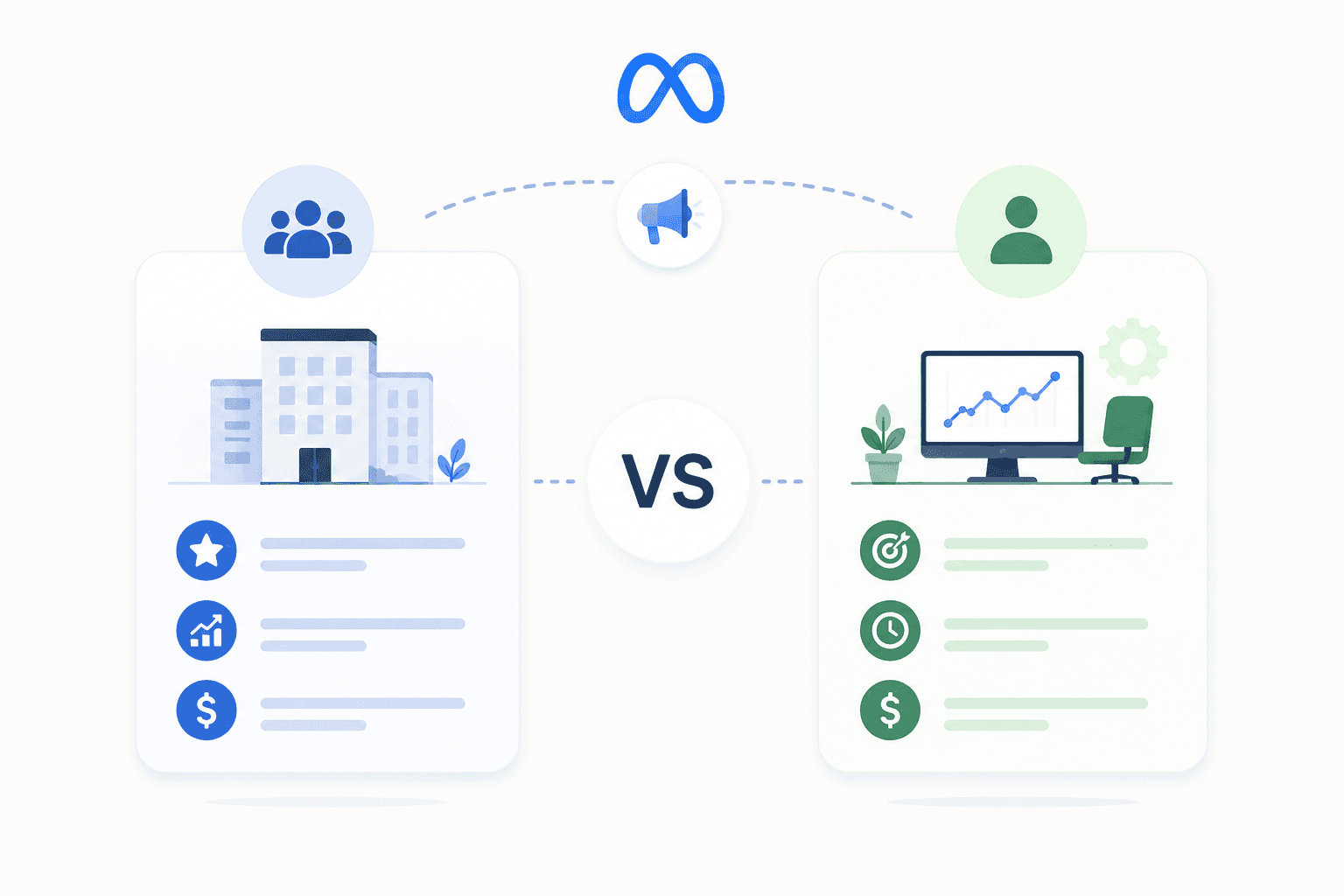
1. What Makes B2B Meta Creative Different from DTC
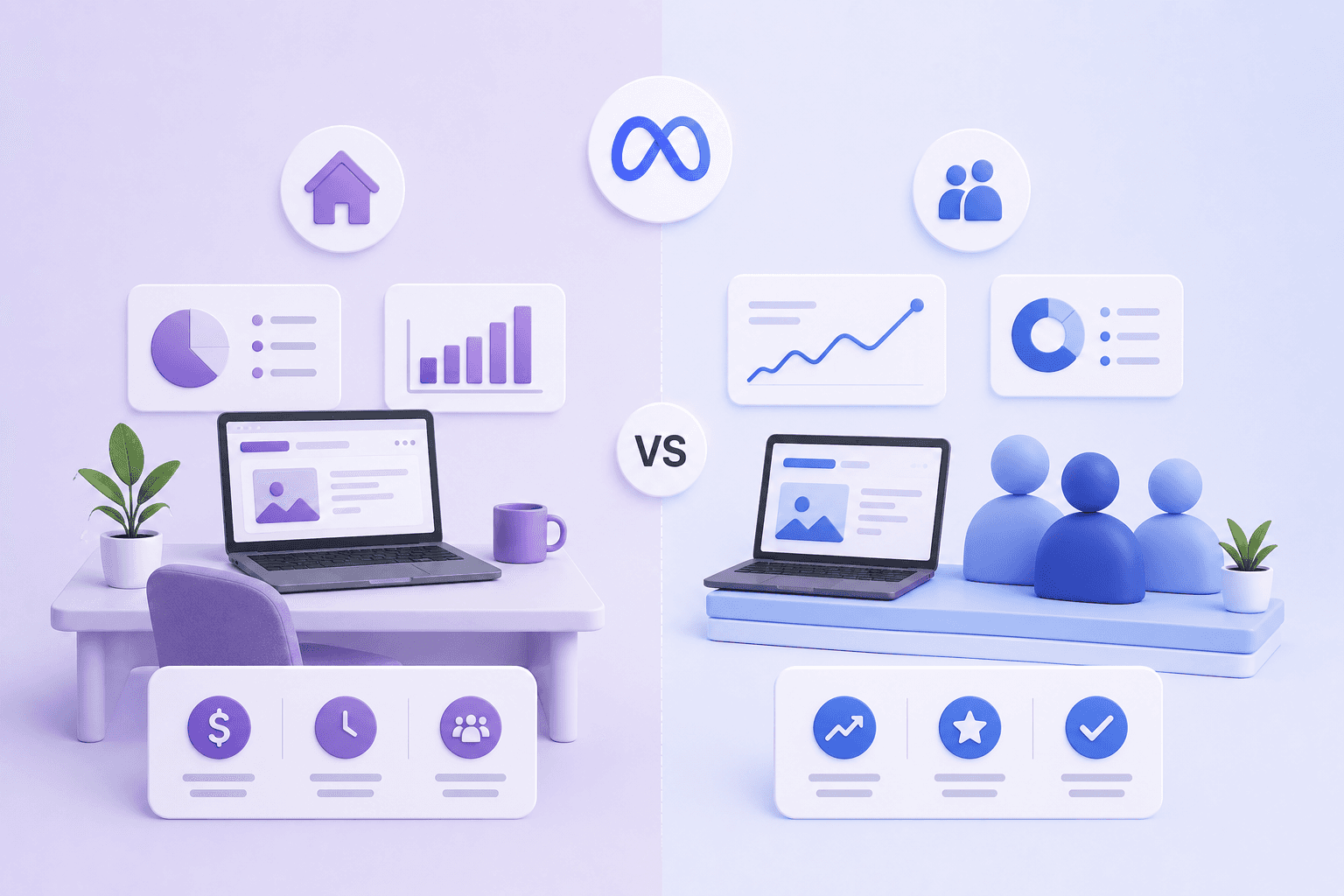
DTC advertisers have two structural advantages that B2B teams don't. The product itself is usually inherently interesting on a paid social feed — a candle, a supplement, a piece of athleisure. And the buyer doesn't need to be educated on what the product is or why it exists. A skincare ad doesn't have to explain skincare.
B2B SaaS gets neither of those benefits. The subject matter is dry. The audience is small. The product often references workflows or features that only a tiny cohort of users have ever interacted with — and if you try to broaden the message to make it more "accessible," you immediately gut its performance.
This leads to the most important — and most counterintuitive — principle in B2B SaaS Meta creative: the creative does the targeting.
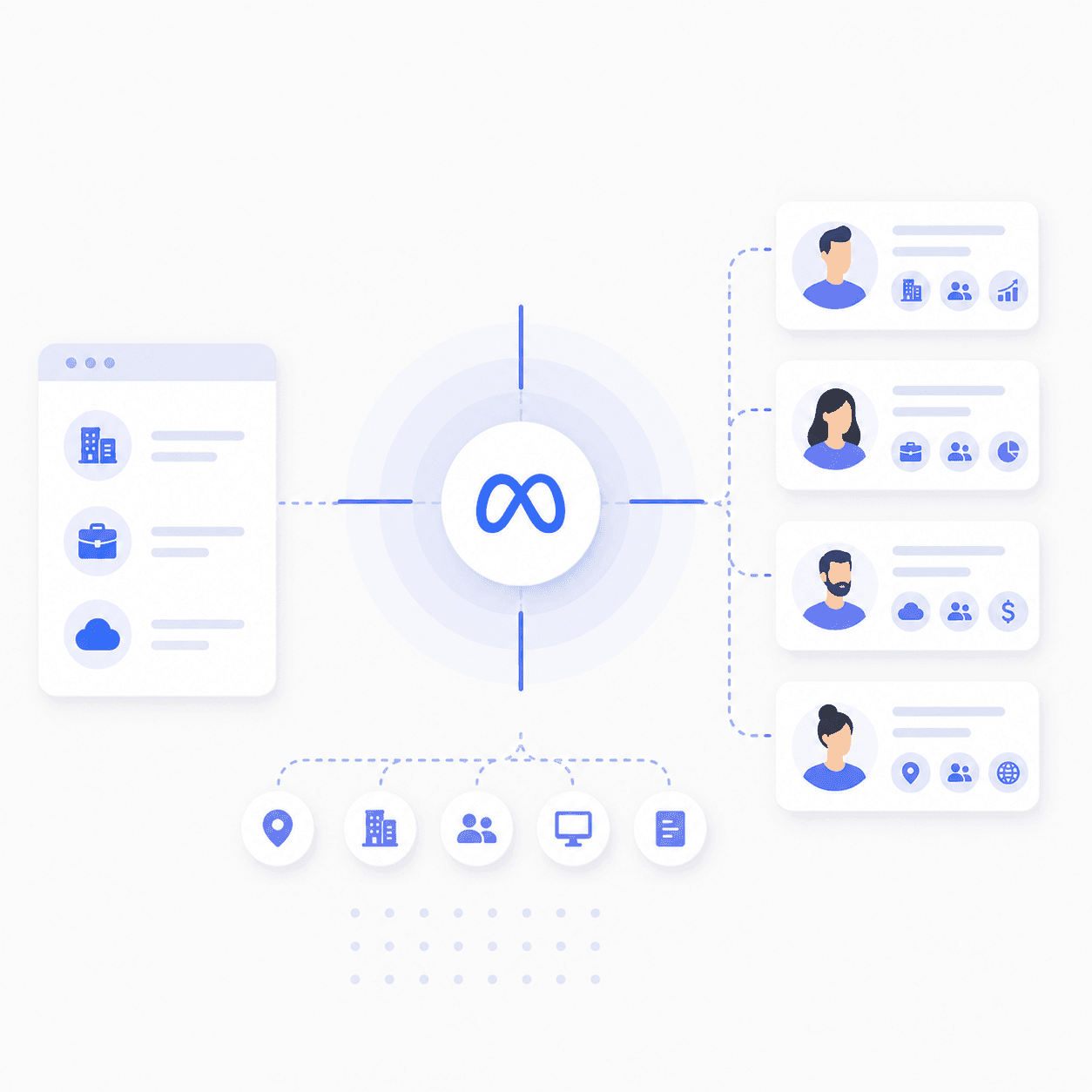
Meta's algorithm can't natively distinguish "VP of Engineering at a Series B SaaS company" from "anyone who clicked on a tech-adjacent post last week." What it can do is observe who responds to a given ad and optimize toward more of those people. So if your ad references something hyperspecific — a feature, a workflow, an industry term, an inside joke — the only people who will engage with it are the people who recognize what you're talking about. Those people are, almost by definition, your ICP. For more on this principle, read our guide to audience targeting for B2B SaaS.
The ads that look the most "arcane" or "too in the weeds" to a generalist marketer are usually the ones that scale. They self-qualify their own audience.
2. The Messaging Matrix: The Four Inputs Behind Every B2B SaaS Ad
A scalable B2B SaaS Meta creative strategy doesn't rely on someone on your team having a brilliant ad idea in the shower. It relies on a structured set of inputs you can recombine into hundreds of testable concepts. You can structure ad concepts at scale using what I call the messaging matrix, and it has four variables.
1. Hyper-specific ICPs
Most B2B teams keep their ICPs way too broad. "CMOs." "Dentists." "Manufacturing company owners." That level of abstraction is useless for Meta creative because it doesn't give the ad anything to grab onto.
A good ICP is much narrower than that, and you should have at least three to five of them. If you're an email marketing software company, your ICPs might look like:
A retention marketing expert whose entire identity is wrapped up in growing the list and is judged at performance reviews on list growth.
A Shopify founder who is a generalist on email — doesn't care about the craft, just wants email revenue to go up.
A performance marketing lead who wants to grow the email list specifically to improve retargeting match rates.
Same product, three radically different people. They respond to different language, different pain points, and different proof points. The whole rest of the matrix flows downstream of how specifically you've defined these.
2. Pain Points Per ICP
For each ICP, generate an exhaustive list of pain points your product solves — at least four per ICP. Vague pain points produce vague ads. The pain points should be specific enough that the ICP would recognize their own week in them.
A useful structure for generating pain points is to map each one to one of four buckets:
Does the product reduce time the ICP spends on a workflow?
Does it improve the quality of work the ICP produces?
Does it save cost for the ICP or their company?
Does it generate revenue for the ICP or their company?
For the retention marketing expert above, the pain points might be missing performance reviews because list growth is too slow, getting confused about why batch send rates look low in the ESP, or losing hours of the week to manually reconciling list segments. Each one of those is a hook waiting to be written.
3. Unique Value Props vs. Each Competitor
The easiest way to scale on Meta is to target buyers who are already solution-aware — they know the category exists and they're actively comparing options. Calling out a competitor is one of the highest-signal hooks you can use on those buyers, because if they recognize the competitor name, they know exactly what your ad is about.
Pick the competitors with the largest brand awareness in your category. Then, for each one, write down how you actually beat them. Price. Ease of use. Quality of output. Integration coverage. Speed to set up. The deliverable here is a concrete list, not a vibe — every line is a potential ad concept.
4. Repeated Competitor Ad Angles
The last input is what your competitors are already running. If three competitors in your category are all hammering the same hook — say, "stop stitching together five tools for X" — that hook is almost certainly a proven winner. Their accounts have already paid the testing cost for you.
Pull a list of competitor ads using an ad spy tool like Foreplay, or just dig through Meta's public ad library. Flag the angles that show up repeatedly across multiple competitors. Those are high-confidence concepts you should be testing against your own positioning.
3. Putting the Matrix to Work
Once you have the four inputs — ICPs, pain points, unique value props, and proven competitor angles — you have everything you need to brief dozens of ads without a single moment of creative block.
The combinatorics do the work for you. Three ICPs times four pain points each times five competitor framings times a handful of proven angles is well over a hundred testable concepts before you've drawn a single thumbnail. Even a junior team member can execute against it.
From there, you plug each variable into the ad formats that work in B2B SaaS on Meta — pain-point-driven VSLs, UGC-style hooks, brandless UI mimicry statics, founder POV videos, stripped-down value prop statics, and tool feature previews. Each variable maps cleanly onto each format. A pain point becomes a VSL hook. A competitor framing becomes a static headline. An ICP call-out becomes the opening line of a UGC clip.
For a full breakdown of which ad formats actually work in B2B SaaS Meta advertising, we've written a complete guide to B2B SaaS ad creative types, with examples.
4. The Best Hooks for B2B SaaS Meta Ads
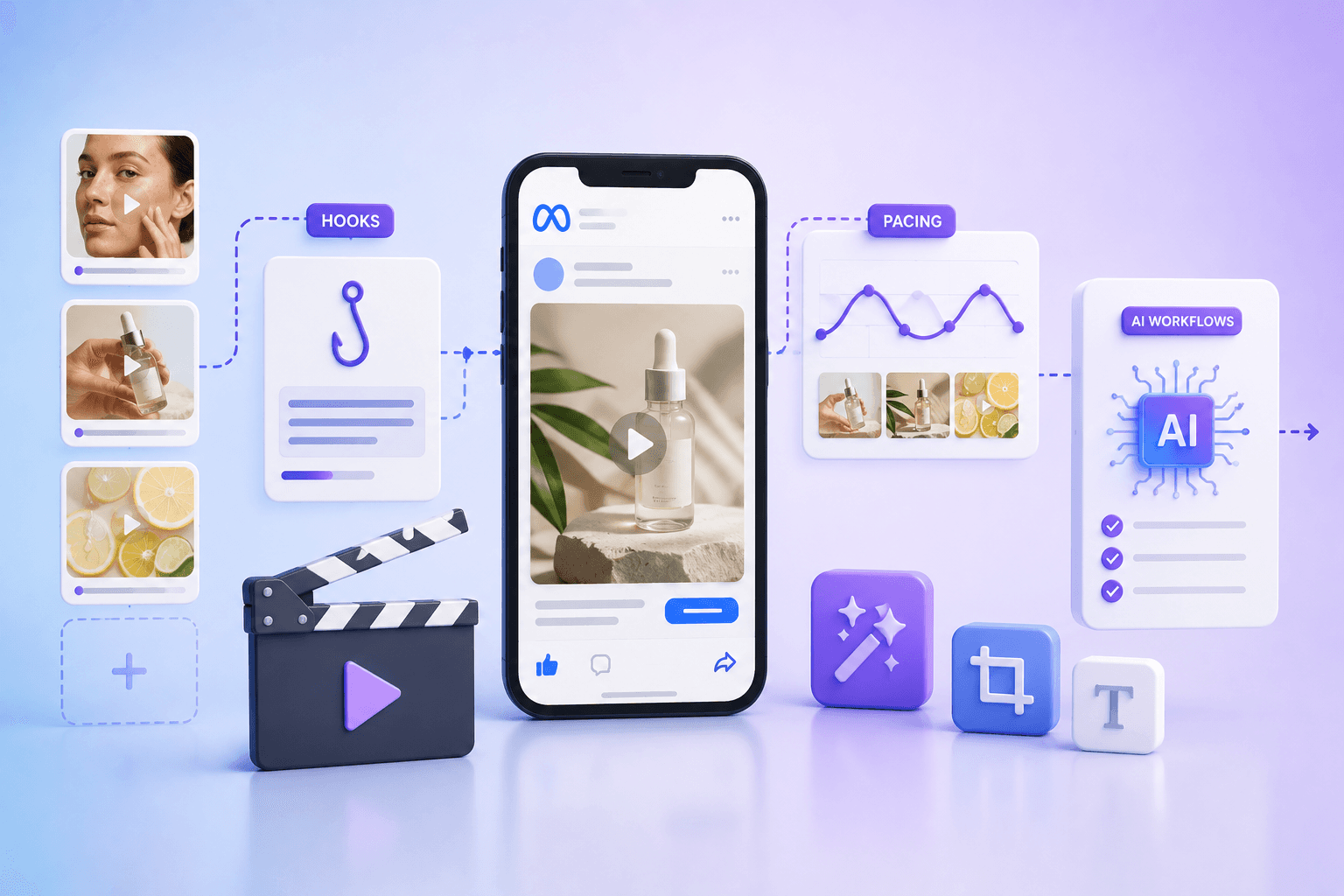
The best hooks for B2B SaaS Meta ads are direct-response angles proven in DTC that almost no other software brands are running. These hooks are outputs of the messaging matrix — each one maps directly to an ICP, a pain point, or a competitor framing.
Why do hooks matter so much? In a 2015 Nielsen study commissioned by Facebook, viewers who watched three seconds or less accounted for up to 47% of a video campaign's total value. Meta's own 2022 attention research reached the same conclusion — feed environments reward introducing the brand in the first few seconds. Flighted tests ad hooks that capture attention in under two seconds. The hook does the work.
Here are the six hook types that perform for B2B SaaS:
Competitor-callout hook: Name a competitor your ICP already uses and frame against it. Example: "Still paying $500/mo for [Competitor]? Here's what we built instead." Use when targeting solution-aware buyers actively comparing options.
Hyper-specific-pain-point ("arcane") hook: Reference a workflow or frustration only your ICP would recognize. Example: "If you've ever spent an hour reconciling Salesforce sync errors, this is for you." Use when you want to self-qualify the audience and filter out generalists.
Skeptic ("I didn't believe it until…") hook: Lead with doubt, then show the proof. Example: "I didn't believe AI could write better sales emails than my team — until we A/B tested it." Use when your product claim sounds too good to be true and needs credibility.
POV / "stop scrolling if you [specific workflow problem]" hook: Call out a specific behavior or role in the first line. Example: "Stop scrolling if you manage paid social for a B2B SaaS and hate building reports every Monday." Use when you need to grab a narrow audience fast.
Founder-POV hook: Have the founder speak directly to camera about the problem they built the product to solve. Example: "I'm [Name], CEO of [Company]. We built this because our team wasted 10 hours a week on manual data entry." Use when founder credibility or origin story resonates with your ICP.
Brandless UI-mimicry static hook: Show your product's interface without heavy branding — let the UI speak. Example: A screenshot of a dashboard with a headline like "This saved our ops team 6 hours/week." Use when your product has a clear, visual workflow and the interface itself is the proof.
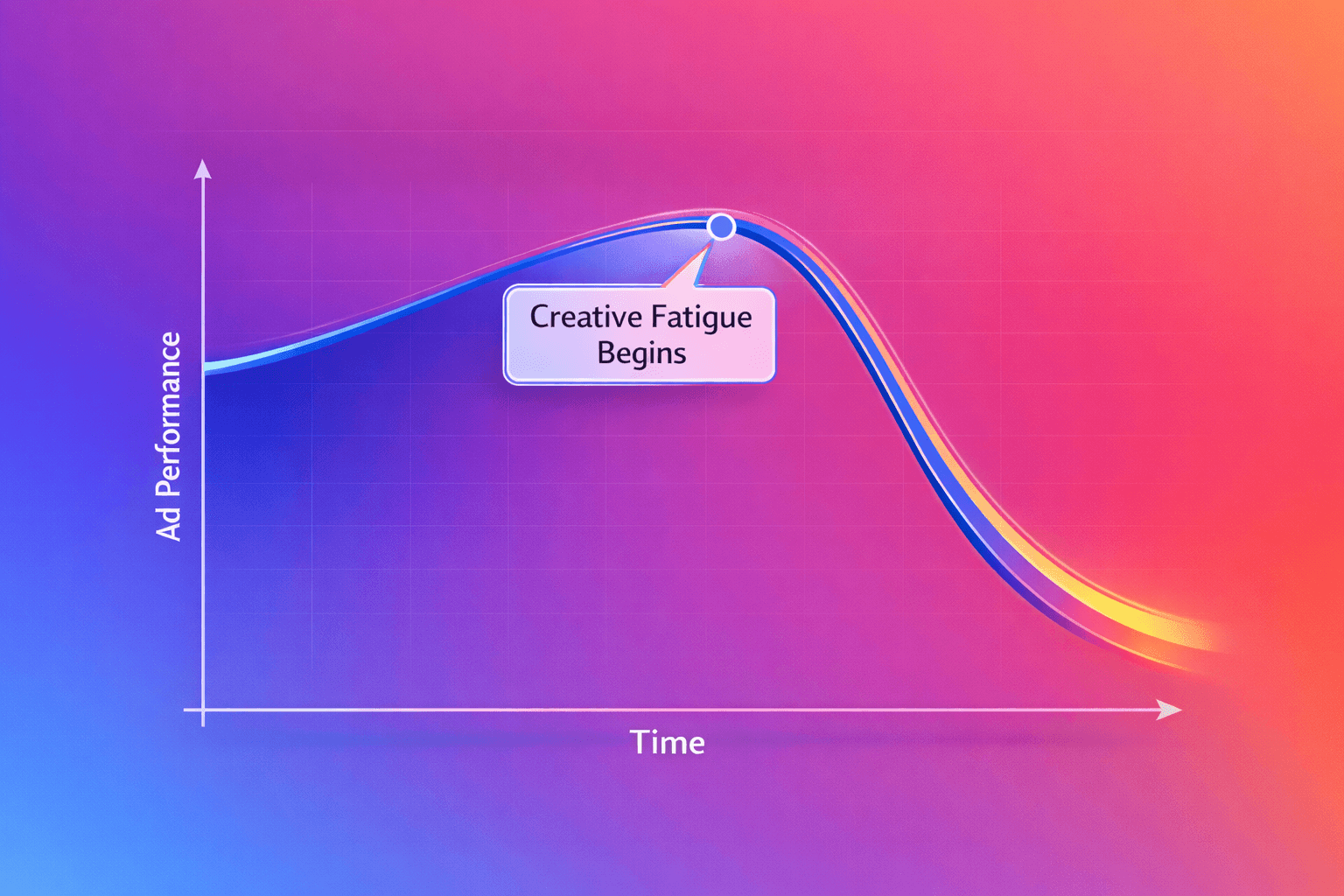
When you test multiple hooks at volume, you need a system to prevent creative fatigue. Rotate angles, refresh creative, and retire winners before they burn out.
Final Thoughts
The teams winning on Meta in B2B SaaS in 2026 aren't the ones with the most creative team. They're the ones who've stopped relying on inspiration entirely and built a system that produces ad concepts on demand. Hyper-specific ICPs. Pain points mapped to time, quality, cost, and revenue. Unique value props against named competitors. Repeated angles pulled straight out of competitor ad libraries. Proven hooks that most software brands aren't running. If you want a profitable B2B SaaS Meta ads strategy, start with the matrix.
Flighted is a B2B SaaS growth agency that brings Paid Media Expertise, Creative Strategy, and Landing Page Design together as one system — with Meta Ads management at the core.
Get those four variables right and the rest of B2B SaaS Meta creative is mostly execution. Get them wrong and the best ad designer in the world won't save the account.
Key Takeaways
Broad ICPs (ideal customer profiles) kill performance. Replace "CMOs" or "dentists" with 3–5 hyper-specific personas defined by role, motivation, and how they're measured at work.
The creative does the targeting. Meta's algorithm can't natively distinguish niche B2B buyers, so hyper-specific references in your ad copy self-qualify the audience. Arcane beats accessible.
Generate at least 4 pain points per ICP, mapped to four buckets: reduce time, improve quality, save cost, or generate revenue.
Target solution-aware buyers by framing against named competitors. Pick the largest competitors in your category and write down concretely how you beat each one — price, ease of use, speed, integrations, output quality.
Steal proven angles from competitor ad libraries. If three competitors are running the same hook, they've already paid the testing cost. Use Foreplay or Meta's public ad library to surface repeated angles.
The messaging matrix is the system. ICPs × pain points × competitor UVPs × proven angles = hundreds of testable concepts without relying on inspiration.
Plug each variable into proven B2B SaaS ad formats — VSLs (video sales letters), UGC (user-generated content), brandless UI mimicry statics, founder POVs, stripped-down value props, tool feature previews.
The best hooks for B2B SaaS Meta ads are DTC-proven direct-response angles most software brands aren't running: competitor callouts, hyper-specific pain points, skeptic hooks, POV hooks, founder POVs, and brandless UI mimicry.
Stop relying on shower thoughts. The teams winning on Meta in 2026 have replaced creative inspiration with a structured input system any team member can execute against.
1. What Makes B2B Meta Creative Different from DTC
DTC advertisers have two structural advantages that B2B teams don't. The product itself is usually inherently interesting on a paid social feed — a candle, a supplement, a piece of athleisure. And the buyer doesn't need to be educated on what the product is or why it exists. A skincare ad doesn't have to explain skincare.
B2B SaaS gets neither of those benefits. The subject matter is dry. The audience is small. The product often references workflows or features that only a tiny cohort of users have ever interacted with — and if you try to broaden the message to make it more "accessible," you immediately gut its performance.
This leads to the most important — and most counterintuitive — principle in B2B SaaS Meta creative: the creative does the targeting.
Meta's algorithm can't natively distinguish "VP of Engineering at a Series B SaaS company" from "anyone who clicked on a tech-adjacent post last week." What it can do is observe who responds to a given ad and optimize toward more of those people. So if your ad references something hyperspecific — a feature, a workflow, an industry term, an inside joke — the only people who will engage with it are the people who recognize what you're talking about. Those people are, almost by definition, your ICP. For more on this principle, read our guide to audience targeting for B2B SaaS.
The ads that look the most "arcane" or "too in the weeds" to a generalist marketer are usually the ones that scale. They self-qualify their own audience.
2. The Messaging Matrix: The Four Inputs Behind Every B2B SaaS Ad
A scalable B2B SaaS Meta creative strategy doesn't rely on someone on your team having a brilliant ad idea in the shower. It relies on a structured set of inputs you can recombine into hundreds of testable concepts. You can structure ad concepts at scale using what I call the messaging matrix, and it has four variables.
1. Hyper-specific ICPs
Most B2B teams keep their ICPs way too broad. "CMOs." "Dentists." "Manufacturing company owners." That level of abstraction is useless for Meta creative because it doesn't give the ad anything to grab onto.
A good ICP is much narrower than that, and you should have at least three to five of them. If you're an email marketing software company, your ICPs might look like:
A retention marketing expert whose entire identity is wrapped up in growing the list and is judged at performance reviews on list growth.
A Shopify founder who is a generalist on email — doesn't care about the craft, just wants email revenue to go up.
A performance marketing lead who wants to grow the email list specifically to improve retargeting match rates.
Same product, three radically different people. They respond to different language, different pain points, and different proof points. The whole rest of the matrix flows downstream of how specifically you've defined these.
2. Pain Points Per ICP
For each ICP, generate an exhaustive list of pain points your product solves — at least four per ICP. Vague pain points produce vague ads. The pain points should be specific enough that the ICP would recognize their own week in them.
A useful structure for generating pain points is to map each one to one of four buckets:
Does the product reduce time the ICP spends on a workflow?
Does it improve the quality of work the ICP produces?
Does it save cost for the ICP or their company?
Does it generate revenue for the ICP or their company?
For the retention marketing expert above, the pain points might be missing performance reviews because list growth is too slow, getting confused about why batch send rates look low in the ESP, or losing hours of the week to manually reconciling list segments. Each one of those is a hook waiting to be written.
3. Unique Value Props vs. Each Competitor
The easiest way to scale on Meta is to target buyers who are already solution-aware — they know the category exists and they're actively comparing options. Calling out a competitor is one of the highest-signal hooks you can use on those buyers, because if they recognize the competitor name, they know exactly what your ad is about.
Pick the competitors with the largest brand awareness in your category. Then, for each one, write down how you actually beat them. Price. Ease of use. Quality of output. Integration coverage. Speed to set up. The deliverable here is a concrete list, not a vibe — every line is a potential ad concept.
4. Repeated Competitor Ad Angles
The last input is what your competitors are already running. If three competitors in your category are all hammering the same hook — say, "stop stitching together five tools for X" — that hook is almost certainly a proven winner. Their accounts have already paid the testing cost for you.
Pull a list of competitor ads using an ad spy tool like Foreplay, or just dig through Meta's public ad library. Flag the angles that show up repeatedly across multiple competitors. Those are high-confidence concepts you should be testing against your own positioning.
3. Putting the Matrix to Work
Once you have the four inputs — ICPs, pain points, unique value props, and proven competitor angles — you have everything you need to brief dozens of ads without a single moment of creative block.
The combinatorics do the work for you. Three ICPs times four pain points each times five competitor framings times a handful of proven angles is well over a hundred testable concepts before you've drawn a single thumbnail. Even a junior team member can execute against it.
From there, you plug each variable into the ad formats that work in B2B SaaS on Meta — pain-point-driven VSLs, UGC-style hooks, brandless UI mimicry statics, founder POV videos, stripped-down value prop statics, and tool feature previews. Each variable maps cleanly onto each format. A pain point becomes a VSL hook. A competitor framing becomes a static headline. An ICP call-out becomes the opening line of a UGC clip.
For a full breakdown of which ad formats actually work in B2B SaaS Meta advertising, we've written a complete guide to B2B SaaS ad creative types, with examples.
4. The Best Hooks for B2B SaaS Meta Ads
The best hooks for B2B SaaS Meta ads are direct-response angles proven in DTC that almost no other software brands are running. These hooks are outputs of the messaging matrix — each one maps directly to an ICP, a pain point, or a competitor framing.
Why do hooks matter so much? In a 2015 Nielsen study commissioned by Facebook, viewers who watched three seconds or less accounted for up to 47% of a video campaign's total value. Meta's own 2022 attention research reached the same conclusion — feed environments reward introducing the brand in the first few seconds. Flighted tests ad hooks that capture attention in under two seconds. The hook does the work.
Here are the six hook types that perform for B2B SaaS:
Competitor-callout hook: Name a competitor your ICP already uses and frame against it. Example: "Still paying $500/mo for [Competitor]? Here's what we built instead." Use when targeting solution-aware buyers actively comparing options.
Hyper-specific-pain-point ("arcane") hook: Reference a workflow or frustration only your ICP would recognize. Example: "If you've ever spent an hour reconciling Salesforce sync errors, this is for you." Use when you want to self-qualify the audience and filter out generalists.
Skeptic ("I didn't believe it until…") hook: Lead with doubt, then show the proof. Example: "I didn't believe AI could write better sales emails than my team — until we A/B tested it." Use when your product claim sounds too good to be true and needs credibility.
POV / "stop scrolling if you [specific workflow problem]" hook: Call out a specific behavior or role in the first line. Example: "Stop scrolling if you manage paid social for a B2B SaaS and hate building reports every Monday." Use when you need to grab a narrow audience fast.
Founder-POV hook: Have the founder speak directly to camera about the problem they built the product to solve. Example: "I'm [Name], CEO of [Company]. We built this because our team wasted 10 hours a week on manual data entry." Use when founder credibility or origin story resonates with your ICP.
Brandless UI-mimicry static hook: Show your product's interface without heavy branding — let the UI speak. Example: A screenshot of a dashboard with a headline like "This saved our ops team 6 hours/week." Use when your product has a clear, visual workflow and the interface itself is the proof.
When you test multiple hooks at volume, you need a system to prevent creative fatigue. Rotate angles, refresh creative, and retire winners before they burn out.
Final Thoughts
The teams winning on Meta in B2B SaaS in 2026 aren't the ones with the most creative team. They're the ones who've stopped relying on inspiration entirely and built a system that produces ad concepts on demand. Hyper-specific ICPs. Pain points mapped to time, quality, cost, and revenue. Unique value props against named competitors. Repeated angles pulled straight out of competitor ad libraries. Proven hooks that most software brands aren't running. If you want a profitable B2B SaaS Meta ads strategy, start with the matrix.
Flighted is a B2B SaaS growth agency that brings Paid Media Expertise, Creative Strategy, and Landing Page Design together as one system — with Meta Ads management at the core.
Get those four variables right and the rest of B2B SaaS Meta creative is mostly execution. Get them wrong and the best ad designer in the world won't save the account.
Related Posts
Related Posts
Related Posts
Related Posts


































Ready to talk?
New York, NY 11217
hello@flighted.co
© Flighted, 2026
Ready to talk?
New York, NY 11217
hello@flighted.co
© Flighted, 2026