What is Marketing Mix Modeling? A Guide For Growth Leaders
Paid Media
August 11, 2026

Table Of Contents
Looking for paid media support?
We're a small, hardworking, US-based team. Book a call and get a free audit today.
5. MMM vs. Multi-Touch Attribution vs. Incrementality
Marketing mix modeling isn't the only measurement approach—but it answers a different question than multi-touch attribution (MTA) or incrementality testing. Here's the comparison:
Dimension | Marketing Mix Modeling (MMM) | Multi-Touch Attribution (MTA) | Incrementality Testing |
|---|---|---|---|
Data level | Aggregate (weekly/daily totals) | User-level (cookies, device IDs) | Test vs. control groups |
What it measures | Long-term channel contribution to sales | Touchpoints along the digital path | Causal lift from a specific change |
Privacy resilience | High—no user-level tracking | Low—depends on cookies and consent | Medium—requires holdouts, not tracking |
Best use | Macro budget allocation across channels | Intra-channel optimization, path analysis | Validating a channel or tactic |
Key point: These methods are complementary, not rivals. Use MMM to decide how much goes to Meta vs. Google vs. offline. Use MTA for within-channel path insight. Use incrementality tests to validate that spend caused lift.
The Breakdown Effect: Why In-Platform Metrics Mislead
At Flighted, we optimize toward incrementality, not just ad-level CPA or ROAS. Here's why.
Pausing a high-spend ad that looks bad on CPA can collapse whole-account performance. We call it the Breakdown Effect. That "expensive" ad is often generating top-of-funnel demand that other, cheaper-looking ads convert. Kill it, and the ads that looked efficient suddenly stop performing, because the demand feeding them is gone. This is exactly why account structure decisions cannot be made on ad-level metrics alone. For the mechanics, see our guide to the best Meta Ads account structure for 2026.
6. What MMM Means for Your Paid Social Program
MMM won't replace your day-to-day ad buying. But it should change how you evaluate channels:
Trust spend allocation over ad-level metrics. In a consolidated account, the signal you care about is total spend by channel, not individual ad CPA.
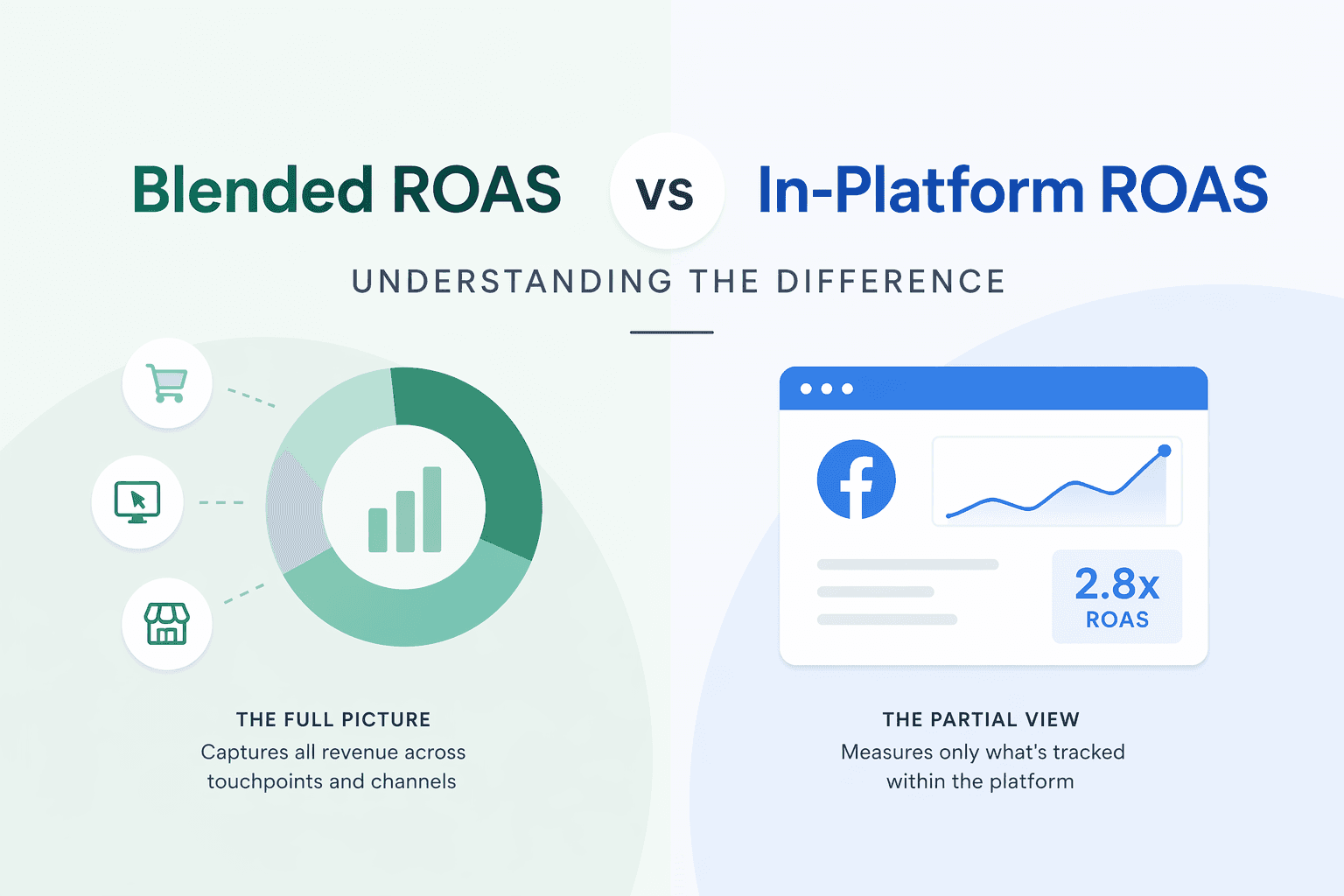
Watch blended MER, not just platform ROAS. MER (total revenue ÷ total ad spend) is what hit the bank. We often start Facebook ROAS targets 20–30% lower than blended MER. See the difference between ROAS and MER.
Use MMM's macro view alongside your buying. Let the model tell you where budget should move; let your Meta ads best practices tell you how to spend within Meta.
At Flighted, turning measurement insight into growth requires three pillars working together:
Paid Media Expertise: Meta Ads management, account structure (Advantage+ vs. manual, CBO vs. ABO), bidding, scaling.
Creative Strategy: Message testing, variant production.
Landing Page Design: Converting the traffic you pay for.
MMM gives you the budget roadmap; the pillars execute it.
A Real Example: Finding Hidden Incremental Value
Cat Person, owned by Harry's, ran a weekly "How Did You Hear About Us?" (HDYHAU) survey. That first-party signal revealed something in-platform reporting missed: YouTube was a highly efficient new-customer channel that Google's in-platform reporting undervalued, because it rarely earned last-click credit. Acting on the incremental read rather than the last-click read, Flighted increased top-of-funnel YouTube budget and cut CPA while scaling spend. See the full Cat Person case study on reducing CPA while scaling spend.
7. MMM Tools And Provider Selection
Once you decide to model, you have to pick tools and providers. This is where most teams stall, so here is what to actually evaluate. There are two dominant open-source engines, three commercial archetypes, and a short list of selection criteria that will save you from an expensive mistake.
Google Meridian
Meridian is the open-source marketing mix model built by Google, available to all marketers and data scientists, launched publicly on January 29, 2025. It carries no software license fee. It relies on Bayesian causal inference that blends your prior knowledge with real-world data, and it easily integrates incrementality experiment results as priors, agnostic of the channel or experiment. Because it relies on aggregated data, it measures performance in a privacy-centric way.
You also get full transparency. As an open-source framework, Meridian offers full transparency, letting you examine its code and methodology and modify the code and model parameters to fit your needs. The catch is capability: Meridian fits mid-market brands that have data scientists or people savvy with analytics in-house. If you do not, Meridian is not a shortcut. Read Google's Meridian launch announcement.
Meta Robyn
Robyn is an experimental, AI/ML-powered, open-sourced marketing mix modeling package from Meta Marketing Science. Keep the word "experimental" front of mind; that is Meta's own label, not ours. On the method, Robyn uses ridge regression to regularize multicollinearity and prevent overfitting, and automated hyperparameter optimization with evolutionary algorithms from Meta's Nevergrad library. It calibrates models based on ground-truth methodologies such as geo tests, Meta lift studies, and MTA. It is privacy-friendly and uses no personally identifiable information or cookies.
On fit: Robyn is built for granular datasets with many independent variables, and is therefore especially suitable for digital and direct-response advertisers with rich data sources. That describes most DTC brands spending six figures a month across Meta, Google, and TikTok. Read the Meta Robyn documentation.
Build vs. Buy: Three Archetypes
Do not assume open-source is the cheap option. It is not. There are three archetypes, and their three-year total cost of ownership tends to converge.
Open-source (Meridian or Robyn). No license fee, but heavy analyst and data-science labor. Improvado estimates year-one all-in costs of roughly $76K to $129K once you account for the people who build and maintain it.
Self-service SaaS. Improvado puts self-service platforms at $24K to $60K per year in software, plus 15 to 20 analyst hours per week.
Managed services. Improvado puts managed services at $50K to $200K+ per engagement.
The trade is labor for license fees, not a genuine discount. See the Improvado provider, pricing, and TCO breakdown. If you build in-house on an open-source foundation, budget the calendar too: Measured estimates a typical in-house build takes 6 to 12+ months to launch, with ongoing iteration after that.
How To Choose: An Operator Checklist
Use these criteria before you sign anything. Most come from Gartner's MMM guidance for CMOs, published July 23, 2025.
Demand a real track record. Gartner advises focusing on vendors with a proven track record of delivering MMM solutions for at least three years. Rule out first-year tools for a budget-defining decision.
Watch for conflicts of interest. Gartner warns to be cautious of providers involved in media-buying, strategy, or owning advertising-supported platforms, as these can introduce conflicts of interest. A vendor that also sells you media has a reason to overstate its own channels.
Expect opaque pricing. Gartner notes most vendors do not list prices on their websites and price on a one-to-one basis during the sales process, which makes comparing value difficult. Get at least three quotes and normalize them yourself.
Check model portability and lock-in. Improvado's lock-in audit scores open-source tools like Meridian and Robyn a 10 out of 10 because you can walk away anytime with complete model ownership, while a managed service can score as low as 2.5, meaning you start from scratch with a new vendor if you leave. If a managed vendor will not share the model code, assume you own nothing when the contract ends.
Net it out: pick open-source if you have data-science muscle and want ownership, SaaS if you want speed with a smaller analytics team, and managed services if you want to outsource the whole build and can afford the premium.
8. How To Get Started With Marketing Mix Modeling
You do not need a perfect model to get value. You need a disciplined first pass. Run these five steps.
Inventory your data. Confirm you have 18 to 24 months of clean, weekly spend and revenue data, plus external factors. If it is messy, fix it before modeling.
Decide build vs. buy. Choose your archetype using Section 7. On the open-source side, evaluate Google Meridian and Meta Robyn against your in-house capability.
Start simple. Build a focused single-brand model in 8 to 12 weeks. Do not try to model every channel and every promotion in version one.
Validate with incrementality tests. Confirm the model's biggest recommendations with geo-holdout or lift tests before you move real budget. See our guide to testing Meta Ads for CPG startups.
Re-run quarterly. Refresh with new data, recalibrate, and compare coefficients against the prior version so you catch drift early.
9. MMM Challenges And Troubleshooting
MMM is powerful, but it fails in predictable ways. Know the pitfalls and the fixes before you stake a budget decision on the output.
Insufficient or dirty data. Improvado notes MMM requires 18 to 24 months of weekly data (a minimum of roughly 80 to 100 observations) to produce stable coefficient estimates, and that organizations under about $1M in annual spend lack the sample size for stable coefficients. Quality matters as much as quantity: Circana states that successful marketing mix modeling depends on the quality and completeness of the data it is built on, and that poor data inputs lead to inaccurate models and unreliable predictions. Fix: clean and complete your data before you model, not after. Read Circana on improving MMM effectiveness and the Improvado provider guide.
Multicollinearity. When two channels move together, the model cannot separate their individual contributions. As a practitioner heuristic (not an official standard), Improvado suggests that when two channels correlate above 0.7 you consider aggregating them into a single variable such as "paid social," and treats VIF above 10 as a failure-level warning. Fix: aggregate correlated channels or lengthen the data window. Note that ridge regression, as used in Robyn, is designed to regularize this.
Correlation vs. causation. MMM finds correlations, not proof of cause. Improvado notes a spike in sales might coincide with increased TV spend while the real driver was something else, like a competitor's product recall or a viral moment. Reallocating purely on coefficients risks cutting a channel that actually drives lift. Fix: pair MMM with incrementality and holdout testing. This is the same incrementality-first discipline Flighted applies to paid social.
Overfitting. A model that is too complex captures noise instead of signal and predicts the future poorly. Fix: balance complexity against generalizability, and resist adding variables just because you have them.
Model degradation. Models decay as consumer behavior, competitors, and platform algorithms shift. As a practitioner best practice (not an official standard), Measured recommends quarterly recalibration for most organizations, monthly updates for fast-moving categories or major changes, and warns that annual-only updates risk going stale. Fix: recalibrate quarterly, monthly for fast-moving categories, and compare each version's coefficients against the last.
B2B limitation. Be realistic about where MMM struggles. Gartner states MMM builds more credibility for B2C than B2B, because B2B sales journeys vary greatly, with some deals taking months or years to close, and time-series methods struggle with that variability, making MMM ineffective for proving marketing's value in B2B. But it is not all-or-nothing: Gartner adds that MMM can support marketing optimization for B2B given enough working media spend and well-defined mid-funnel outcomes, such as optimizing for marketing-qualified-lead generation. Fix: in B2B, aim MMM at mid-funnel optimization (like MQL generation), not at proving end-to-end pipeline value. See Gartner's MMM guidance.
The Bottom Line For Growth Leaders
Marketing mix modeling is the privacy-durable, aggregate way to see what actually drives sales. It does not depend on cookies, so it holds up while user-level tracking keeps eroding. It is not a replacement for multi-touch attribution or incrementality testing; it complements them. Triangulate across all three.
The operating principle is simple: measure at the business level, then execute at the channel level. Watch blended MER, not just platform ROAS. Trust the model's spend allocation over ad-level metrics, and validate the big moves with incrementality tests. Then let the three pillars of Paid Media Expertise, Creative Strategy, and Landing Page Design turn that allocation into revenue.
Frequently Asked Questions
What is marketing mix modeling?
Marketing mix modeling (MMM) is a statistical method that uses historical, aggregated data and regression analysis to estimate how each marketing channel and external factor (seasonality, promotions, pricing) drives sales. It lets you reallocate budget toward what actually earns, without any user-level tracking. That makes it durable in a post-cookie, post-ATT world.
How does marketing mix modeling work?
MMM gathers two to five years of weekly spend, revenue, and external-factor data, then runs regression to separate baseline sales from the incremental lift each channel adds. It controls for seasonality and promotions, produces response curves that show diminishing returns, and outputs an optimized budget mix. The result is a macro allocation you can defend to finance.
What are the best marketing mix modeling tools?
The two leading open-source engines are Google Meridian and Meta Robyn, both free to download and use but demanding on in-house data-science skill. Commercial options split into self-service SaaS platforms and fully managed services. Choose based on your analytics capability, budget, and how much model ownership you want to retain.
Is marketing mix modeling the same as media mix modeling?
Yes. "Marketing mix modeling" and "media mix modeling" are used interchangeably, and both abbreviate to MMM. Some teams use "media mix modeling" when the focus is narrowly on paid media channels, but the method is the same.
How is MMM different from multi-touch attribution?
MMM works on aggregate data to estimate long-term channel contribution and guide macro budget allocation. Multi-touch attribution works on user-level data to map touchpoints along the digital path and optimize within channels. MMM is highly privacy-resilient; MTA is not, because it depends on cookies and device IDs. Use them together.
How much data do you need for marketing mix modeling?
Most models use two to five years of weekly data, with 18 to 24 months as a practical minimum for stable estimates. Practitioners also flag a rough $1M+ annual spend threshold for reliable coefficients. If you have 18 to 24 months of clean data, you have enough to start a focused model.
Does MMM work without third-party cookies?
Yes. MMM never relied on cookies or user-level tracking. It uses aggregated spend and revenue data, so cookie deprecation, ATT, and ad blockers do not degrade it the way they degrade multi-touch attribution.
Is marketing mix modeling only for big enterprises?
No. Historically it was an enterprise-only exercise, but open-source tools like Google Meridian and Meta Robyn and self-service SaaS platforms have brought it within reach of mid-market DTC brands. If you have 18 to 24 months of clean data and roughly $1M+ in annual spend, you can run a useful model.