From Zero To a 6-Figure Meta Ads ACV For Podium
Intro
Podium, an AI agent software company serving businesses, partnered with Flighted to launch and scale paid social with a performance-first approach. Starting from zero, the objective was to build a Meta acquisition engine via a Meta agency partner that could drive qualified demand efficiently, establish cost benchmarks quickly, and create a repeatable system for scale.
The launch plan centered on a phased media buying strategy: begin with streamlined creative testing, identify winning messages and formats, then layer in audience testing, lower-funnel conversion optimization, and creative scale. The result was a launch that exceeded expectations in both revenue generation and media efficiency.
In the first 60 days, Podium scaled from zero to six figures in annual contract value generated in the first month and achieved a 3.98 pipeline ROI, outperforming both revenue and efficiency goals for launch.
An Account Structure Built for Rapid Creative Testing
Flighted designed the account to prioritize speed of learning without overcomplicating the initial setup. The launch plan began with a creative testing campaign using campaign budget optimization and highest-volume bidding, allowing Meta to allocate spend dynamically toward the best-performing assets while maintaining efficiency. The initial campaign was built around broad targeting with all-time leads excluded, giving the algorithm room to find the highest-intent pockets of demand while avoiding wasted spend on existing contacts.
Once the first round of data was collected, the account structure was built to evolve. Winning creatives were consolidated into a dedicated scaling campaign using post IDs so Podium could preserve engagement history, maintain social proof, and carry learnings forward. Alongside that, Flighted planned parallel audience testing across broad, lookalike, themed interest, and Advantage+ audiences to identify the best balance between scale and efficiency.
This approach kept the account simple in the early phase, which is critical in a new launch, but structured enough to support more advanced testing once signal density improved. Instead of fragmenting budget too early, the strategy focused first on creative signal, then on audience refinement, then on event optimization.
Conversion Optimization and Funnel Strategy
The funnel strategy was built around sequencing. Rather than optimizing immediately for a deeper-funnel event with limited data, Flighted’s launch plan started by optimizing for booked demos in order to generate volume, establish baseline CPLs, and understand how Meta traffic converted through the funnel. The goal in the early phase was to learn quickly: identify which messages drove response, what traffic quality looked like, and where performance benchmarks landed across CPC, CPM, and lead conversion rate.
From there, the plan called for a conversion shift once enough data existed. After accumulating at least 25 qualified lead conversions, the next step was to launch a dedicated campaign optimized toward qualified leads, using proven creatives and broad targeting to help Meta train against a more valuable event. This is a strong lower-funnel progression: first optimize for volume to create learning, then optimize for quality once there is enough historical signal.
The launch plan also included landing page and funnel testing. After building a performance baseline on Podium’s current landing page, Flighted planned a 50/50 URL redirect test against a purpose-built paid landing page. The winning experience would then be rolled out to all traffic. This ensured that growth would not rely only on media buying improvements, but also on funnel conversion rate improvements.
Creative Strategy
The creative strategy was intentionally built as our primary growth lever. The initial plan called for testing 4 to 8 unique adsets of Flighted-produced creative, alongside top-performing organic social assets, user-generated content, and boosted Instagram Reels where relevant. That mix gave Podium immediate variety while keeping production nimble.
We focused on targeting hyper-specific customer avatars, what we call "micro personas", who would respond immediately to being called out in the hook or headline of an ad. This went deeper than simply advertising Podium's core feature set: we went after personas like "Overwhelmed Med Spa Owner", or "Busy Front Desk Manager", knowing this would make our ads more likely to resonate.
We conducted a thorough analysis of the ads that we had running already, picking up on patterns across our top performers, and even analyzed Reddit for insights on the challenges that their core ICP was facing that we could repurpose in our ad messaging.
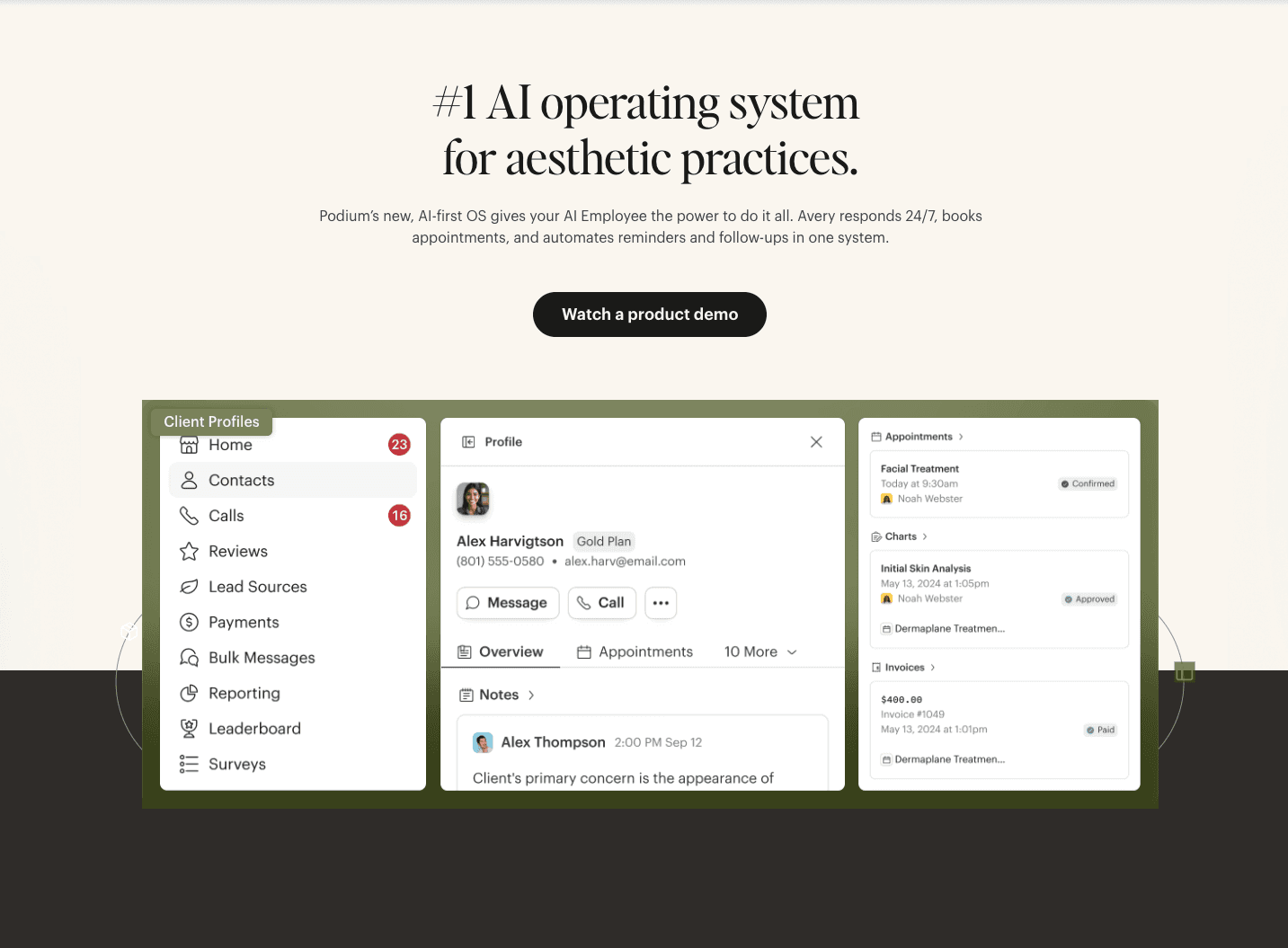
The result of this thorough creative analysis led to social-native ads with compelling hooks like the below:
The longer-term roadmap extended beyond standard direct-response creative. The launch plan included whitelisting, creator-led ads, advertorial-style landing page flows, higher-quality net-new UGC, ambassador partnerships, and a broader creative production flywheel designed to increase output without creating operational strain on Podium’s internal team.
This is one of the clearest strengths of the strategy: creative was not treated as a one-time launch asset, but as an ongoing system. Testing was designed to uncover winning messaging quickly, then scale those messages across new formats, new identities, and new funnel entry points.
Results
The outcome of this launch validated the structure of the strategy.
Within the first 60 days of partnering with us as their growth agency, Podium:
Scale from zero to six figures in ACV generated in the first month
Achieve a 3.98 pipeline ROI
Outperform both revenue and efficiency goals for launch
Those results reflect more than strong top-line performance. They show that the launch plan successfully balanced scale with efficiency, built an acquisition system quickly, and translated media spend into meaningful pipeline impact. Rather than relying on a single campaign or short-term tactic, the account was set up to generate learnings fast, compound what worked, and move steadily toward higher-quality conversion optimization over time.