Cutting Bliss & Bone's CPA by 57%
Service
Service
Meta Ads
Meta Ads
Quick Stat
Quick Stat
-57% CPA Reduction
-57% CPA Reduction
Year
Year
11 September, 2026
11 September, 2026
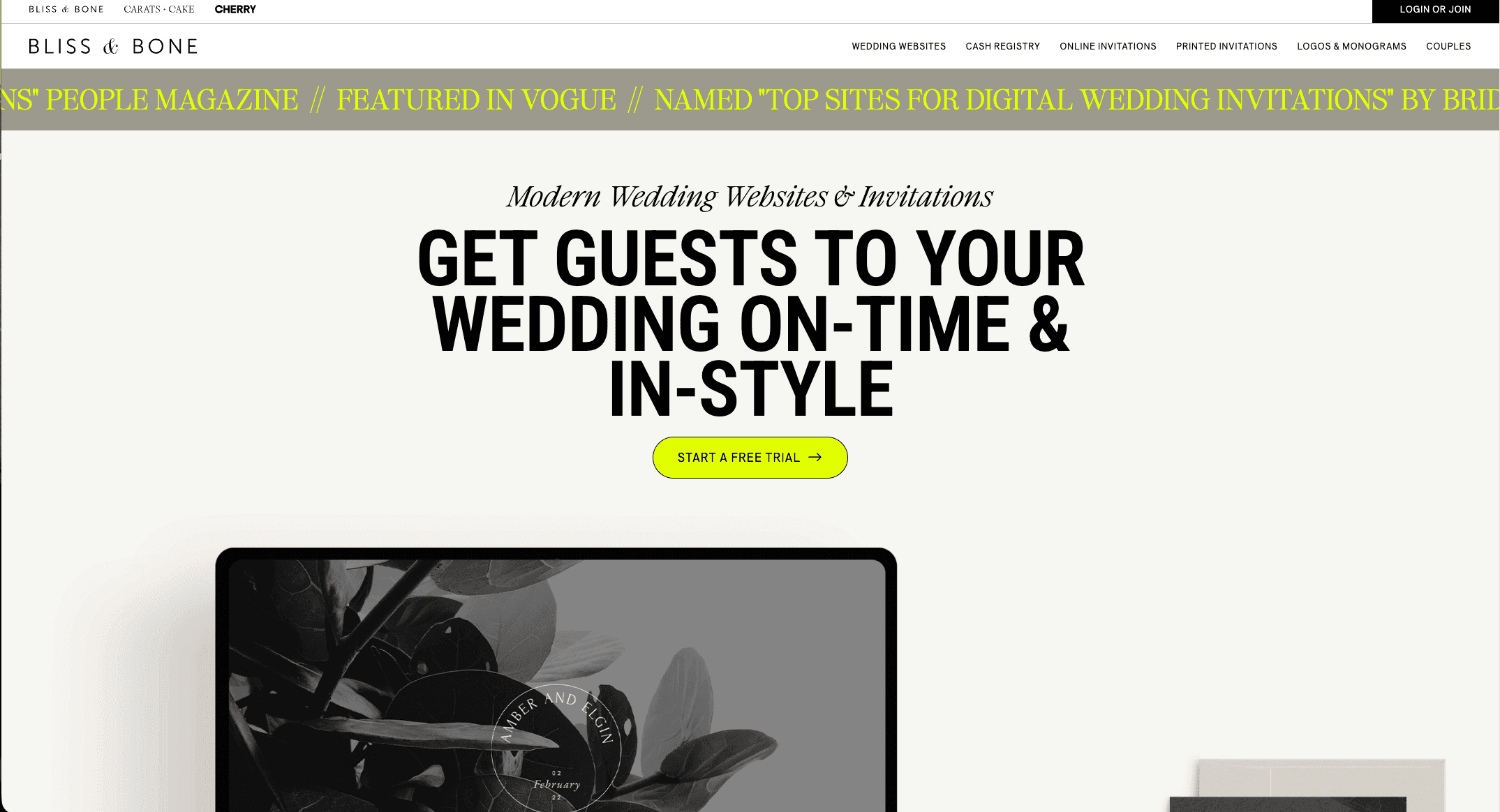
Bliss & Bone makes modern, design-forward wedding websites and invitations. Couples pick from 100+ templates, start a 7-day free trial, and convert into paying subscribers. The product is gorgeous.
On paper, that sounds like an easy product to advertise. In practice, Bliss & Bone comes with three constraints most DTC brands never have to think about:
The audience is finite. Somewhere between 2 and 4 million couples get married in the US each year. You burn through that audience much faster than a supplement or apparel brand would.
Demand is seasonal. Engagement season runs roughly January through May. The year before we started, the business hit its MRR high on March 31st and churned for the rest of the year.
Subscription economics delay the payoff. Revenue from each subscriber lands over months, not at checkout. Every acquisition dollar is fronted, which makes any founder cautious about scaling spend.
When we took over the account in February 2026, Meta was spending about $18,000 per month at a cost per paying subscriber of $165. The account was optimizing for account creation (a two-click action), creative was almost entirely polished static ads, and the account's first-time impression ratio had been stuck in the high 30s for months. In plain English: Meta was finding cheap sign-ups and repeatedly showing the same ads to the same people.
In one month, we cut Bliss & Bone's cost per paying subscriber from $165 to $70, a 57% reduction. Then we kept that efficiency while scaling Meta spend to $60,000 per month in H2 2026, more than 3x where we started. Here's how.
Ad Account Structure and Scaling
Start With Signal, Not Structure
Before we touched a single campaign, we had to fix what Meta was being asked to find.
Bliss & Bone's funnel runs account creation → trial start → "start my site" (entering names and picking a URL) → first payment. Both Meta and Google were optimizing for account creation, the very top of that chain. That takes two clicks. Meta is extremely good at finding people who will click twice. It is not nearly as good at finding people who will pay a week later, unless you tell it that's the goal.
The perfect signal would be the payment itself, but that lands on day seven, after the free trial ends. So we worked backward to the deepest event that still gave Meta enough volume to learn from. The Bliss & Bone team's own analysis found the "start my site" event was roughly a 2.5x better signal than account creation. It takes real effort (filling out a form, choosing a URL), so fewer people fake their way through it.
We didn't spend a dollar on that event right away. We let it track in the background until it had 20–30 conversions, so Meta had historical data to work with on day one. In parallel, we set up offline conversion uploads with their engineer, matching customers who actually paid back to Meta on a 30-day window. That paying-subscriber list pulled double duty as an exclusion list and as a lookalike seed.
Phase 1: Consolidate What Already Works
The worst thing you can do when taking over an ad account is fix everything at once. Meta has historical expectations baked in, and ripping out the structure overnight craters performance. So we built on what was already working.
Inside the existing scale campaign, we launched a new Advantage+ targeting ad set loaded with Bliss & Bone's top 10 historical ads and highest-engagement Instagram posts. Every ad was launched by its original Post ID rather than duplicated, so it kept its social proof and its high Estimated Action Rate in the ad auction.
Next to it, we launched a Creative Testing CBO campaign at $200/day: broad targeting (men and women 21+), all past leads excluded, and two ad sets of Flighted-produced creative (one statics, one videos), using Highest Volume bidding so Meta could move spend toward the concepts it liked best.
The first round of changes didn't move the numbers the way we hoped. We adjusted target CPA bids on the scale ad set and let the new creative earn spend. Within two weeks, the picture changed completely:
The top three spending ads in the entire account were Flighted-produced creative
Spend was up 24% week over week while cost per registration fell 15%
Cost per subscription dropped more than 40% week over week as the first trial cohorts matured into subscribers
We then grouped all of our month-one winners into a single Flex ad unit and launched it into the scale campaign. That Flex ad became the top spender in the account for the next two months.
The Hardest Call: Not Launching the Next Thing
Our launch plan said the next step was a new campaign optimizing for the deeper subscription event. In theory, that campaign would cut cost per subscription by another third.
We delayed it anyway.
The core campaign was humming, and we had a lever that didn't require adding anything new: the target CPA bid. About a quarter of the time, launching too much too soon introduces enough volatility to erase the gains. So instead, we nudged the target CPA bid from $46 to $50, a little each day, and scaled daily budget toward $1,200–$1,500.
(For anyone newer to Meta: a target CPA bid is a signal, not the price you pay. Raising it gives Meta more room to collect conversions and get smarter about who to show your new creative to. It doesn't automatically make conversions more expensive.)
Meanwhile, the Bliss & Bone team started pulling budget out of Google, where non-branded search was costing around $100 per registration, not even per paying customer. They kept branded search, which was benefiting from the awareness Meta was driving.
Phase 2: Move Optimization Down the Funnel
Eventually the cost cap campaign started under-pacing, spending closer to $1,000/day than our $1,200 target. Bid caps help efficiency, but they constrain delivery. That was our cue.
We launched an Audience Testing CBO campaign optimizing for the subscription event, using Highest Volume bidding at $300/day. Every ad was a proven winner launched via Post ID. Creative stayed constant, and audience became the variable across four ad sets:
Broad (no targeting)
1% Lookalike of all past paying subscribers
A themed interest stack built around the wedding journey: Engaged, Newly Engaged (3 months), Newly Engaged (6 months), wedding dresses, wedding rings, wedding photography, wedding invitations, and wedding websites & blogs
Advantage+ targeting
Rather than flipping a switch, we shifted spend gradually. Over two weeks, we scaled the audience test from $300 to $700/day while lowering the cost cap bid on the older campaign a little every day. The broad ad set couldn't earn spend, so we turned it off.
The tell that this was working came in the funnel data. In the audience testing campaign, cost per registration was $68 and cost per subscription was $71, nearly identical. When a campaign's cost for a deep-funnel event almost matches its cost for a shallow one, it means Meta has figured out how to find people who go all the way through. That's the whole point of moving optimization down the funnel.
By late March, we turned off the cost cap campaign entirely. By mid-April, we'd consolidated nearly all audience testing spend into the Advantage+ ad set, posting a cost per subscription around $64 over a trailing seven days. Note that we pick winners by where Meta chooses to put spend, not by whichever row has the lowest CPA. The top spender is often filling the funnel that makes everything else look efficient (the breakdown effect).
We also changed how new creative entered the account. At this spend level, a third standalone campaign would fragment budget, so we launched new concepts as individual Flex ad units directly into the active ad sets. Once the account stabilized, Creative Testing came back optimizing for trial starts, a middle ground between volume and intent.
Riding Out Meta's Attribution Change
In mid-March, Meta changed its definition of a click-through conversion to count link clicks only. Across our client roster, the following week was the worst seven-day stretch of performance we'd seen. Bliss & Bone's CPA jumped along with everyone else's.
We did nothing, on purpose.
We held spend flat, left the structure untouched, and added a blended MER graph to the reporting dashboard as our source of truth. Most of the damage we see in ad accounts comes from human error during periods like this: pausing ads that look expensive, resetting campaigns into learning, making changes that trigger more changes. Performance recovered the following week, and we resumed scaling from a stable base.
Protecting a Finite Audience
When your market is 2 to 4 million couples per year, first-time impression ratio (FTIR) goes from a nice-to-know metric to a leading indicator of whether you can keep scaling. FTIR is simply reach divided by impressions: the share of your impressions going to people who are seeing your ad for the first time. Bliss & Bone had been sitting around 39%. For a consumer brand we like to see 45% or higher, and we set a 50% target given how niche the audience is.
We pulled two main levers to get there:
A top-of-funnel campaign. We launched it at $75/day and grew it to about $150/day, roughly 10% of total spend. It optimized for registrations, targeted the core demographic (women 25–34) layered with engagement-based interests (engaged in the last 3 months, 6 months, and 1 year), and used strict exclusions: followers, ad engagers, website visitors, anyone who had ever registered, trialed, or subscribed, and every customer list. We didn't care what its cost per lead looked like. Its only job was reaching engaged couples who had never seen the brand.
A Challengers ASC campaign. Same audience as the main scale campaign, containing every ad from that campaign except the top three spenders. When a few ads dominate, promising ads never get enough spend to prove themselves. A Challengers campaign gives those possible false negatives a less competitive place to compete.
Scaling on a Subscription P&L
For a subscription business, scaling pace has to respect cash flow. We never raised budgets more than about 10% every day or two, usually in $100–$200/day increments. By mid-April, the account was spending about $1,650/day. By the second half of 2026, it was spending $60,000 per month.
The impact showed up well beyond Ads Manager:
Active trials climbed past 600, up from the high 400s in January and February
Trial-to-paid conversion held steady in its usual 28–31% range, despite the concern that a broader Meta audience would attract lower-quality trials
Branded search rose as Meta built awareness, which let the team cut unprofitable non-branded Google spend
MRR kept climbing past March 31st, the exact date it had peaked and started declining the year before
Creative Strategy
From Polished Statics to Social-Native Formats
For roughly a year before we started, Bliss & Bone's ads were premium, designed statics showing off their templates and brand elements. That makes sense for a design-led brand. It's also why the account was stuck. When every ad looks the same, Meta keeps serving it to the same pocket of people.
The founders came in with the right mindset. They hold their work to a very high standard, but they understood that ads have one job, and the ad the team likes least might be the best performer. Our challenge was keeping their biggest value prop (design) front and center while delivering it in formats the brand had never run: vertical video, lo-fi statics, and content that looks like it belongs on Instagram.
The First Winners
Our first month of creative produced the three top-spending ads in the account:
"5 Reasons Why": a simple listicle concept that names the product, who it's for, and why it's better within the first few seconds. It works on someone with zero context.
A fake tweet static: a social-native format that doesn't look like an ad, so people don't scroll past it as one. It was a top spender for two months, so we remade it as a video to extend its life.

An organic image slideshow with a credibility hook: a format that was also working in other accounts we manage. The hook establishes authority, and each slide after it walks through one value prop.
These formats reached new placements, especially Reels, and new cohorts who had never engaged with the brand's polished statics, which is why FTIR jumped almost as soon as they started spending. When we find winning messaging, our job isn't to make 20 near-identical copies. It's to put that message into formats the account has never run.
Messaging That Qualifies the Buyer
With the account optimizing for paying subscribers, we wanted creative that did some of the qualifying up front. Our April batch leaned into that:
A price objection video that opens by saying Bliss & Bone costs money, screening out people who only wanted a free template, then walks through every reason it's worth paying for. A free trial attracts casual browsers, and filtering them out before the click protects cost per paying subscriber.
A "fake apology letter" static addressed to every bride: Up until now, you've always had to choose from generic wedding templates. That ends now. It positions Bliss & Bone against the category giants without naming them.
A video version of the top-performing tweet static, carrying proven messaging into a new format.
Their Best Ideas Were Already on Instagram
Some strong concepts came straight from Bliss & Bone's organic feed. The team had been posting a slideshow series along the lines of "This is your wedding… this is your wedding website," pairing real wedding aesthetics with matching site designs. As an ad, it needed a cover frame explaining the concept in the first second, because a cold viewer has no idea what they're looking at. Their design team built the cover, and we lined it up for testing.
Our rule for client-originated concepts is simple: send them over. If an ad doesn't work, Meta won't spend on it. And we launch organic posts via Post ID whenever possible, because boosted organic posts regularly outperform the same content uploaded as a standard ad.
A Creator Engine Built for the Wedding Market
UGC is a harder puzzle for a wedding brand than for most DTC products. The obvious creator, a bride who loved her wedding website, has an audience that mostly isn't getting married. Once her wedding is over, her followers aren't customers.
So we built the creator strategy around a different archetype: wedding planners and photographers. Their followers are always either about to get married or recently married. They're used to brand collaborations, they can produce polished content, and a message like "I recommend this website builder to all of my couples" carries real authority.
Bliss & Bone had a big head start here. Its sister platform, Carats & Cake, reaches thousands of wedding planners. The playbook we built with the team:
Treat creator content as a content investment, not an influencer bet. Paying a flat fee and hoping a post pays for itself organically rarely works anymore. The value is how that content performs behind ad spend. Set a fixed monthly budget and get as many quality pieces as possible within it.
Use a fixed fee to eliminate negotiation. Around $250–$300 per piece attracts plenty of creators in the 5,000–15,000 follower range. A Typeform interest form sent to a slice of the Carats & Cake list tests response before a wider rollout.
Think in portfolios. Aim for 10 whitelisting partnerships expecting one or two big winners. You don't put your whole 401(k) into a single stock.
Run it as Partnership Ads from the creator's handle, tapping their audience and lifting FTIR at the same time, and keep the raw footage as on-brand B-roll for our editors.
Capture the UGC that already exists. Tools like Archive save every tagged post across TikTok and Instagram and request usage rights in one click, and Meta's free Creator Marketplace is an easy way to test partnerships first.
A Creative Process That Doesn't Eat the Client's Week
With past agencies, reviewing ads had been a big drain on Bliss & Bone's small team. The founders' goal was to eventually not look at ads at all, so we built the process around that: a client portal that pings Slack when an ad is ready, a three-business-day window before automatic approval, and permission to apply only the revisions that will improve the ad. Creative ships in monthly batches (March was four videos and two statics) launched on a single day each week, because every launch adds some volatility.
We carried the same thinking past the click, writing the framework and copy for a new paid landing page with a Bliss & Bone vs. the alternatives comparison, for the brand's design team to build and test with a 50/50 URL redirect. A 25% lift in conversion rate cuts CPA by 20% without touching the ad account.
Conclusion
Bliss & Bone came to us with a great product, a finite audience, a seasonal business, and an ad account optimizing for the wrong thing. We didn't fix it with a hack. We gave Meta a better signal, consolidated around what already worked, moved optimization down the funnel in controlled steps, protected FTIR in a limited market, and fed the account social-native creative that finally looked different.
The results:
Cost per paying subscriber cut from $165 to $70, a 57% reduction, in one month
Meta spend scaled from $18,000/month to $60,000/month in H2 2026, more than 3x
Higher trial volume with trial-to-paid conversion holding steady, and MRR still climbing past the point where it had peaked the year before
Just as important, the founding team no longer has to manage the account or review every ad to keep it growing.
Bliss & Bone makes modern, design-forward wedding websites and invitations. Couples pick from 100+ templates, start a 7-day free trial, and convert into paying subscribers. The product is gorgeous.
On paper, that sounds like an easy product to advertise. In practice, Bliss & Bone comes with three constraints most DTC brands never have to think about:
The audience is finite. Somewhere between 2 and 4 million couples get married in the US each year. You burn through that audience much faster than a supplement or apparel brand would.
Demand is seasonal. Engagement season runs roughly January through May. The year before we started, the business hit its MRR high on March 31st and churned for the rest of the year.
Subscription economics delay the payoff. Revenue from each subscriber lands over months, not at checkout. Every acquisition dollar is fronted, which makes any founder cautious about scaling spend.
When we took over the account in February 2026, Meta was spending about $18,000 per month at a cost per paying subscriber of $165. The account was optimizing for account creation (a two-click action), creative was almost entirely polished static ads, and the account's first-time impression ratio had been stuck in the high 30s for months. In plain English: Meta was finding cheap sign-ups and repeatedly showing the same ads to the same people.
In one month, we cut Bliss & Bone's cost per paying subscriber from $165 to $70, a 57% reduction. Then we kept that efficiency while scaling Meta spend to $60,000 per month in H2 2026, more than 3x where we started. Here's how.
Ad Account Structure and Scaling
Start With Signal, Not Structure
Before we touched a single campaign, we had to fix what Meta was being asked to find.
Bliss & Bone's funnel runs account creation → trial start → "start my site" (entering names and picking a URL) → first payment. Both Meta and Google were optimizing for account creation, the very top of that chain. That takes two clicks. Meta is extremely good at finding people who will click twice. It is not nearly as good at finding people who will pay a week later, unless you tell it that's the goal.
The perfect signal would be the payment itself, but that lands on day seven, after the free trial ends. So we worked backward to the deepest event that still gave Meta enough volume to learn from. The Bliss & Bone team's own analysis found the "start my site" event was roughly a 2.5x better signal than account creation. It takes real effort (filling out a form, choosing a URL), so fewer people fake their way through it.
We didn't spend a dollar on that event right away. We let it track in the background until it had 20–30 conversions, so Meta had historical data to work with on day one. In parallel, we set up offline conversion uploads with their engineer, matching customers who actually paid back to Meta on a 30-day window. That paying-subscriber list pulled double duty as an exclusion list and as a lookalike seed.
Phase 1: Consolidate What Already Works
The worst thing you can do when taking over an ad account is fix everything at once. Meta has historical expectations baked in, and ripping out the structure overnight craters performance. So we built on what was already working.
Inside the existing scale campaign, we launched a new Advantage+ targeting ad set loaded with Bliss & Bone's top 10 historical ads and highest-engagement Instagram posts. Every ad was launched by its original Post ID rather than duplicated, so it kept its social proof and its high Estimated Action Rate in the ad auction.
Next to it, we launched a Creative Testing CBO campaign at $200/day: broad targeting (men and women 21+), all past leads excluded, and two ad sets of Flighted-produced creative (one statics, one videos), using Highest Volume bidding so Meta could move spend toward the concepts it liked best.
The first round of changes didn't move the numbers the way we hoped. We adjusted target CPA bids on the scale ad set and let the new creative earn spend. Within two weeks, the picture changed completely:
The top three spending ads in the entire account were Flighted-produced creative
Spend was up 24% week over week while cost per registration fell 15%
Cost per subscription dropped more than 40% week over week as the first trial cohorts matured into subscribers
We then grouped all of our month-one winners into a single Flex ad unit and launched it into the scale campaign. That Flex ad became the top spender in the account for the next two months.
The Hardest Call: Not Launching the Next Thing
Our launch plan said the next step was a new campaign optimizing for the deeper subscription event. In theory, that campaign would cut cost per subscription by another third.
We delayed it anyway.
The core campaign was humming, and we had a lever that didn't require adding anything new: the target CPA bid. About a quarter of the time, launching too much too soon introduces enough volatility to erase the gains. So instead, we nudged the target CPA bid from $46 to $50, a little each day, and scaled daily budget toward $1,200–$1,500.
(For anyone newer to Meta: a target CPA bid is a signal, not the price you pay. Raising it gives Meta more room to collect conversions and get smarter about who to show your new creative to. It doesn't automatically make conversions more expensive.)
Meanwhile, the Bliss & Bone team started pulling budget out of Google, where non-branded search was costing around $100 per registration, not even per paying customer. They kept branded search, which was benefiting from the awareness Meta was driving.
Phase 2: Move Optimization Down the Funnel
Eventually the cost cap campaign started under-pacing, spending closer to $1,000/day than our $1,200 target. Bid caps help efficiency, but they constrain delivery. That was our cue.
We launched an Audience Testing CBO campaign optimizing for the subscription event, using Highest Volume bidding at $300/day. Every ad was a proven winner launched via Post ID. Creative stayed constant, and audience became the variable across four ad sets:
Broad (no targeting)
1% Lookalike of all past paying subscribers
A themed interest stack built around the wedding journey: Engaged, Newly Engaged (3 months), Newly Engaged (6 months), wedding dresses, wedding rings, wedding photography, wedding invitations, and wedding websites & blogs
Advantage+ targeting
Rather than flipping a switch, we shifted spend gradually. Over two weeks, we scaled the audience test from $300 to $700/day while lowering the cost cap bid on the older campaign a little every day. The broad ad set couldn't earn spend, so we turned it off.
The tell that this was working came in the funnel data. In the audience testing campaign, cost per registration was $68 and cost per subscription was $71, nearly identical. When a campaign's cost for a deep-funnel event almost matches its cost for a shallow one, it means Meta has figured out how to find people who go all the way through. That's the whole point of moving optimization down the funnel.
By late March, we turned off the cost cap campaign entirely. By mid-April, we'd consolidated nearly all audience testing spend into the Advantage+ ad set, posting a cost per subscription around $64 over a trailing seven days. Note that we pick winners by where Meta chooses to put spend, not by whichever row has the lowest CPA. The top spender is often filling the funnel that makes everything else look efficient (the breakdown effect).
We also changed how new creative entered the account. At this spend level, a third standalone campaign would fragment budget, so we launched new concepts as individual Flex ad units directly into the active ad sets. Once the account stabilized, Creative Testing came back optimizing for trial starts, a middle ground between volume and intent.
Riding Out Meta's Attribution Change
In mid-March, Meta changed its definition of a click-through conversion to count link clicks only. Across our client roster, the following week was the worst seven-day stretch of performance we'd seen. Bliss & Bone's CPA jumped along with everyone else's.
We did nothing, on purpose.
We held spend flat, left the structure untouched, and added a blended MER graph to the reporting dashboard as our source of truth. Most of the damage we see in ad accounts comes from human error during periods like this: pausing ads that look expensive, resetting campaigns into learning, making changes that trigger more changes. Performance recovered the following week, and we resumed scaling from a stable base.
Protecting a Finite Audience
When your market is 2 to 4 million couples per year, first-time impression ratio (FTIR) goes from a nice-to-know metric to a leading indicator of whether you can keep scaling. FTIR is simply reach divided by impressions: the share of your impressions going to people who are seeing your ad for the first time. Bliss & Bone had been sitting around 39%. For a consumer brand we like to see 45% or higher, and we set a 50% target given how niche the audience is.
We pulled two main levers to get there:
A top-of-funnel campaign. We launched it at $75/day and grew it to about $150/day, roughly 10% of total spend. It optimized for registrations, targeted the core demographic (women 25–34) layered with engagement-based interests (engaged in the last 3 months, 6 months, and 1 year), and used strict exclusions: followers, ad engagers, website visitors, anyone who had ever registered, trialed, or subscribed, and every customer list. We didn't care what its cost per lead looked like. Its only job was reaching engaged couples who had never seen the brand.
A Challengers ASC campaign. Same audience as the main scale campaign, containing every ad from that campaign except the top three spenders. When a few ads dominate, promising ads never get enough spend to prove themselves. A Challengers campaign gives those possible false negatives a less competitive place to compete.
Scaling on a Subscription P&L
For a subscription business, scaling pace has to respect cash flow. We never raised budgets more than about 10% every day or two, usually in $100–$200/day increments. By mid-April, the account was spending about $1,650/day. By the second half of 2026, it was spending $60,000 per month.
The impact showed up well beyond Ads Manager:
Active trials climbed past 600, up from the high 400s in January and February
Trial-to-paid conversion held steady in its usual 28–31% range, despite the concern that a broader Meta audience would attract lower-quality trials
Branded search rose as Meta built awareness, which let the team cut unprofitable non-branded Google spend
MRR kept climbing past March 31st, the exact date it had peaked and started declining the year before
Creative Strategy
From Polished Statics to Social-Native Formats
For roughly a year before we started, Bliss & Bone's ads were premium, designed statics showing off their templates and brand elements. That makes sense for a design-led brand. It's also why the account was stuck. When every ad looks the same, Meta keeps serving it to the same pocket of people.
The founders came in with the right mindset. They hold their work to a very high standard, but they understood that ads have one job, and the ad the team likes least might be the best performer. Our challenge was keeping their biggest value prop (design) front and center while delivering it in formats the brand had never run: vertical video, lo-fi statics, and content that looks like it belongs on Instagram.
The First Winners
Our first month of creative produced the three top-spending ads in the account:
"5 Reasons Why": a simple listicle concept that names the product, who it's for, and why it's better within the first few seconds. It works on someone with zero context.
A fake tweet static: a social-native format that doesn't look like an ad, so people don't scroll past it as one. It was a top spender for two months, so we remade it as a video to extend its life.
An organic image slideshow with a credibility hook: a format that was also working in other accounts we manage. The hook establishes authority, and each slide after it walks through one value prop.
These formats reached new placements, especially Reels, and new cohorts who had never engaged with the brand's polished statics, which is why FTIR jumped almost as soon as they started spending. When we find winning messaging, our job isn't to make 20 near-identical copies. It's to put that message into formats the account has never run.
Messaging That Qualifies the Buyer
With the account optimizing for paying subscribers, we wanted creative that did some of the qualifying up front. Our April batch leaned into that:
A price objection video that opens by saying Bliss & Bone costs money, screening out people who only wanted a free template, then walks through every reason it's worth paying for. A free trial attracts casual browsers, and filtering them out before the click protects cost per paying subscriber.
A "fake apology letter" static addressed to every bride: Up until now, you've always had to choose from generic wedding templates. That ends now. It positions Bliss & Bone against the category giants without naming them.
A video version of the top-performing tweet static, carrying proven messaging into a new format.
Their Best Ideas Were Already on Instagram
Some strong concepts came straight from Bliss & Bone's organic feed. The team had been posting a slideshow series along the lines of "This is your wedding… this is your wedding website," pairing real wedding aesthetics with matching site designs. As an ad, it needed a cover frame explaining the concept in the first second, because a cold viewer has no idea what they're looking at. Their design team built the cover, and we lined it up for testing.
Our rule for client-originated concepts is simple: send them over. If an ad doesn't work, Meta won't spend on it. And we launch organic posts via Post ID whenever possible, because boosted organic posts regularly outperform the same content uploaded as a standard ad.
A Creator Engine Built for the Wedding Market
UGC is a harder puzzle for a wedding brand than for most DTC products. The obvious creator, a bride who loved her wedding website, has an audience that mostly isn't getting married. Once her wedding is over, her followers aren't customers.
So we built the creator strategy around a different archetype: wedding planners and photographers. Their followers are always either about to get married or recently married. They're used to brand collaborations, they can produce polished content, and a message like "I recommend this website builder to all of my couples" carries real authority.
Bliss & Bone had a big head start here. Its sister platform, Carats & Cake, reaches thousands of wedding planners. The playbook we built with the team:
Treat creator content as a content investment, not an influencer bet. Paying a flat fee and hoping a post pays for itself organically rarely works anymore. The value is how that content performs behind ad spend. Set a fixed monthly budget and get as many quality pieces as possible within it.
Use a fixed fee to eliminate negotiation. Around $250–$300 per piece attracts plenty of creators in the 5,000–15,000 follower range. A Typeform interest form sent to a slice of the Carats & Cake list tests response before a wider rollout.
Think in portfolios. Aim for 10 whitelisting partnerships expecting one or two big winners. You don't put your whole 401(k) into a single stock.
Run it as Partnership Ads from the creator's handle, tapping their audience and lifting FTIR at the same time, and keep the raw footage as on-brand B-roll for our editors.
Capture the UGC that already exists. Tools like Archive save every tagged post across TikTok and Instagram and request usage rights in one click, and Meta's free Creator Marketplace is an easy way to test partnerships first.
A Creative Process That Doesn't Eat the Client's Week
With past agencies, reviewing ads had been a big drain on Bliss & Bone's small team. The founders' goal was to eventually not look at ads at all, so we built the process around that: a client portal that pings Slack when an ad is ready, a three-business-day window before automatic approval, and permission to apply only the revisions that will improve the ad. Creative ships in monthly batches (March was four videos and two statics) launched on a single day each week, because every launch adds some volatility.
We carried the same thinking past the click, writing the framework and copy for a new paid landing page with a Bliss & Bone vs. the alternatives comparison, for the brand's design team to build and test with a 50/50 URL redirect. A 25% lift in conversion rate cuts CPA by 20% without touching the ad account.
Conclusion
Bliss & Bone came to us with a great product, a finite audience, a seasonal business, and an ad account optimizing for the wrong thing. We didn't fix it with a hack. We gave Meta a better signal, consolidated around what already worked, moved optimization down the funnel in controlled steps, protected FTIR in a limited market, and fed the account social-native creative that finally looked different.
The results:
Cost per paying subscriber cut from $165 to $70, a 57% reduction, in one month
Meta spend scaled from $18,000/month to $60,000/month in H2 2026, more than 3x
Higher trial volume with trial-to-paid conversion holding steady, and MRR still climbing past the point where it had peaked the year before
Just as important, the founding team no longer has to manage the account or review every ad to keep it growing.
Related Posts
Related Posts
Related Posts
Related Posts

Ready to talk?
Flighted is the operating brand of Peter Czepiga LLC, a New York City-based performance marketing agency.
New York, NY 11217
hello@flighted.co
© Flighted, 2026
Ready to talk?
Flighted is the operating brand of Peter Czepiga LLC, a New York City-based performance marketing agency.
New York, NY 11217
hello@flighted.co
© Flighted, 2026